Species details
Penny bun
Boletus edulis
Traditionally edible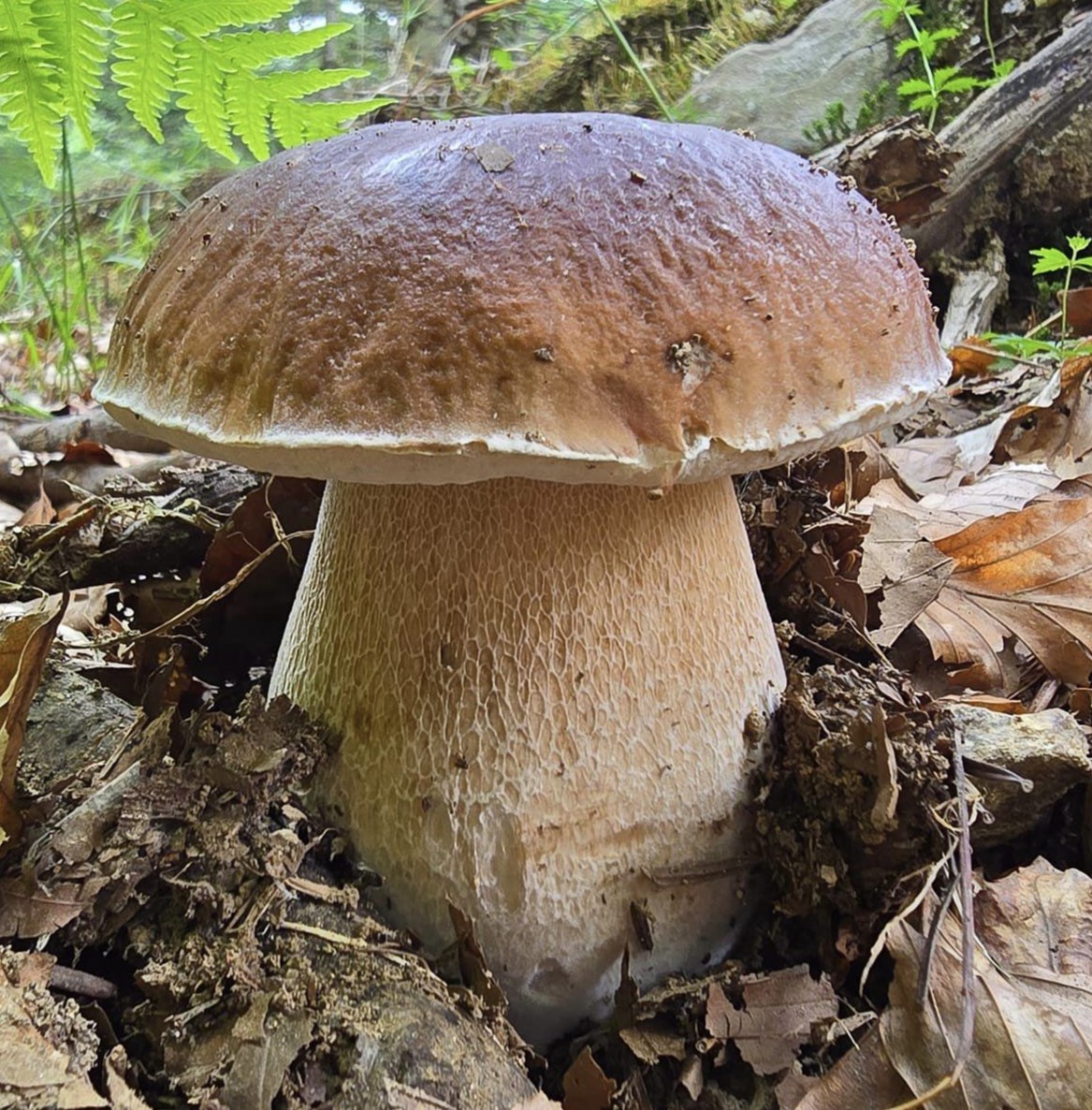
Photo: Matthieu Brochon · CC BY 4.0 · Photo source · License

Description
A stout bolete with a brown cap, white to olive pores, and a pale net on the upper stem.
Identification features
Young pores are white, later yellow to olive. The stem is stout, and the flesh normally does not turn blue when cut.
Identification checklist
Check the whole fruitbody: a brown, often slightly greasy cap; pores white when young, becoming yellow-olive; and a stout pale stem with a white net, especially near the top. The white flesh normally does not turn blue when cut.
Detailed features
- Cap
- The cap is initially hemispherical, later convex and cushion-shaped in older fruitbodies. Its surface varies through shades of brown, is often paler near the margin, and may be slightly greasy or tacky when moist.
- Hymenophore
- The fertile surface is made of tubes. It is whitish when young, later yellow, and becomes olive green with age. The tube layer separates fairly easily from the cap flesh.
- Stem
- The stem is stout to swollen when young, later more club-shaped or nearly cylindrical. It is solid, pale to brownish, and typically bears a pale net-like reticulation, especially on the upper part.
- Flesh
- The flesh is white and firm and normally does not turn blue when cut. Just beneath the cap skin it may show a slight brownish tint.
- Smell
- The smell is pleasant but not distinctive enough to identify the species on its own.
- Taste
- The taste is regarded as pleasant. Tasting wild mushrooms should not be used as an identification test.
- Spore print
- Olive-brown.
Size
- Cap diameter
- 5–25 cm
- Stem height
- 5–12 cm
- Stem diameter
- 2–6 cm
Habitat
A mycorrhizal species in spruce, beech, oak, and mixed woodland.
Fruiting period
June, July, August, September, October, November
Ecology
- Trophic mode
- Mycorrhizal
- Host trees
- Spruce (Picea), Beech (Fagus), Oak (Quercus)
- Notes
- The species forms ectomycorrhiza with trees. It occurs in coniferous, deciduous, and mixed woodland; common partners include spruce, beech, and oak.
Distribution
- Notes
- Boletus edulis is a European species. Records outside Europe require taxonomic caution because some may represent related species within the B. edulis complex.
How to separate similar species
Bitter bolete develops pinkish pores and a darker stem net; tasting is not a safe identification test. Summer bolete is very similar but usually has a drier, velvety, often cracked cap and a more extensive stem net.
Similar species
- Bitter bolete (Tylopilus felleus)
Bitter bolete develops pinkish pores and usually a darker, coarser stem net. It is intensely bitter, but tasting is not a safe identification test.
- Summer bolete (Boletus reticulatus)
Summer bolete usually has a drier, velvety cap that may crack in dry weather and more extensive reticulation over the stem.
- Bronze bolete (Boletus aereus)
Bronze bolete usually has a very dark, dry, velvety cap that is not greasy or sticky.
Interesting facts
Did you know? The species was described in 1782 by Jean Baptiste François Bulliard. The Latin epithet edulis means “edible”, and Boletus edulis is the type species of the genus Boletus.