Species details
Summer bolete
Boletus reticulatus
Traditionally edible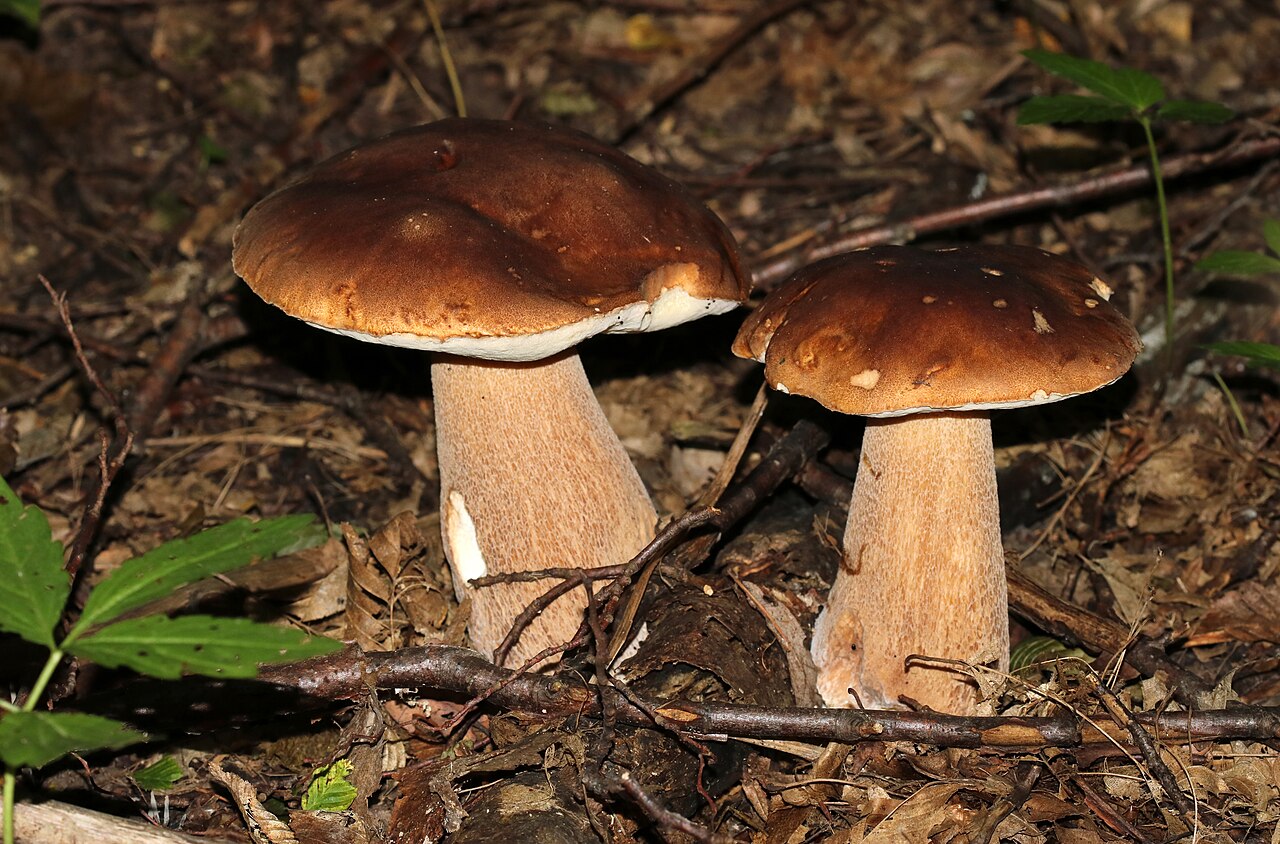
Photo: George Chernilevsky · Public Domain · Photo source · License

Description
A warmth-loving bolete with a dry, often finely cracked cap and a clear pale net on the stem.
Identification features
The cap is usually dry and velvety. The net may cover much of the stem, and the pores become yellow with age.
Identification checklist
Typical features are a dry pale- to chestnut-brown cap that often cracks in dry weather, white to olive pores, and a pronounced pale net covering much of the stem. The flesh is white and usually does not blue.
Detailed features
- Cap
- Dry, pale- to chestnut-brown, initially hemispherical and later cushion-shaped; often finely cracked in dry weather.
- Hymenophore
- The tubes are initially white, then yellow and finally olive green; pores remain small.
- Stem
- Initially swollen, later club-shaped to cylindrical, whitish to pale brown; pale reticulation may cover much of the stem.
- Flesh
- White and usually not blueing; becomes softer in older fruitbodies.
- Spore print
- Olive-brown.
Size
- Cap diameter
- 5–20 cm
- Stem height
- 7–15 cm
- Stem diameter
- 2–5 cm
Habitat
Mostly in warm deciduous woodland with oak and beech.
Fruiting period
May, June, July, August, September, October
Ecology
- Trophic mode
- Mycorrhizal
- Host trees
- Oak (Quercus), Beech (Fagus)
Distribution
- Notes
- Widespread in Europe, especially in warmer deciduous woodland.
How to separate similar species
Penny bun often has a greasier cap and netting concentrated near the top of the stem. Bitter bolete develops pink pores and a darker net; no single feature is sufficient, so compare the entire fruitbody.
Similar species
Interesting facts
Did you know? It often fruits earlier in the season than penny bun; the pronounced stem reticulation is an important feature.