Species details
Bloody milkcap
Lactarius sanguifluus
Traditionally edible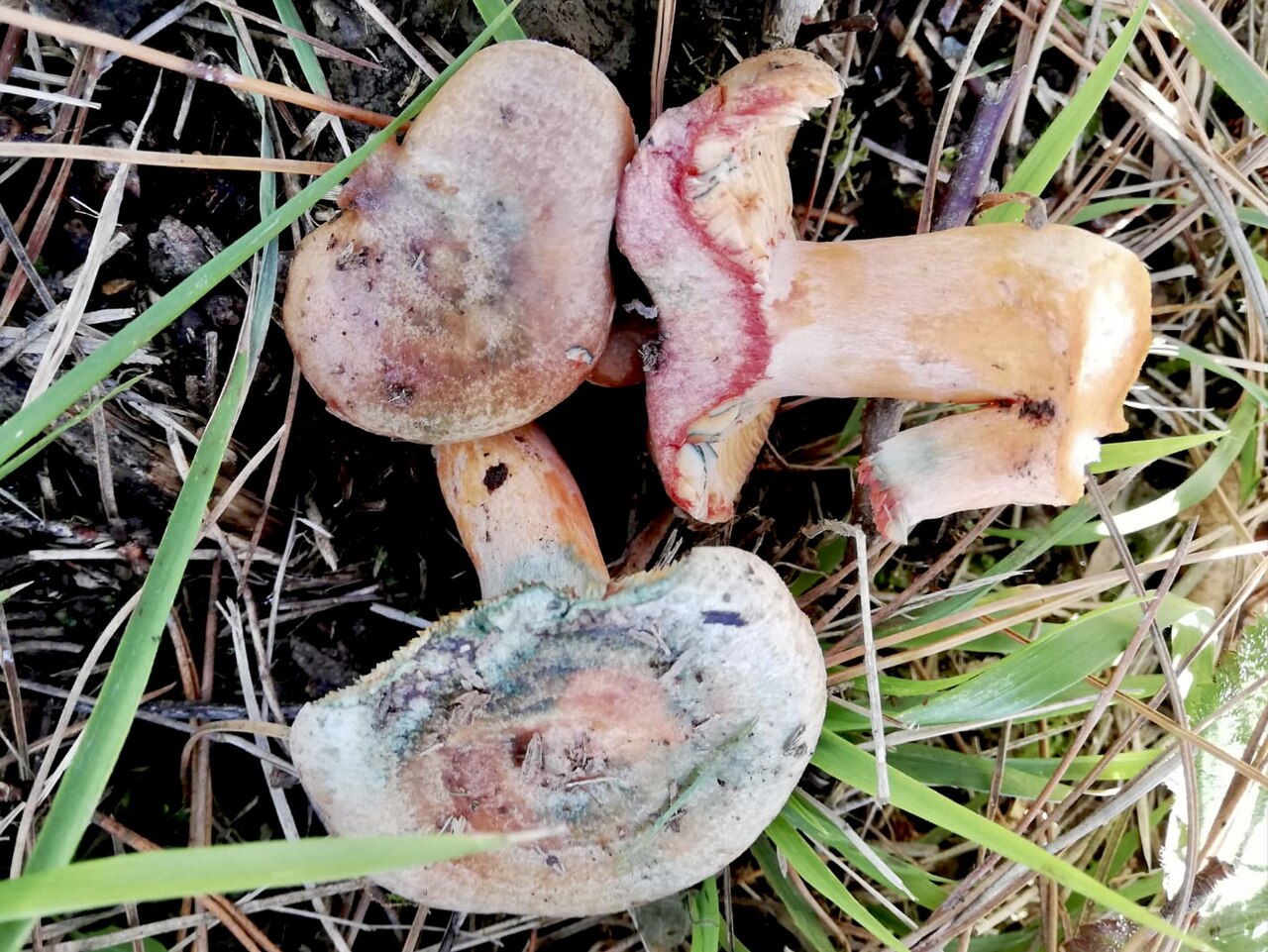
Photo: Jose Angel Urquia Goitia · CC BY-SA 4.0 · Photo source · License

Description
A milkcap with orange to wine-red latex that often develops green staining after damage.
Identification features
The cap is orange-brown with greenish stains; damaged gills exude reddish latex.
Identification checklist
Check the entire fruitbody for identification. A milkcap with orange to wine-red latex that often develops green staining after damage. The cap is orange-brown with greenish stains; damaged gills exude reddish latex. Typical habitat: Warm pine woodland, especially on calcareous soils.
Detailed features
- Cap
- 6–15 cm, initially rounded, later depressed to broadly funnel-shaped, orange-ochre to wine-red, often zoned and with green patches.
- Hymenophore
- Gills are ochre to wine-red; when damaged they exude blood-red latex and later turn green.
- Stem
- Up to 10 × 2.5 cm, pale wine-red to orange-red, often with oval pits; damaged areas turn green.
- Flesh
- Pale yellow to orange, firm and brittle; latex wine-red to blood-red.
- Smell
- Fresh specimens may smell pleasantly fruity.
- Spore print
- Ochre.
Size
- Cap diameter
- 6–15 cm
- Stem height
- ≤ 10 cm
- Stem diameter
- ≤ 2,5 cm
Habitat
Warm pine woodland, especially on calcareous soils.
Fruiting period
August, September, October, November
Ecology
- Trophic mode
- Mycorrhizal
- Host trees
- Pine (Pinus)
- Substrate
- Forest soil
- Soil
- Calcareous
- Notes
- Mycorrhizal with pines, especially in warm pine woodland; in Slovenia it is more frequent in the coastal region.
How to separate similar species
Compare especially with these similar species: Lactarius deliciosus, Lactarius deterrimus, Lactarius salmonicolor. Check the combination of cap shape and colour, spore-bearing surface, stem, flesh changes and habitat. A single feature or photograph is not enough; if the key characters do not match the description, do not treat the identification as confirmed.
Similar species
- Saffron milk cap (Lactarius deliciosus)
Saffron milkcap has distinctly orange latex that is not immediately blood-wine red.
- False saffron milkcap (Lactarius deterrimus)
False saffron milkcap is characteristically associated with spruce and often greens more strongly and rapidly.
Interesting facts
Did you know? The name sanguifluus refers to the characteristic blood-red latex.