Species details
False saffron milkcap
Lactarius deterrimus
Extra caution required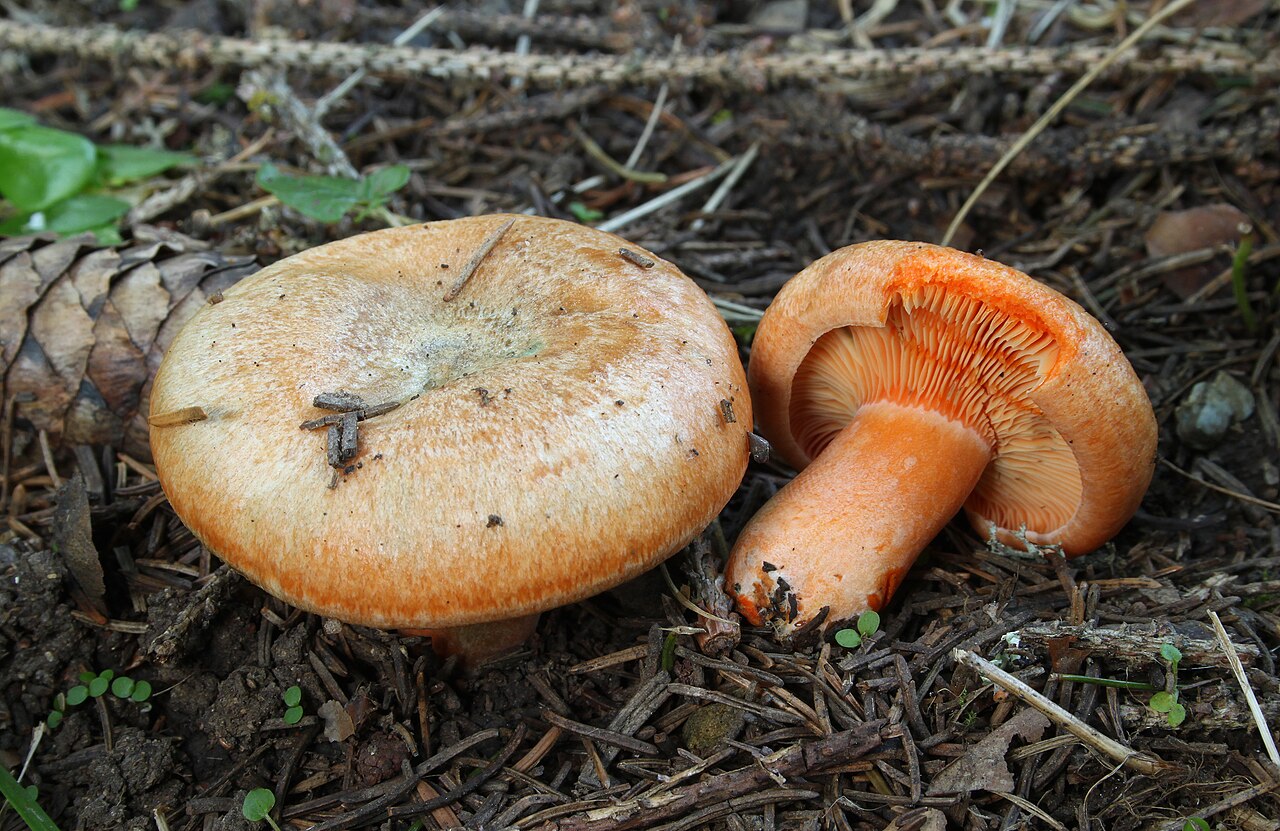
Photo: Holleday · CC BY 3.0 · Photo source · License

Description
An orange milkcap under spruce with orange latex that later darkens wine-red.
Identification features
Damaged areas often turn strongly green and the cap is zoned. The host tree also helps distinguish it from other orange milkcaps.
Identification checklist
The cap is orange and zoned, often showing green patches even when young. Crowded orange gills release orange latex that turns wine-red within about half an hour and later dark green. The smooth stem lacks orange pits, and the species is almost always associated with spruce.
Detailed features
- Cap
- 5–10 cm, orange to carrot-orange, often zoned; distinctly greening with age and bruising.
- Hymenophore
- Gills are orange, crowded, somewhat decurrent and turn green when bruised.
- Stem
- 5–8 × 1–1.5 cm, orange, becoming hollow; usually without conspicuous pits, sometimes with reddish marks.
- Flesh
- Pale orange; damaged tissue exudes orange latex that later turns wine-red, and bruised areas may green.
- Smell
- Mild to fruity-mushroom-like.
- Spore print
- Pale ochre.
Size
- Cap diameter
- 5–10 cm
- Stem height
- 5–8 cm
- Stem diameter
- 1–1,5 cm
Habitat
Almost exclusively with spruce, in spruce and mixed woodland.
Fruiting period
July, August, September, October, November
Ecology
- Trophic mode
- Mycorrhizal
- Host trees
- Spruce (Picea)
- Substrate
- Forest soil
- Notes
- Mycorrhizal almost exclusively with spruce, in spruce and mixed woodland and along their edges.
Distribution
- Notes
- In Europe it broadly follows the distribution of spruce and can be locally common in spruce stands.
How to separate similar species
Saffron milkcap grows mainly with pine, has shallow orange pits on the stem, and usually shows fewer green patches when young. Woolly milkcap has a pink cap with a woolly margin, white latex, and grows with birch.
Similar species
- Saffron milk cap (Lactarius deliciosus)
Saffron milkcap is more strongly associated with pine and often has conspicuous stem pits; false saffron milkcap is spruce-associated and greens more strongly.
Interesting facts
Did you know? The strong greening after damage results from chemical changes in pigments in the latex and tissues.