Species details
The Prince
Agaricus augustus
Traditionally edible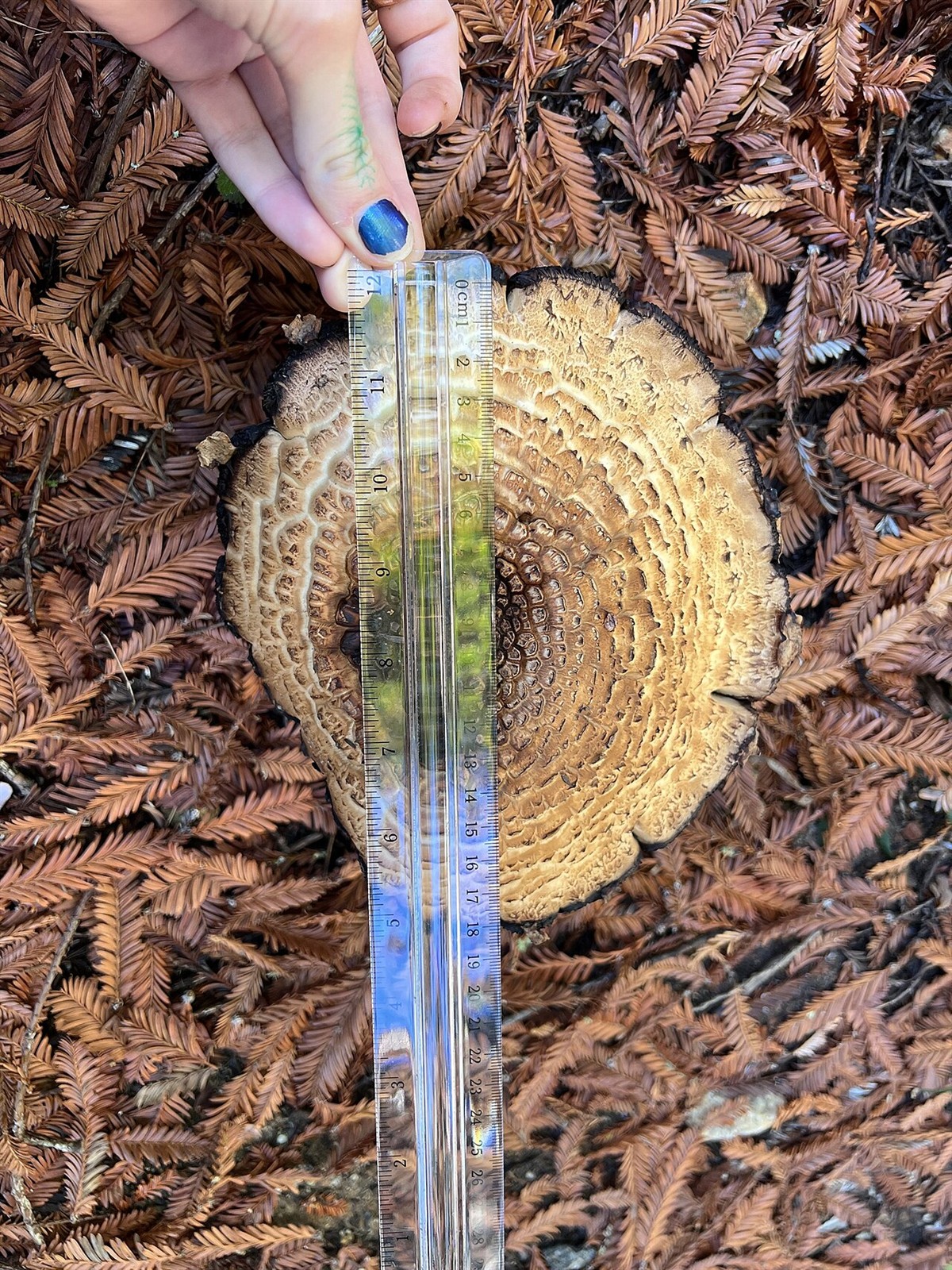
Photo: Reagan Peschke · CC BY 4.0 · Photo source · License

Description
A very large Agaricus with brown fibrous scales on a pale cap, a strong ring, and a pleasant almond-to-aniseed smell.
Identification features
The cap is large and densely brown-scaled. Gills start very pale, become pinkish grey, and finally chocolate brown. The stout whitish stem carries a broad ring; the flesh may yellow slightly, especially in the stem.
Identification checklist
Look for the combination of a very large scaly cap, free gills, broad ring, and almond/aniseed smell. Always check flesh reactions and the stem base as well.
Detailed features
- Cap
- The cap is large and densely brown-scaled.
- Hymenophore
- Gills start very pale, become pinkish grey, and finally chocolate brown.
- Stem
- The stout whitish stem carries a broad ring; the flesh may yellow slightly, especially in the stem.
- Flesh
- White; yellowing then browning in the stem, sometimes reddish-brown at the base.
- Smell
- Distinctly pleasant, almond- to anise-like.
- Spore print
- Chocolate-brown with a violet tinge.
Size
- Cap diameter
- 10–20 cm
- Stem height
- 7–15 cm
- Stem diameter
- 2–4 cm
Habitat
Occurs singly or in small groups in woodland, parks, and woodland edges, often near conifers, from late summer into autumn.
Fruiting period
August, September, October
Ecology
- Trophic mode
- Saprotrophic
- Host trees
- Spruce (Picea)
- Substrate
- Forest soil, Needle litter
- Notes
- Occurs singly or in small groups in woodland, parks, and woodland edges, often near conifers, from late summer into autumn.
How to separate similar species
Poisonous Agaricus such as A. moelleri and A. xanthodermus may yellow more strongly and smell unpleasantly phenolic or inky. Size or brown scales alone are not enough.
Similar species
Interesting facts
Did you know? It is among the largest European Agaricus species; size, scales and almond scent form a distinctive combination.