Species details
Inky mushroom
Agaricus moelleri
Poisonous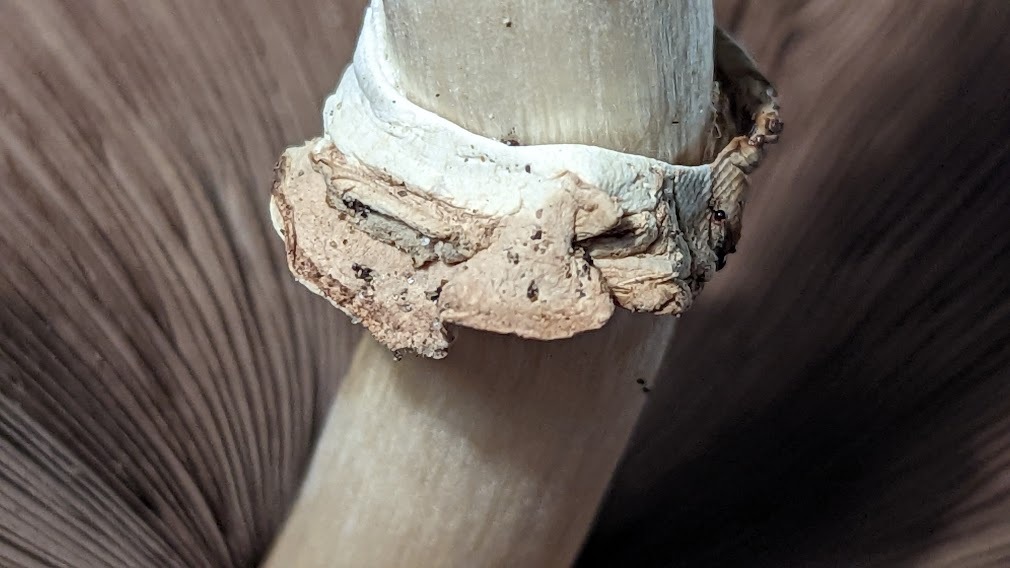
Photo: Michel Langeveld · CC BY-SA 4.0 · Photo source · License

Description
A whitish agaric with numerous grey-brown to black cap scales, yellowing when bruised.
Identification features
The stem base quickly turns chrome-yellow, smells of phenol or ink, and gills darken from pink to brown.
Identification checklist
Check the entire fruitbody for identification. A whitish agaric with numerous grey-brown to black cap scales, yellowing when bruised. The stem base quickly turns chrome-yellow, smells of phenol or ink, and gills darken from pink to brown. Typical habitat: Deciduous woodland, parks, gardens, and grassy edges, often on rich soil.
Detailed features
- Cap
- 6–10(12) cm, whitish with grey-brown to darker appressed scales, denser toward the centre; initially hemispherical, later convex to flat.
- Hymenophore
- Gills free, pale when young, then pink, becoming very dark brown at maturity.
- Stem
- 6–8(10) × 1–1.5 cm, whitish, cylindrical with a bulbous base; strongly yellows on handling, especially when the base is cut.
- Flesh
- White, rapidly yellowing when cut, especially at the base.
- Smell
- Unpleasant, carbolic or phenolic.
- Taste
- Do not taste.
- Spore print
- Dark purplish-brown.
Size
- Cap diameter
- 6–12 cm
- Stem height
- 6–10 cm
- Stem diameter
- 1–1,5 cm
Habitat
Deciduous woodland, parks, gardens, and grassy edges, often on rich soil.
Fruiting period
June, July, August, September, October
Ecology
- Trophic mode
- Saprotrophic
- Substrate
- Soil, Grassland
- Soil
- Moist
- Notes
- Grows on nutrient-rich soil in parks, gardens, grassland, scrub and woodland edges.
How to separate similar species
Compare especially with these similar species: Agaricus xanthodermus, Agaricus sylvaticus, Agaricus augustus. Check the combination of cap shape and colour, spore-bearing surface, stem, flesh changes and habitat. A single feature or photograph is not enough; if the key characters do not match the description, do not treat the identification as confirmed.
Similar species
- Yellow stainer (Agaricus xanthodermus) DANGEROUS
Also strongly yellowing and carbolic-smelling; usually has a smoother white cap without such pronounced grey-brown scales.
- The Prince (Agaricus augustus)
The prince is usually much larger, smells pleasantly different, and lacks the characteristic strong carbolic yellowing at the base.