Species details
Meadow mushroom
Agaricus campestris
Extra caution required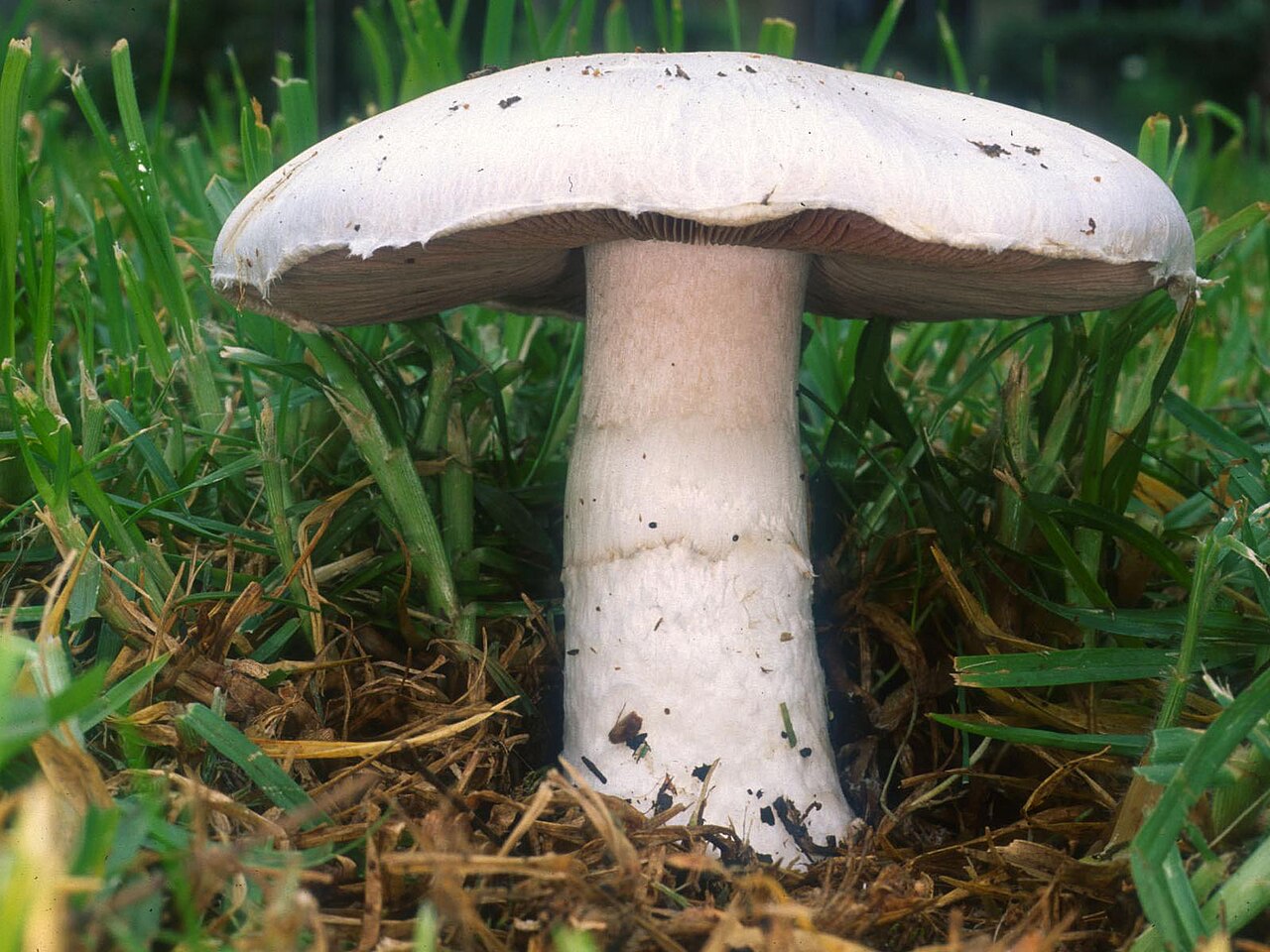
Photo: Nathan Wilson · CC BY-SA 3.0 · Photo source · License

Description
A white grassland agaric with gills that begin pink and later become chocolate brown.
Identification features
It lacks a sac-like volva and the flesh may redden slightly. Yellow stainers and deadly white amanitas must be ruled out before any use.
Identification checklist
It grows in grassland and pasture, not from wood. The cap is white to cream, while the gills are pink even when young and later become dark chocolate-brown. The stem has a delicate ring but no sac-like volva; the flesh usually does not stain strongly yellow.
Detailed features
- Cap
- 3–10 cm, initially hemispherical and white, later convex to flat; may be brownish or slightly scaly and can crack in dry weather.
- Hymenophore
- Gills are pink when young, then brown and finally very dark brown; free from the stem.
- Stem
- 3–8 × 1–2 cm, white, cylindrical, with a delicate ring that may soon disappear; no sac-like volva.
- Flesh
- White, may redden slightly; lacks the characteristic strong yellow staining at the base.
- Smell
- Mild and pleasant, without a phenolic or inky odour.
- Spore print
- Dark brown to almost blackish brown.
Size
- Cap diameter
- 3–10 cm
- Stem height
- 3–8 cm
- Stem diameter
- 1–2 cm
Habitat
On unfertilised meadows, pastures, lawns, and other open grassland.
Fruiting period
May, June, July, August, September, October, November
Ecology
- Trophic mode
- Saprotrophic
- Substrate
- Grassland, Soil
- Notes
- A saprotroph of nutrient-rich meadows, pastures, and other grassy places.
Distribution
- Notes
- Widespread in grassy habitats across Europe and other temperate regions.
How to separate similar species
Yellow stainer turns bright chrome yellow rapidly at the cut stem base and smells of phenol or ink. White amanitas retain white gills with age and have a sac-like volva. A complete stem and base are essential for examination.
Similar species
- Yellow stainer (Agaricus xanthodermus) DANGEROUS
Yellow stainer rapidly turns bright yellow at the stem base and has an unpleasant phenolic or inky smell.
- Destroying angel (Amanita virosa) DANGEROUS
Destroying angel retains white gills and has a large sac-like volva at the base.
Interesting facts
Did you know? Gill colour development is important in Agaricus: pink when young, becoming chocolate-brown as the spores mature.