Species details
Destroying angel
Amanita virosa
Deadly poisonous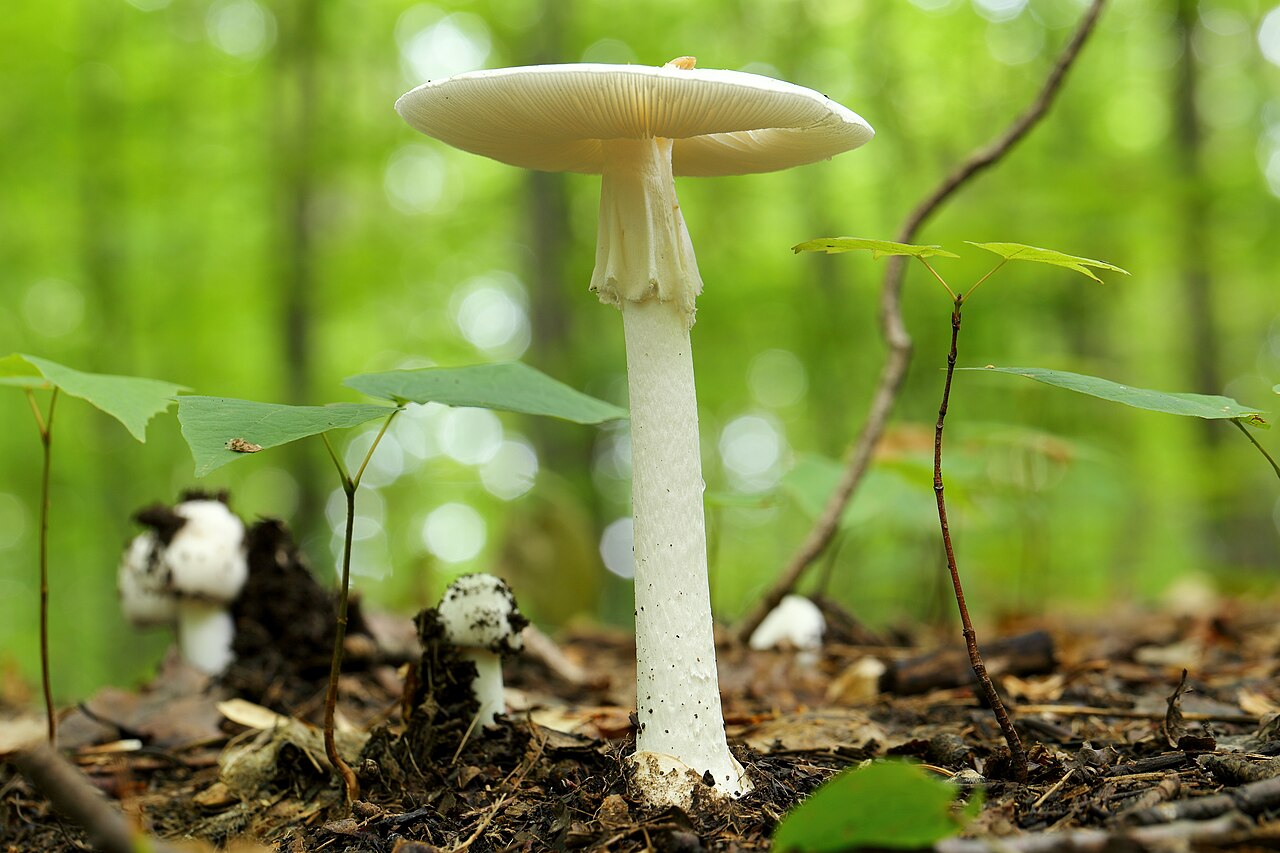
Photo: Cephas · CC BY-SA 4.0 · Photo source · License

Description
An entirely white, deadly amanita with a conical cap, white gills, a ring, and a sac-like volva.
Identification features
The cap may be irregularly conical and moist, and the stem often floccose. The whole base must be retained.
Identification checklist
The fruitbody is almost entirely white. The young cap is bell- to cone-shaped, gills are white and free, the ring is thin and fragile, and a large sack-like volva at the stem base may be hidden in soil.
Detailed features
- Cap
- White, 8–9 cm, initially almost globose, later conical to bell-shaped, silky-fibrillose and often umbonate.
- Hymenophore
- Gills are white, crowded, broad and free from the stem.
- Stem
- 8–15 cm, white, often scaly, with a ragged ring and bulbous base enclosed in a sac-like volva.
- Flesh
- White and soft.
- Smell
- Often reminiscent of raw potato.
- Spore print
- White.
Size
- Cap diameter
- 8–9 cm
- Stem height
- 8–15 cm
- Stem diameter
- 0,6–1,5 cm
Habitat
Mostly in damp coniferous and mixed woodland, often with spruce.
Fruiting period
June, July, August, September, October
Ecology
- Trophic mode
- Mycorrhizal
- Host trees
- Beech (Fagus), Spruce (Picea)
- Soil
- Acidic, Moist
Distribution
- Notes
- Relatively uncommon in Europe, occurring in damp woodland on acidic soils.
How to separate similar species
White Agaricus species have pink then brown gills and no sack-like volva. Spring destroying angel is also deadly and very similar. Always excavate and inspect the entire base.
Similar species
- Agaricus species
- Leucoagaricus leucothites
- Destroying angel (Amanita verna) DANGEROUS
Interesting facts
Did you know? With white Amanita species the whole stem base must be exposed because the sac-like volva is an important feature of deadly species.