Species details
Destroying angel
Amanita verna
Deadly poisonous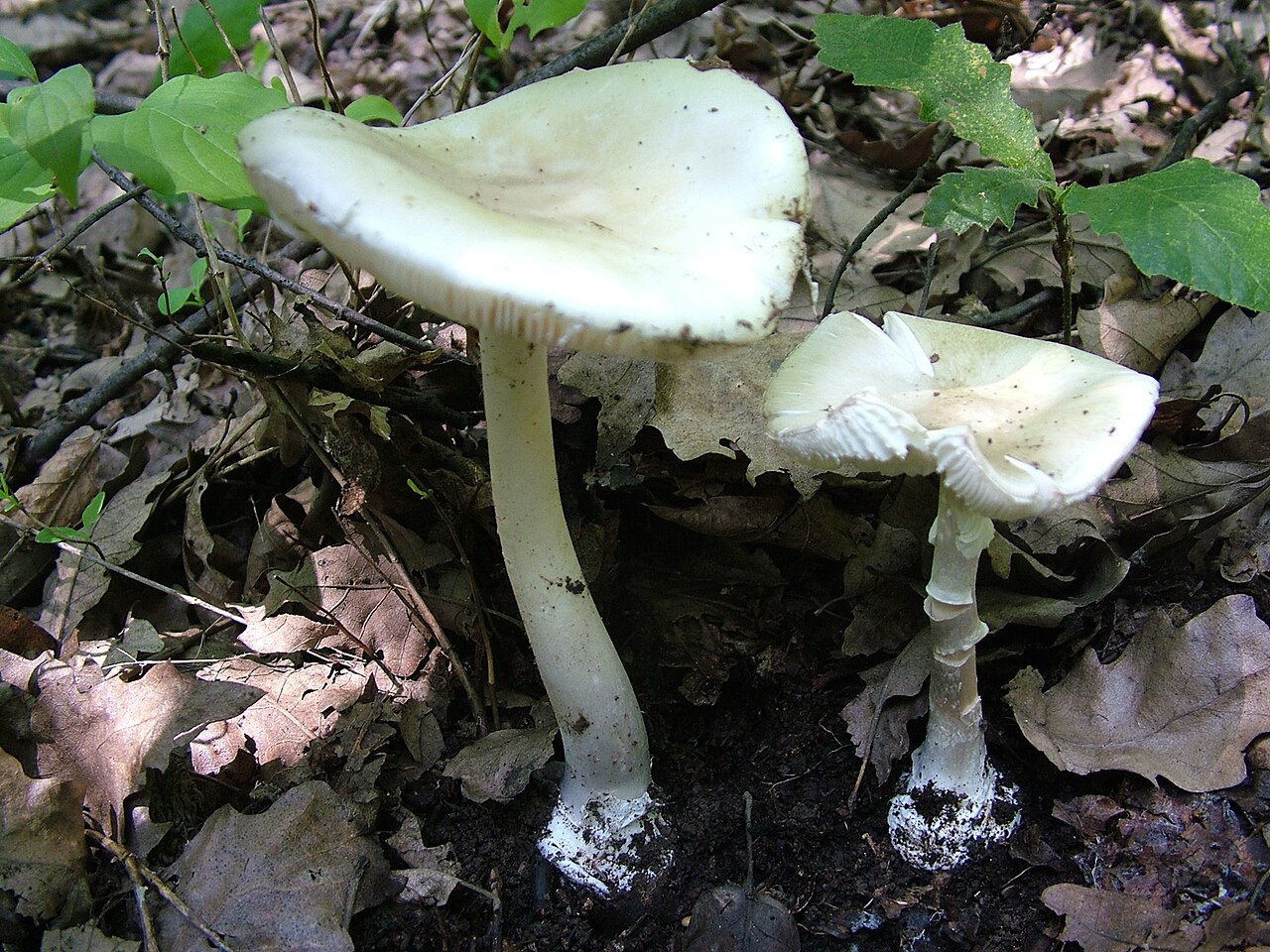
Photo: Sinisa Radic · CC BY-SA 4.0 · Photo source · License

Description
A deadly all-white amanita with a ring and a sack-like volva at the base.
Identification features
Gills are free and white, the stem white with a ring, and the bulbous base enclosed by a clear volva.
Identification checklist
Check the entire fruitbody for identification. A deadly all-white amanita with a ring and a sack-like volva at the base. Gills are free and white, the stem white with a ring, and the bulbous base enclosed by a clear volva. Typical habitat: Warm deciduous woodland in spring and early summer, especially under oak and chestnut.
Detailed features
- Cap
- 4–8 cm, pure white to cream, young egg-shaped to hemispherical, later convex to nearly flat; surface smooth to finely fibrous.
- Hymenophore
- Gills white, broad, and free from the stem.
- Stem
- 7–10 × 1–1.5 cm, white, with a hanging membranous ring; base bulbous and enclosed in a sac-like white volva.
- Flesh
- White and thin-fleshed.
- Smell
- Weak, sometimes slightly unpleasant.
- Taste
- Do not taste.
- Spore print
- White.
Size
- Cap diameter
- 4–8 cm
- Stem height
- 7–10 cm
- Stem diameter
- 1–1,5 cm
Habitat
Warm deciduous woodland in spring and early summer, especially under oak and chestnut.
Fruiting period
April, May, June, July
Ecology
- Trophic mode
- Mycorrhizal
- Host trees
- Oak (Quercus)
- Substrate
- Forest soil
- Notes
- Mycorrhizal mainly with deciduous trees in warmer habitats, often associated with oaks.
How to separate similar species
Compare especially with these similar species: Amanita virosa, Amanita phalloides, Agaricus arvensis. Check the combination of cap shape and colour, spore-bearing surface, stem, flesh changes and habitat. A single feature or photograph is not enough; if the key characters do not match the description, do not treat the identification as confirmed.
Similar species
- Destroying angel (Amanita virosa) DANGEROUS
Also deadly, but usually has a more conical cap and a more floccose or roughened stem.
- Horse mushroom (Agaricus arvensis)
Agaricus species lack a sac-like volva; their gills mature from pink to dark brown.
Conservation
- Protected species
- Yes
- Red list
- R – rare species
- Notes
- The species is legally protected in Slovenia under the regulation on protected wild fungi. On the Slovenian Red List: R – rare species.