Species details
Horse mushroom
Agaricus arvensis
Extra caution required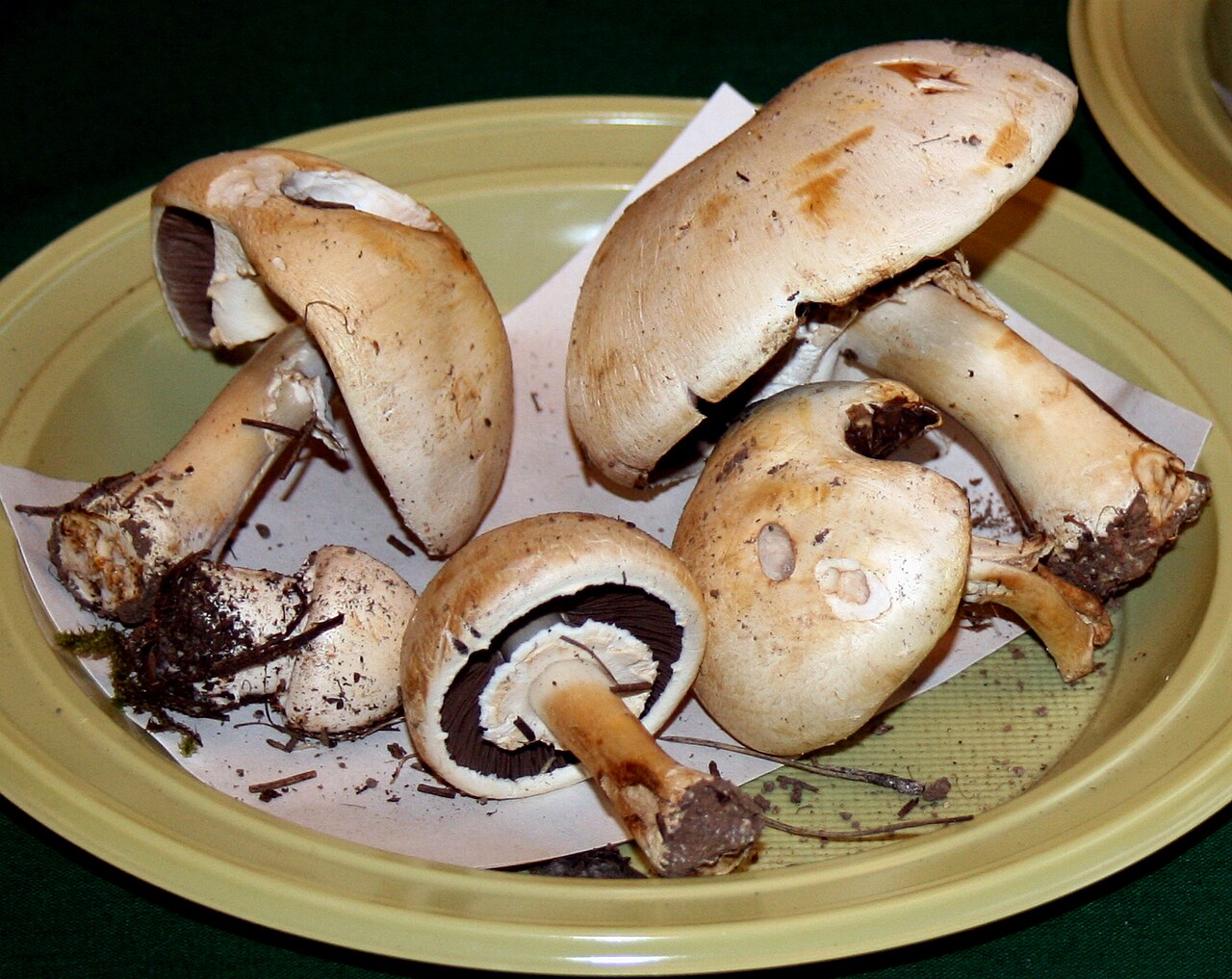
Photo: Missvain · CC0 · Photo source · License

Description
A large white agaric with a double ring, gills that turn brown, and often an aniseed smell.
Identification features
The surface may yellow slowly when touched. Rapid bright yellow staining at the base and a phenolic smell indicate toxic relatives.
Identification checklist
The large white to cream cap yellows slowly when handled. The free gills are greyish pink at first and later dark brown. An aniseed or almond smell and a large double ring with a cogwheel-like underside are characteristic; there is no volva.
Detailed features
- Cap
- 10–15 cm, white to pale yellow, initially bell-shaped to convex; often yellows when handled.
- Hymenophore
- Gills crowded, initially pale to pink, later chocolate-brown; free from the stem.
- Stem
- 10–15 × 1–3 cm, white to yellowish, often club-shaped, with a large double ring.
- Flesh
- White to yellowish and may yellow in air; the base should not show the rapid bright-yellow reaction of yellow stainer.
- Smell
- Often distinctly of aniseed or almonds.
- Spore print
- Dark brown.
Size
- Cap diameter
- 10–15 cm
- Stem height
- 10–15 cm
- Stem diameter
- 1–3 cm
Habitat
In meadows, pastures, gardens, and woodland edges on nutrient-rich soil.
Fruiting period
May, June, July, August, September, October, November
Ecology
- Trophic mode
- Saprotrophic
- Substrate
- Grassland, Soil
- Notes
- Occurs in meadows, pastures, fields, and open woodland edges, often on nutrient-rich soils.
Distribution
- Notes
- Widespread in Europe in open grassy and parkland habitats.
How to separate similar species
Yellow stainer turns vivid yellow very rapidly at the stem base and has an unpleasant phenolic smell. Meadow mushroom is usually smaller, yellows less, and has a simpler ring. White amanitas have white gills and a volva.
Similar species
- Yellow stainer (Agaricus xanthodermus) DANGEROUS
Yellow stainer rapidly turns bright yellow at the base and smells phenolic; horse mushroom usually smells of aniseed.
- Meadow mushroom (Agaricus campestris)
Field mushroom is usually smaller, stains less yellow, and has a simpler ring.
Interesting facts
Did you know? The large double ring and aniseed smell are useful supporting characters, but are not sufficient on their own because poisonous yellow-staining Agaricus exist.