Species details
False morel
Gyromitra esculenta
Deadly poisonous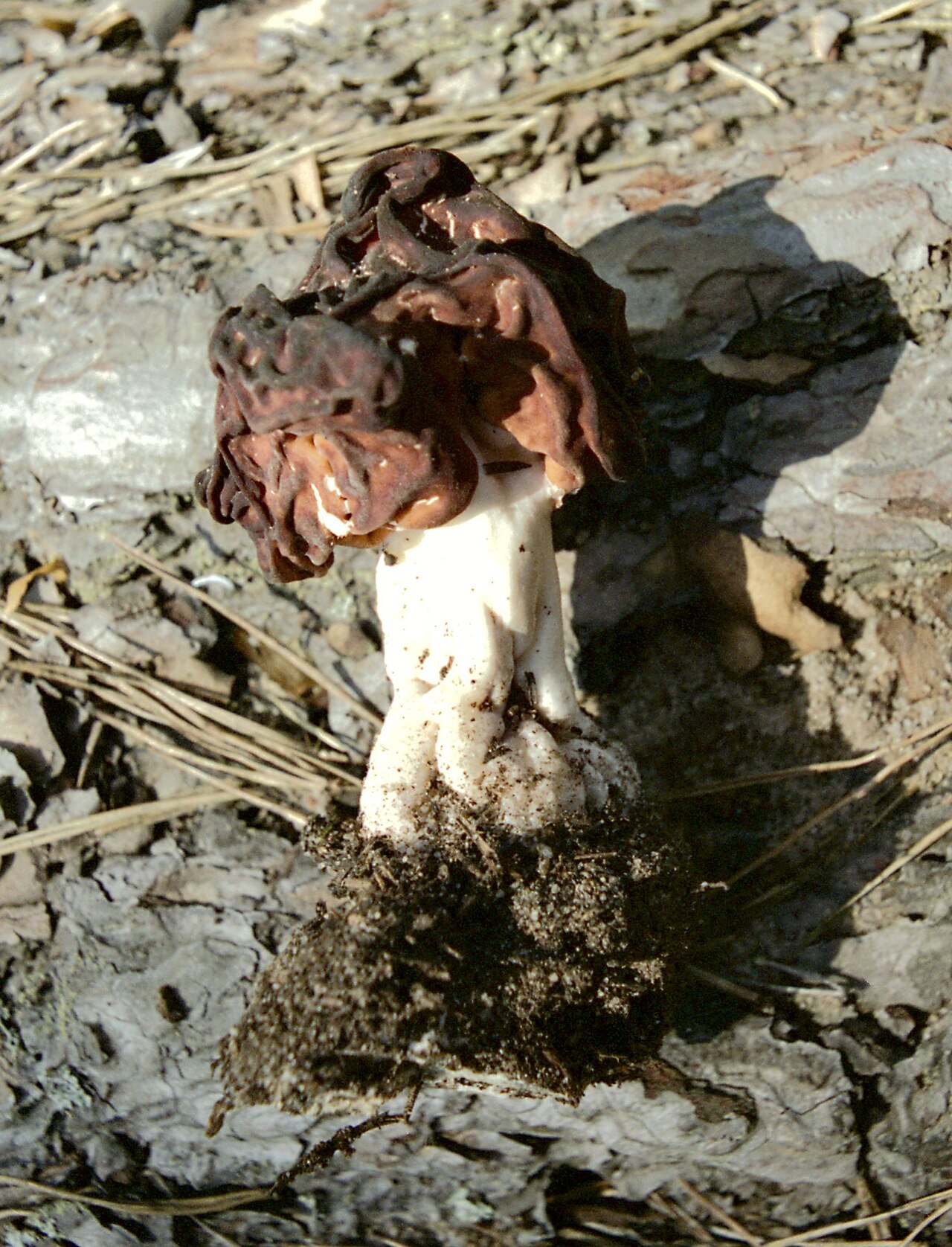
Photo: Аимаина хикари · Public Domain · Photo source · License

Description
A deadly spring fungus with an irregular brown cap folded like the surface of a brain.
Identification features
The cap is brain-like rather than honeycombed. It may contain gyromitrin; cooking or drying does not guarantee safety.
Identification checklist
The cap is red- to chestnut-brown and irregularly brain-like, not honeycomb-pitted. The stem is often short and pale; a lengthwise cut shows several irregular chambers rather than one smooth hollow space.
Detailed features
- Cap
- 5–15 cm wide, red- to chestnut-brown, irregularly brain-like and lobed, not honeycomb-pitted.
- Hymenophore
- The fertile surface lies on the outer folded surface of the cap.
- Stem
- 2–5 cm, cream to whitish, brittle, irregularly grooved and chambered inside.
- Flesh
- Brittle, whitish to cream; the inside is not simply hollow as in true morels.
- Spore print
- Yellowish-buff.
Size
- Cap diameter
- 5–15 cm
- Stem height
- 2–5 cm
- Stem diameter
- 2–3 cm
Habitat
In spring on sandy soil in coniferous woodland, clearings, and forest tracks.
Fruiting period
March, April, May
Ecology
- Host trees
- Pine (Pinus), Spruce (Picea)
- Substrate
- Sandy soil, Soil
Distribution
- Notes
- A spring species found in parts of Europe and other areas of the Northern Hemisphere.
How to separate similar species
True morel has regular pits and ridges and is continuously hollow from cap apex through the stem. False morel is variable, so all brain-like folded specimens should be treated as dangerous.
Similar species
- Common morel (Morchella esculenta)
- Gyromitra gigas
Conservation
- Red list
- R – rare species
- Notes
- On the Slovenian Red List: R – rare species.
Interesting facts
Did you know? The epithet esculenta is historically misleading: the species is regarded as dangerously poisonous, and cooking does not guarantee safety.