Species details
Common morel
Morchella esculenta
Conditional / expert preparation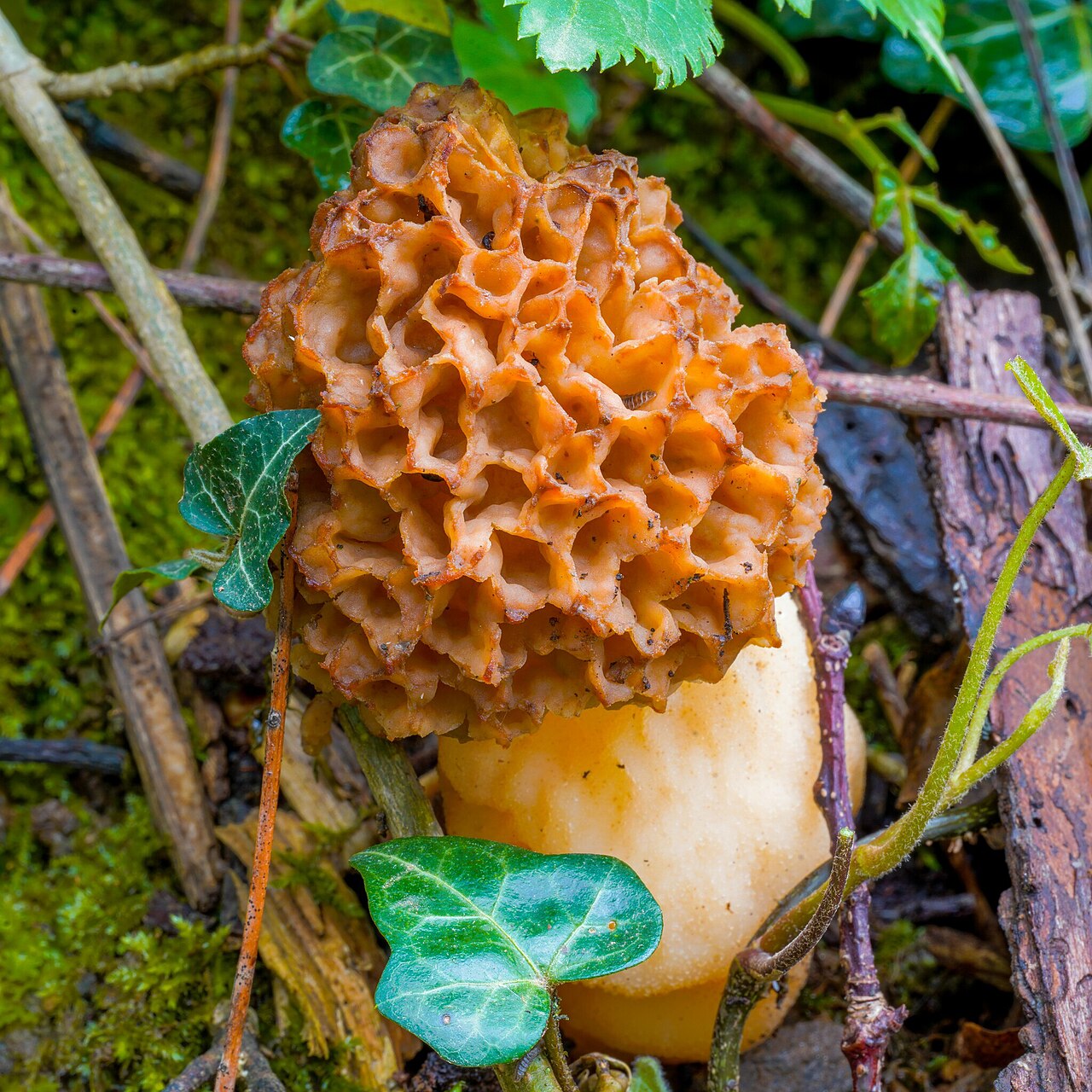
Photo: Matej Frančeškin · CC BY 4.0 · Photo source · License

Description
A spring mushroom with a honeycombed cap attached to the stem and a continuously hollow interior.
Identification features
The cap and stem are hollow inside. Reliable identification and thorough cooking are required.
Identification checklist
The cap has fairly regular honeycomb pits and ridges, with its lower edge attached to the stem. When cut lengthwise, cap and stem form one continuous hollow chamber without cottony material or internal partitions.
Detailed features
- Cap
- Rounded to egg-shaped or elongated, with deep pits and interconnected ridges; hollow inside.
- Hymenophore
- The fertile surface is on the outer pitted surface of the cap.
- Stem
- Pale, hollow, almost smooth to finely granular, often slightly wider at the base.
- Flesh
- Thin and delicate; the whole fruitbody is hollow inside.
- Spore print
- Very pale to colourless.
Size
- Cap diameter
- 4–8 cm
- Stem height
- 3–10 cm
- Stem diameter
- 0,6–3 cm
Habitat
In open woodland, orchards, river margins, and disturbed ground, mainly in spring.
Fruiting period
March, April, May
Ecology
- Trophic mode
- Saprotrophic
- Substrate
- Soil
Distribution
- Notes
- A familiar spring species in Europe; the genus Morchella is taxonomically complex, so related local species may occur.
How to separate similar species
False morel has a brain-like reddish-brown cap and a chambered interior. Verpa species have a cap attached only at the top of the stem. Do not use doubtful specimens.
Similar species
- False morel (Gyromitra esculenta) DANGEROUS
- Verpa bohemica
Interesting facts
Did you know? True morels are hollow lengthwise; confusion with false morel is a major safety concern.