Species details
Weeping milkcap
Lactifluus volemus
Extra caution required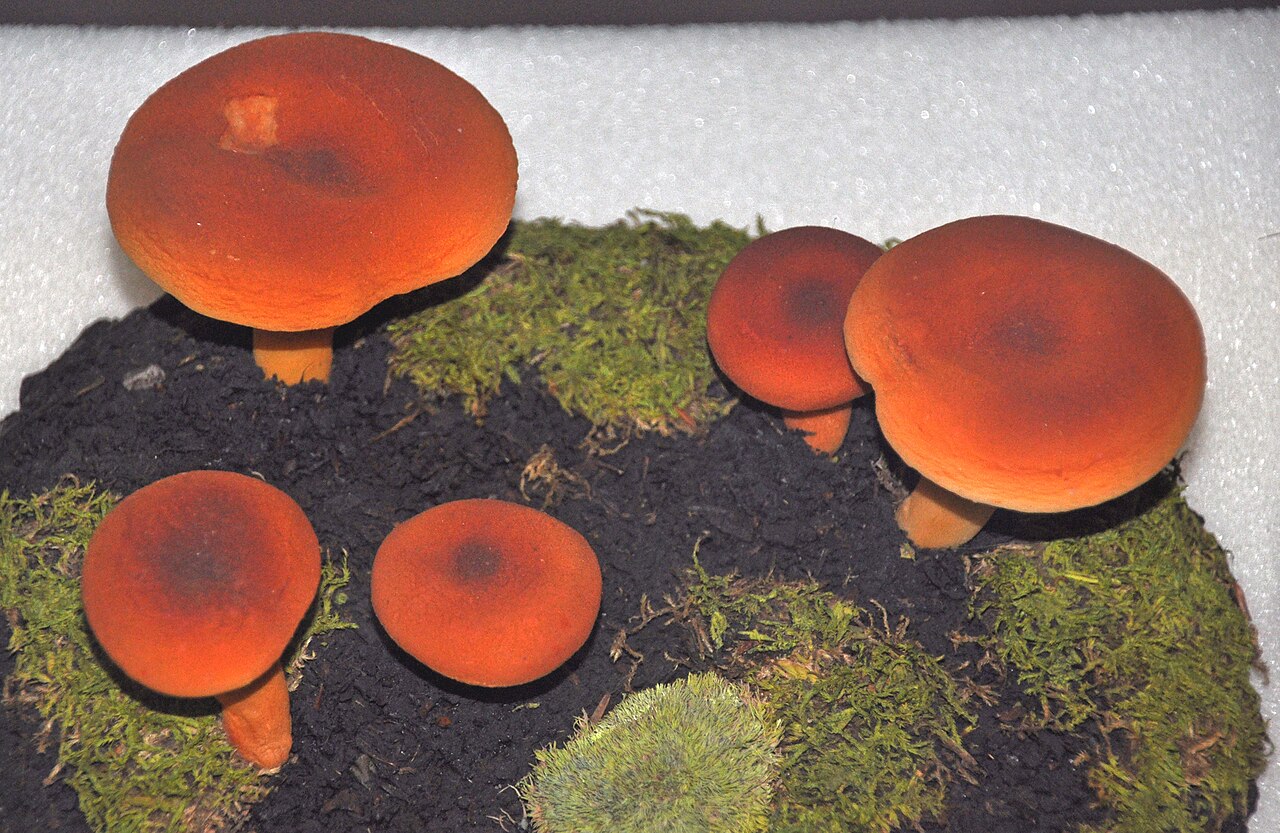
Photo: James St. John · CC BY 2.0 · Photo source · License
_1.jpg)
Description
An orange-brown milkcap with abundant white latex that browns in air and a distinctive fishy smell.
Identification features
The crowded gills exude abundant latex when damaged; the stem is firm and cap-coloured.
Identification checklist
Check the entire fruitbody for identification. An orange-brown milkcap with abundant white latex that browns in air and a distinctive fishy smell. The crowded gills exude abundant latex when damaged; the stem is firm and cap-coloured. Typical habitat: Deciduous woodland, mainly with beech and oak, less often conifers.
Detailed features
- Cap
- 3–7 cm, initially convex, later funnel-shaped, orange-brown to reddish-brown, dry and smooth.
- Hymenophore
- Gills are creamy white to ochre-brown, crowded and thick; injury releases abundant white latex and causes browning.
- Stem
- Up to 7 × 1 cm, cylindrical, orange-red to wine-red, often narrower toward the base.
- Flesh
- Creamy white and firm; produces abundant white, non-acrid latex that may brown on damaged areas.
- Smell
- Characteristic, often described as fishy.
- Spore print
- Creamy white.
Size
- Cap diameter
- 3–7 cm
- Stem height
- 3–7 cm
- Stem diameter
- 0,5–1 cm
Habitat
Deciduous woodland, mainly with beech and oak, less often conifers.
Fruiting period
July, August, September, October
Ecology
- Trophic mode
- Mycorrhizal
- Host trees
- Beech (Fagus), Oak (Quercus), Hornbeam (Carpinus)
- Substrate
- Forest soil
- Soil
- Calcareous
- Notes
- A mycorrhizal species of warm deciduous woodland, especially with beech, oak and hornbeam; often on calcareous soils.
How to separate similar species
Compare especially with these similar species: Lactifluus oedematopus, Lactifluus vellereus, Lactarius quietus. Check the combination of cap shape and colour, spore-bearing surface, stem, flesh changes and habitat. A single feature or photograph is not enough; if the key characters do not match the description, do not treat the identification as confirmed.
Similar species
- Lactifluus vellereus
Larger, whitish and felted, with far less orange-brown coloration.
- Oak milkcap (Lactarius quietus)
Usually browner, differently scented, and without such abundant latex.