Species details
Hazel bolete
Leccinellum pseudoscabrum
Conditional / expert preparation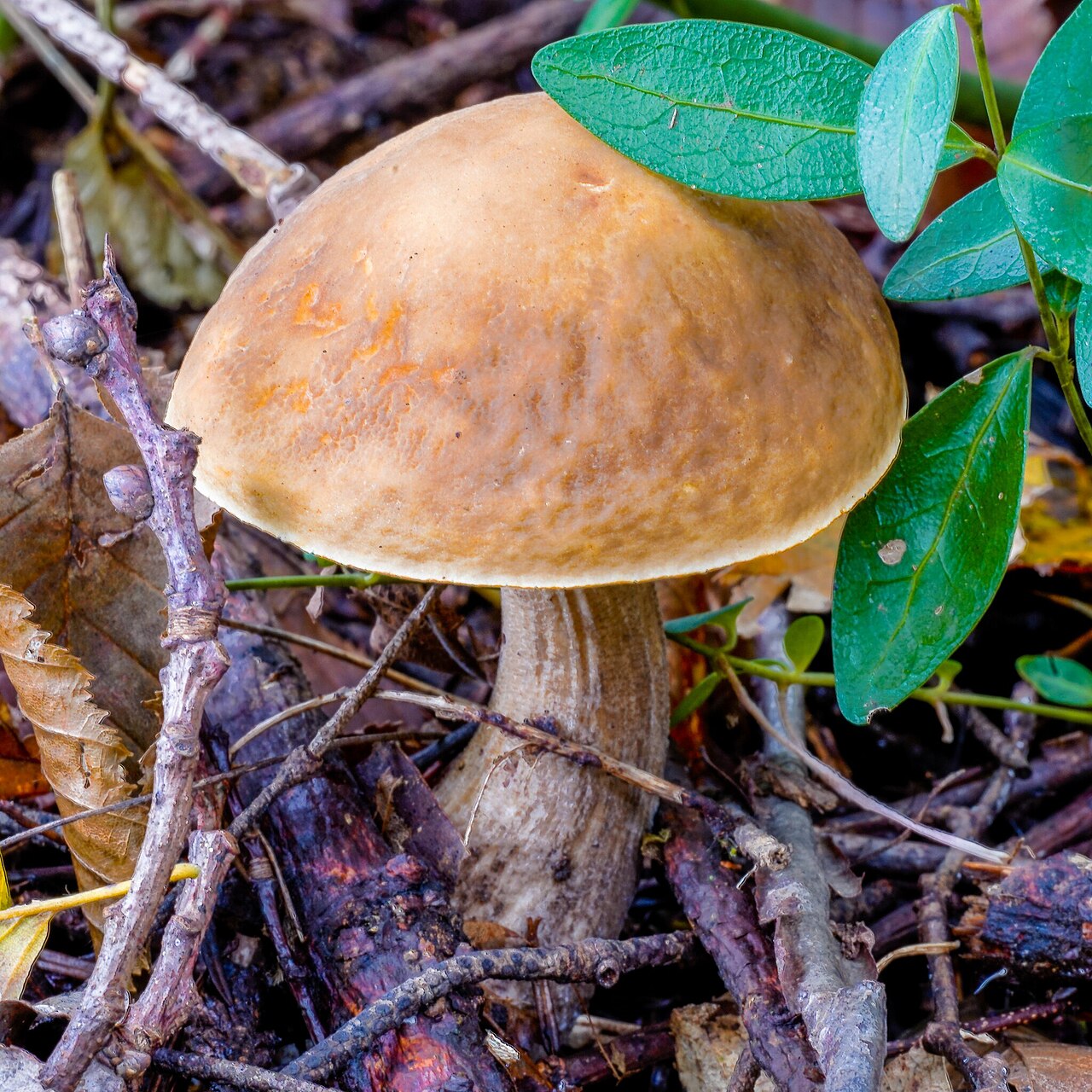
Photo: Matej Frančeškin · CC BY 4.0 · Photo source · License

Description
A grey-brown to brown bolete with a finely cracked cap and scabrous stem, usually with hornbeam.
Identification features
Cut flesh may turn grey, pinkish or blackish; the stem bears dark scabers.
Identification checklist
Check the entire fruitbody for identification. A grey-brown to brown bolete with a finely cracked cap and scabrous stem, usually with hornbeam. Cut flesh may turn grey, pinkish or blackish; the stem bears dark scabers. Typical habitat: Deciduous woodland, parks and avenues with hornbeam and hazel.
Detailed features
- Cap
- 3–12 cm, hemispherical to slightly conical, ochre-brown, roughly wrinkled and often cracking in dry weather.
- Hymenophore
- Tubes are initially whitish, later yellow-grey; pores darken when bruised.
- Stem
- 7–15 × 1–2 cm, whitish to grey, with rough scabers that darken with age.
- Flesh
- Whitish; after cutting it may first blush pink, then grey and blacken strongly.
- Smell
- Pleasant, indistinct.
- Spore print
- Tobacco-brown.
Size
- Cap diameter
- 3–12 cm
- Stem height
- 7–15 cm
- Stem diameter
- 1–2 cm
Habitat
Deciduous woodland, parks and avenues with hornbeam and hazel.
Fruiting period
June, July, August, September, October
Ecology
- Trophic mode
- Mycorrhizal
- Host trees
- Hornbeam (Carpinus), Hazel (Corylus)
- Substrate
- Forest soil, Grassland
- Notes
- Most characteristically associated with hornbeam, also with hazel, often at woodland edges and in grass.
How to separate similar species
Compare especially with these similar species: Leccinum scabrum, Leccinum versipelle. Check the combination of cap shape and colour, spore-bearing surface, stem, flesh changes and habitat. A single feature or photograph is not enough; if the key characters do not match the description, do not treat the identification as confirmed.
Similar species
- Birch bolete (Leccinum scabrum)
Brown birch bolete grows with birch and its flesh usually blackens much less strongly.
- Orange birch bolete (Leccinum versipelle)
Orange birch bolete has an orange to reddish-brown cap and is characteristically associated with birch.
Interesting facts
Did you know? Strong blackening of the flesh together with growth by hornbeam is an important combination of characters.