Species details
Birch bolete
Leccinum scabrum
Traditionally edible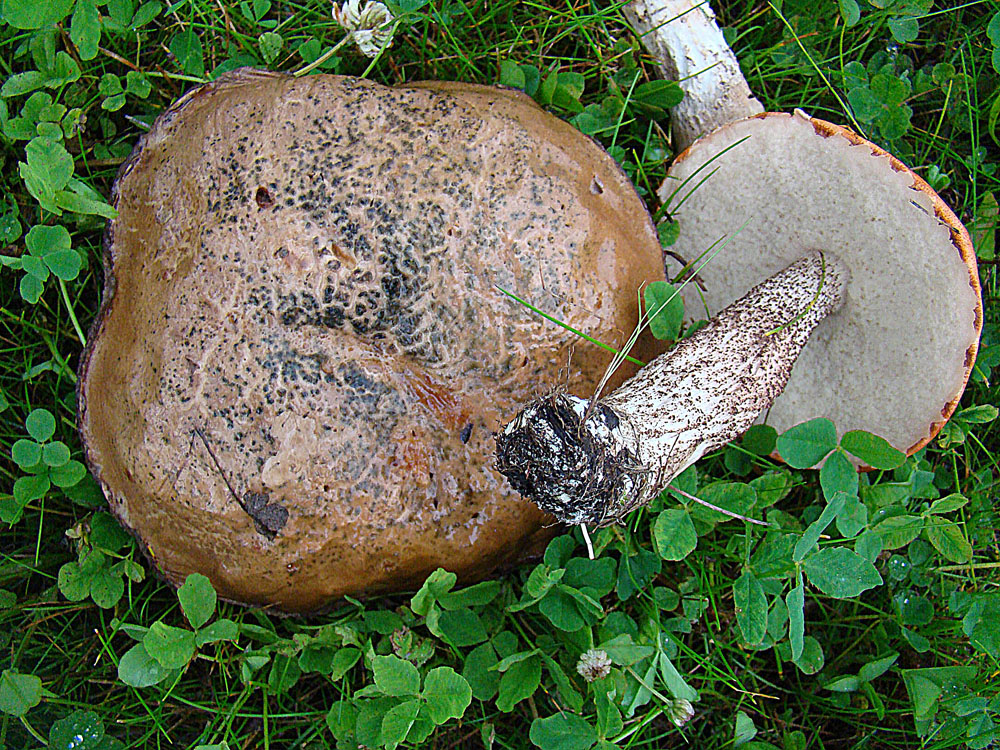
Photo: Dick Culbert · CC BY 2.0 · Photo source · License
.jpg)
Description
A grey-brown bolete with a whitish stem covered in dark rough scales, usually with birch.
Identification features
The pores are pale at first and the stem is not netted. Old specimens become soft; Leccinum identification requires checking the host tree and colour changes.
Identification checklist
Check the entire fruitbody for identification. A grey-brown bolete with a whitish stem covered in dark rough scales, usually with birch. The pores are pale at first and the stem is not netted. Old specimens become soft; Leccinum identification requires checking the host tree and colour changes. Typical habitat: Mycorrhizal with birch in woodland, parks, bogs, and other birch habitats.
Detailed features
- Cap
- 5–10 cm, grey-brown to brown, dry, initially somewhat velvety and later smoother.
- Hymenophore
- Tubes and pores are white when young, later greyish; they do not usually bruise blue.
- Stem
- 8–15 × 1–2 cm, whitish, long and cylindrical, densely covered with brown to black rough scabers.
- Flesh
- Whitish to greyish; may become faintly pink-grey when cut but characteristically does not blue.
- Smell
- Mild mushroom-like smell.
- Spore print
- Tobacco to olive-brown.
Size
- Cap diameter
- 5–10 cm
- Stem height
- 8–15 cm
- Stem diameter
- 1–2 cm
Habitat
Mycorrhizal with birch in woodland, parks, bogs, and other birch habitats.
Fruiting period
June, July, August, September, October, November
Ecology
- Trophic mode
- Mycorrhizal
- Host trees
- Birch (Betula)
- Substrate
- Forest soil
- Notes
- Mycorrhizal essentially with birch, in woodland, parks, bogs and other habitats where birch occurs.
Distribution
- Notes
- Widespread in Europe with birch and often common in suitable habitats.
How to separate similar species
Compare especially with these similar species: Leccinum variicolor, Leccinum holopus. Check the combination of cap shape and colour, spore-bearing surface, stem, flesh changes and habitat. A single feature or photograph is not enough; if the key characters do not match the description, do not treat the identification as confirmed.
Similar species
- Leccinum variicolor
Mottled bolete usually has a more patchily coloured cap and can show stronger blue-green staining near the stem base.
Interesting facts
Did you know? The rough dark scabers on the pale stem are a characteristic feature of the genus Leccinum.