Species details
Orange birch bolete
Leccinum versipelle
Conditional / expert preparation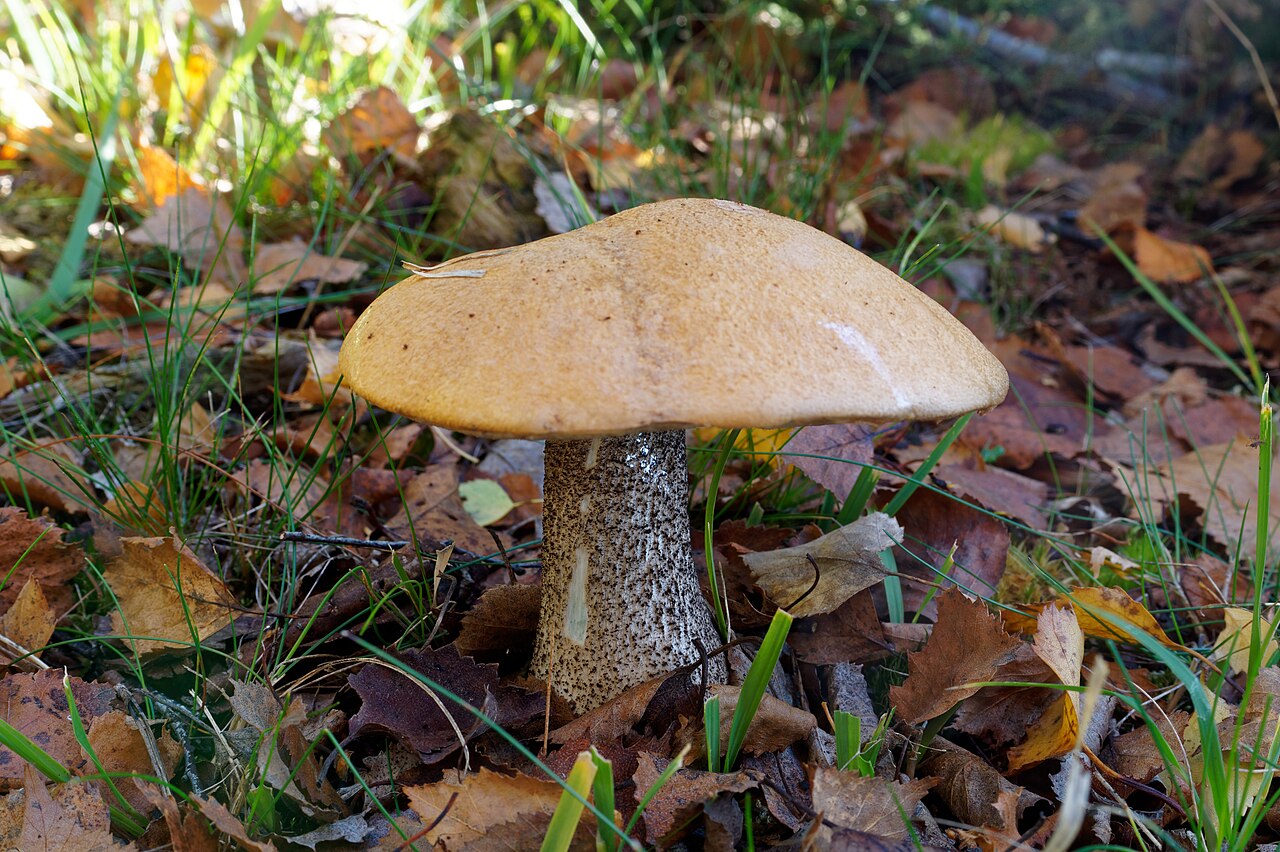
Photo: Lukas from London, England · CC BY-SA 2.0 · Photo source · License
.jpg)
Description
An orange-brown bolete with a whitish, dark-scaled stem growing with birch.
Identification features
The flesh turns grey, violet, or black when cut; pores are pale when young and later greyish.
Identification checklist
Check the entire fruitbody for identification. An orange-brown bolete with a whitish, dark-scaled stem growing with birch. The flesh turns grey, violet, or black when cut; pores are pale when young and later greyish. Typical habitat: Mycorrhizal with birch in woodland, edges, and boggy habitats.
Detailed features
- Cap
- 8–15(–20) cm, orange-red to yellow-brown, dry and felted; the cap skin often overhangs the margin slightly.
- Hymenophore
- Pores initially whitish, later grey to grey-brown.
- Stem
- 10–15 cm tall, whitish, densely covered with dark to black scabers; the base may stain blue-green.
- Flesh
- White; when cut it may first turn pinkish to violet, with blue-green staining near the base.
- Smell
- Mild.
- Spore print
- Brown to tobacco-brown.
Size
- Cap diameter
- 8–20 cm
- Stem height
- 10–15 cm
Habitat
Mycorrhizal with birch in woodland, edges, and boggy habitats.
Fruiting period
June, July, August, September, October
Ecology
- Trophic mode
- Mycorrhizal
- Host trees
- Birch (Betula)
- Substrate
- Forest soil
- Notes
- Closely mycorrhizal with birch.
How to separate similar species
Compare especially with these similar species: Leccinum aurantiacum, Leccinum scabrum, Leccinum vulpinum. Check the combination of cap shape and colour, spore-bearing surface, stem, flesh changes and habitat. A single feature or photograph is not enough; if the key characters do not match the description, do not treat the identification as confirmed.
Similar species
- Slate bolete (Leccinum duriusculum)
Usually associated with poplars/aspen and has a greyer-brown cap.
- Orange bolete (Leccinum aurantiacum)
Associated mainly with aspen or other poplars; the host tree is important for separation.
- Birch bolete (Leccinum scabrum)
Usually has a brown to grey-brown cap without strong orange tones.