Species details
Fenugreek milkcap
Lactarius helvus
Conditional / expert preparation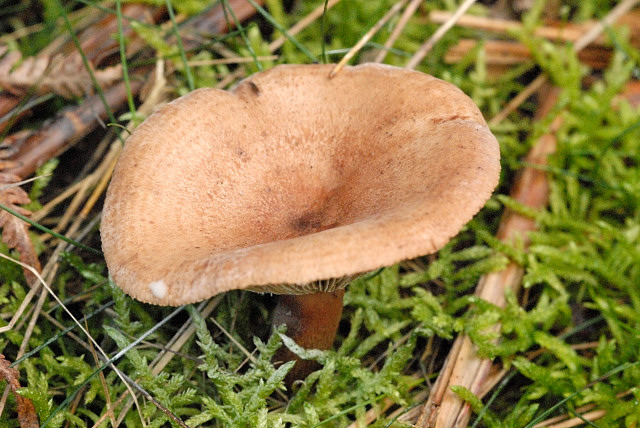
Photo: James Lindsey · CC BY-SA 3.0 · Photo source · License

Description
A brownish milkcap with a dry finely granular to felted cap, watery almost colourless latex and a very distinctive strong spicy smell.
Identification features
The cap is light brown, becomes broadly depressed early and is dry. Gills are initially pale, later pinkish brown. The stem is similar in colour to the cap. Latex is watery and may be sparse in old fruitbodies.
Identification checklist
Check the dry light-brown finely granular cap, broad central depression, watery colourless latex and very strong smell reminiscent of seasoning or fenugreek. Smell is supportive rather than diagnostic on its own.
Detailed features
- Cap
- A brownish milkcap with a dry, finely granular to felted cap, watery almost colourless milk and a very pronounced spicy smell.
- Hymenophore
- Gills are initially pale, later pinkish brown.
- Stem
- The stem is similar in colour to the cap.
- Flesh
- Pale brownish; the latex is watery and may be scant in old fruitbodies.
- Smell
- Becomes strong and spice-like, especially when drying.
- Spore print
- Pale yellowish.
Size
- Cap diameter
- 5–10 cm
- Stem height
- 4–8 cm
- Stem diameter
- 0,5–1,5 cm
Habitat
In damp coniferous woodland, often with spruce and at higher elevations; summer and autumn.
Fruiting period
August, September, October
Ecology
- Trophic mode
- Mycorrhizal
- Host trees
- Spruce (Picea)
- Substrate
- Forest soil
- Soil
- Moist
- Notes
- Mycorrhizal species. In damp coniferous woodland, often with spruce and at higher elevations; summer and autumn.
How to separate similar species
Other brown milkcaps differ in latex colour and changes, cap surface, tree association and smell. Old specimens with little latex are harder to identify reliably.
Similar species
- Oak milkcap (Lactarius quietus)
- Rufous milkcap (Lactarius rufus)
- Lactarius species
Interesting facts
Did you know? Dried fruitbodies can develop a very strong spice-like smell characteristic of the species.