Species details
Woolly milkcap
Lactarius torminosus
Poisonous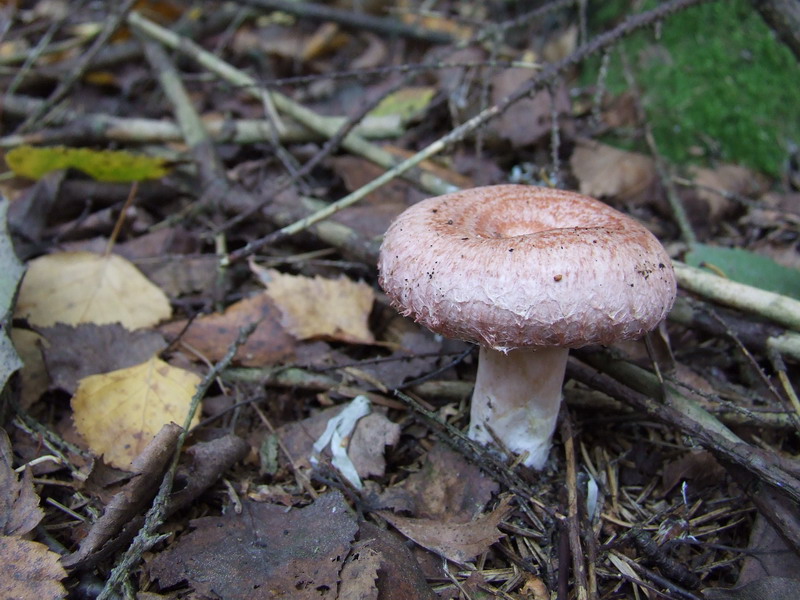
Photo: Tocekas · CC BY-SA 3.0 · Photo source · License

Description
A pink zoned milkcap with a strongly woolly rolled cap margin and white latex.
Identification features
The latex stays white and is acrid, and the gills are pale. The species may cause gastrointestinal poisoning and should not be used as food.
Identification checklist
Check the entire fruitbody for identification. A pink zoned milkcap with a strongly woolly rolled cap margin and white latex. The latex stays white and is acrid, and the gills are pale. The species may cause gastrointestinal poisoning and should not be used as food. Typical habitat: Mycorrhizal with birch, often on damp or acidic soil.
Detailed features
- Cap
- 5–12 cm, pink to salmon, distinctly zoned; the young margin is strongly inrolled and densely woolly.
- Hymenophore
- Gills are whitish to cream, crowded and slightly decurrent.
- Stem
- 2–6 × 1–2 cm, whitish to pink, cylindrical and sometimes hollow with age.
- Flesh
- White and firm; when damaged it exudes white, unchanging, strongly acrid latex.
- Smell
- Fruity to slightly resinous.
- Spore print
- Cream to pale pinkish.
Size
- Cap diameter
- 5–12 cm
- Stem height
- 2–6 cm
- Stem diameter
- 1–2 cm
Habitat
Mycorrhizal with birch, often on damp or acidic soil.
Fruiting period
July, August, September, October, November
Ecology
- Trophic mode
- Mycorrhizal
- Host trees
- Birch (Betula)
- Substrate
- Forest soil
- Soil
- Moist, Acidic
- Notes
- Mycorrhizal with birch, often on wet or acidic soils in birch and mixed stands.
Distribution
- Notes
- Widespread in Europe wherever suitable birch habitat occurs.
How to separate similar species
Compare especially with these similar species: Lactarius pubescens, Lactarius deliciosus. Check the combination of cap shape and colour, spore-bearing surface, stem, flesh changes and habitat. A single feature or photograph is not enough; if the key characters do not match the description, do not treat the identification as confirmed.
Similar species
- Bearded milkcap (Lactarius pubescens) DANGEROUS
Bearded milkcap is usually paler and less distinctly zoned, and is also associated with birch.
- Saffron milk cap (Lactarius deliciosus)
Saffron milkcap has orange rather than white latex and lacks the strongly woolly pink cap margin.
Interesting facts
Did you know? The strongly woolly, inrolled margin of young caps is one of the species’ most distinctive macroscopic characters.