Species details
Bearded milkcap
Lactarius pubescens
Conditional / expert preparation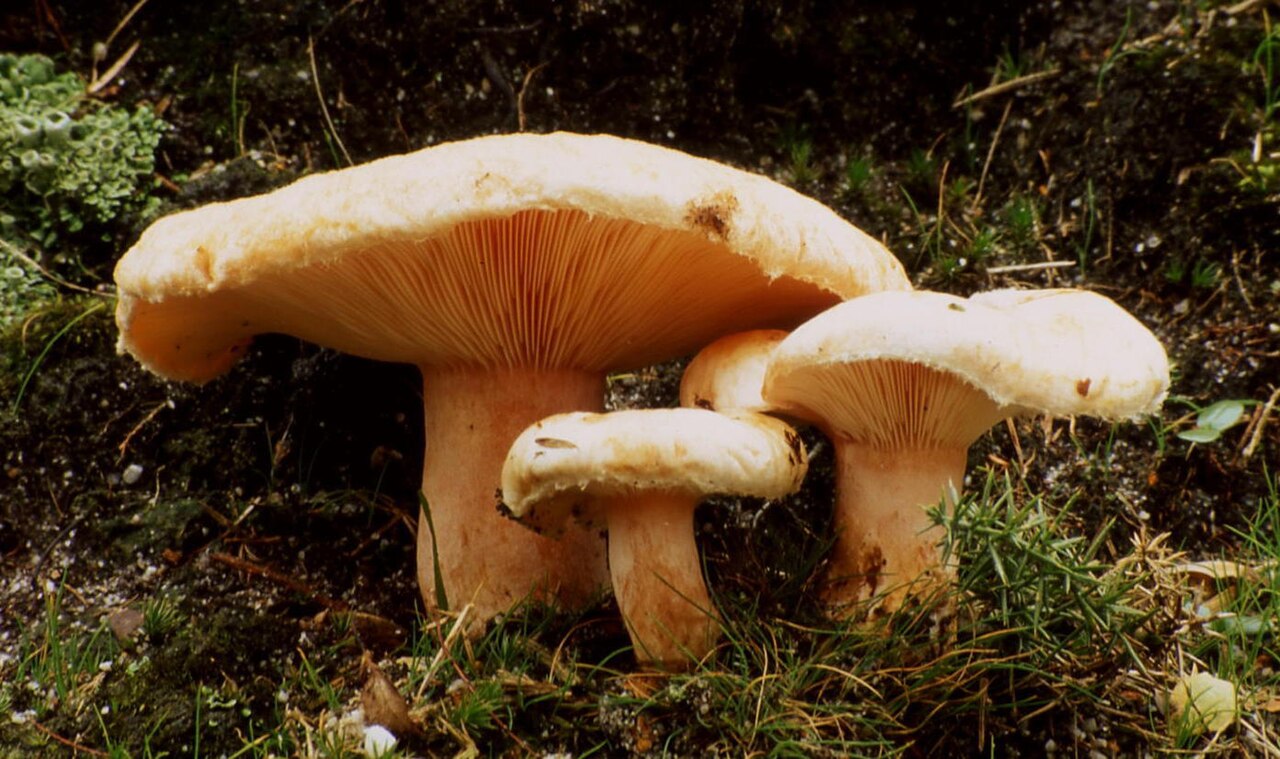
Photo: Mushypic · CC BY 3.0 · Photo source · License

Description
A pale pink to cream milkcap with a hairy cap margin, characteristically under birch.
Identification features
Latex is white and acrid; young caps have a distinctly woolly-hairy margin.
Identification checklist
Check the entire fruitbody for identification. A pale pink to cream milkcap with a hairy cap margin, characteristically under birch. Latex is white and acrid; young caps have a distinctly woolly-hairy margin. Typical habitat: Grassland, parks and open woodland under birch.
Detailed features
- Cap
- 5–12 cm, pale cream to pinkish-white, initially convex, later depressed to funnel-shaped; young margin strongly inrolled and woolly-haired.
- Hymenophore
- Gills white, fairly crowded and slightly decurrent.
- Stem
- 2–6 × 1–1.5 cm, white, cylindrical, initially solid and later hollow.
- Flesh
- White and firm; white latex is strongly acrid.
- Smell
- Usually pleasant to indistinct.
- Taste
- Very acrid; tasting is not recommended.
- Spore print
- White.
Size
- Cap diameter
- 5–12 cm
- Stem height
- 2–6 cm
- Stem diameter
- 1–1,5 cm
Habitat
Grassland, parks and open woodland under birch.
Fruiting period
July, August, September, October, November
Ecology
- Trophic mode
- Mycorrhizal
- Host trees
- Birch (Betula)
- Substrate
- Soil, Grassland
- Soil
- Moist, Acidic
- Notes
- Characteristically grows with birch on moist ground, bogs, lawns and in parks.
How to separate similar species
Compare especially with these similar species: Lactarius torminosus, Lactarius quietus. Check the combination of cap shape and colour, spore-bearing surface, stem, flesh changes and habitat. A single feature or photograph is not enough; if the key characters do not match the description, do not treat the identification as confirmed.
Similar species
- Woolly milkcap (Lactarius torminosus) DANGEROUS
Woolly milkcap is usually pinker and more distinctly concentrically zoned.
- Oak milkcap (Lactarius quietus)
Oak milkcap is brownish, lacks the woolly-hairy margin and is associated with oak.
Interesting facts
Did you know? The combination of an almost white cap, strongly hairy margin and growth with birch is very useful in the field.