Species details
Wood hedgehog
Hydnum repandum
Traditionally edible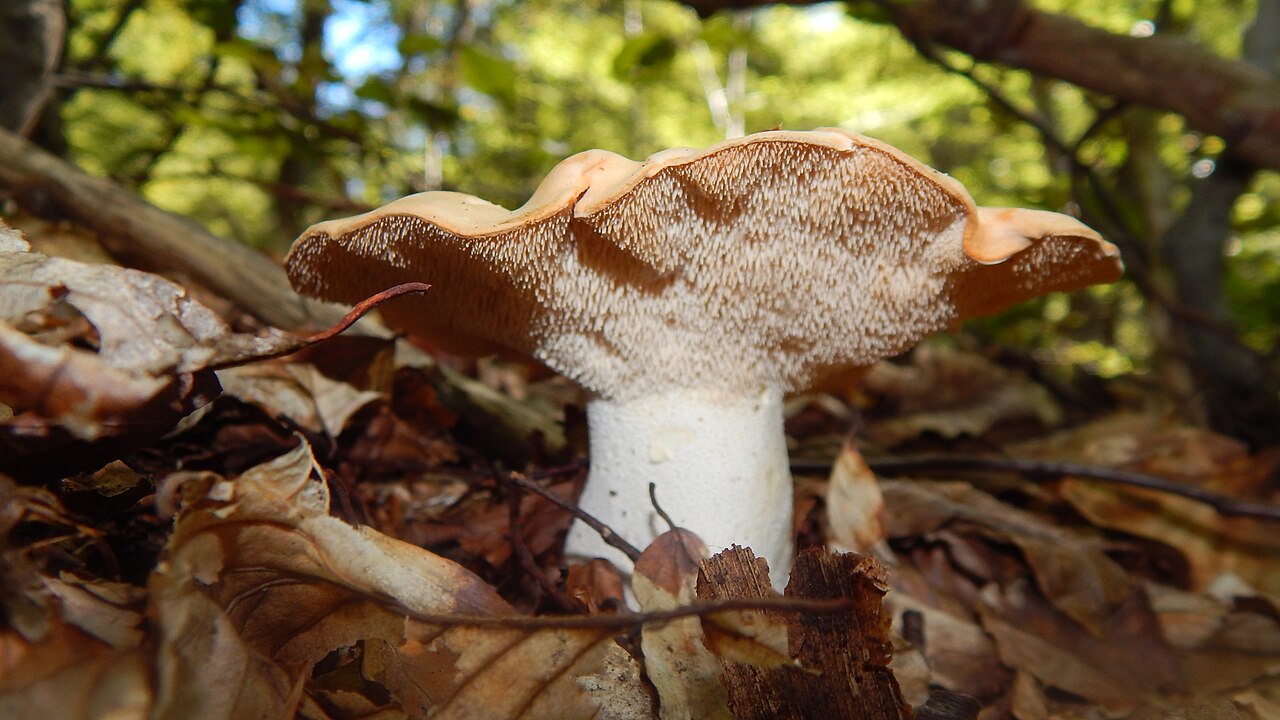
Photo: Megalogena · CC BY-SA 4.0 · Photo source · License

Description
A pale cream to orange mushroom with soft downward-pointing teeth instead of gills or pores.
Identification features
The teeth run down the stem and are brittle. The cap is often irregularly wavy, and the flesh is firm.
Identification checklist
The cap is cream to pale ochre, firm, often irregularly wavy and pitted. The underside has no gills, but soft, brittle teeth that run clearly down the white, solid stem.
Detailed features
- Cap
- 5–15 cm, irregularly rounded, yellowish to pinkish-brown, often wavy, bumpy or wrinkled.
- Hymenophore
- Instead of gills it has brittle spines or teeth, initially whitish then yellowish, running down the stem.
- Stem
- 5–8 cm, usually stout and irregular, white then later coloured similarly to the cap.
- Flesh
- White and thick, sometimes yellowing when cut; older fruitbodies become firmer and may be bitter.
- Spore print
- Cream.
Size
- Cap diameter
- 5–15 cm
- Stem height
- 5–8 cm
- Stem diameter
- 1–3 cm
Habitat
In deciduous and coniferous woodland, often in arcs or groups.
Fruiting period
July, August, September, October, November
Ecology
- Host trees
- Beech (Fagus), Oak (Quercus), Spruce (Picea)
- Substrate
- Forest soil
Distribution
- Notes
- A widespread European woodland species; sources differ on its trophic interpretation, so it is left unset here.
How to separate similar species
Terracotta hedgehog is smaller and more orange-brown; its teeth are attached to or nearly free from the stem rather than clearly decurrent. Dark Sarcodon species usually have darker, scaly caps.
Similar species
- Terracotta hedgehog (Hydnum rufescens)
- Sarcodon species
Interesting facts
Did you know? The toothed fertile surface is highly distinctive and quickly separates it from most gilled and pored mushrooms.