Species details
Winecork brittlegill
Russula adusta
Inedible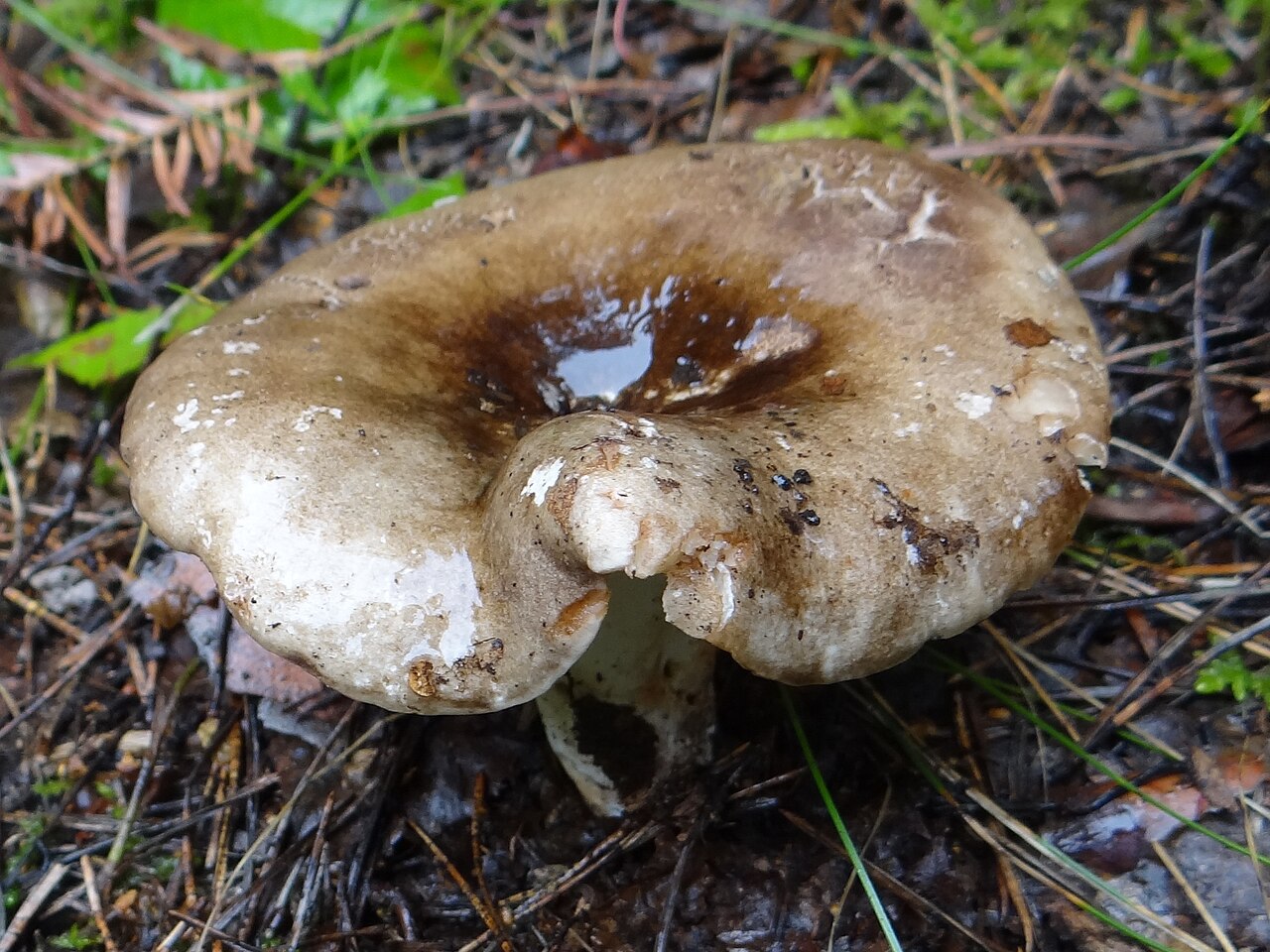
Photo: Jerzy Opioła · CC BY-SA 4.0 · Photo source · License

Description
A large grey-brown to almost black brittlegill with a depressed cap and flesh that slowly changes pinkish to grey after damage.
Identification features
Gills are initially white and crowded, later ochre. The stem is firm, grey-white to smoky grey, and the flesh changes colour more slowly than in some other blackening Russulas.
Identification checklist
Check the large grey-brown to scorched-looking cap, crowded white to ochre gills, firm greyish stem and slow colour change of damaged flesh. The speed and sequence of colour changes are useful but not sufficient alone.
Detailed features
- Cap
- A large grey-brown to almost black brittlegill with a depressed cap and flesh that slowly turns pinkish to grey after damage.
- Hymenophore
- The gills are initially white and crowded, later ochre. The stem is firm, grey-white to smoky grey, and the flesh changes colour more slowly than in some other blackening brittlegills.
- Flesh
- White, slowly becoming pinkish to greyish after damage.
- Smell
- Characteristically somewhat musty, often compared with an old wine cask.
- Spore print
- White.
Size
- Cap diameter
- 5–17 cm
- Stem height
- 4–11 cm
- Stem diameter
- 1–3 cm
Habitat
Mainly in coniferous woodland, often with pine and spruce; from early summer to autumn.
Fruiting period
June, July, August, September, October
Ecology
- Trophic mode
- Mycorrhizal
- Host trees
- Pine (Pinus), Spruce (Picea)
- Substrate
- Forest soil
- Notes
- Mycorrhizal species. Mainly in coniferous woodland, often with pine and spruce; from early summer to autumn.
How to separate similar species
Blackening brittlegill has thicker, more widely spaced gills and often shows stronger reddening before blackening. Other blackening Russulas differ in gill spacing and colour sequence; microscopy may be needed for confident species-level identification.
Similar species
- Blackening brittlegill (Russula nigricans)
- Russula densifolia
- Russula albonigra
Interesting facts
Did you know? The slow pinking of the flesh helps separate it from related blackening Russulas that change more quickly and strongly.