Species details
Blackening brittlegill
Russula nigricans
Extra caution required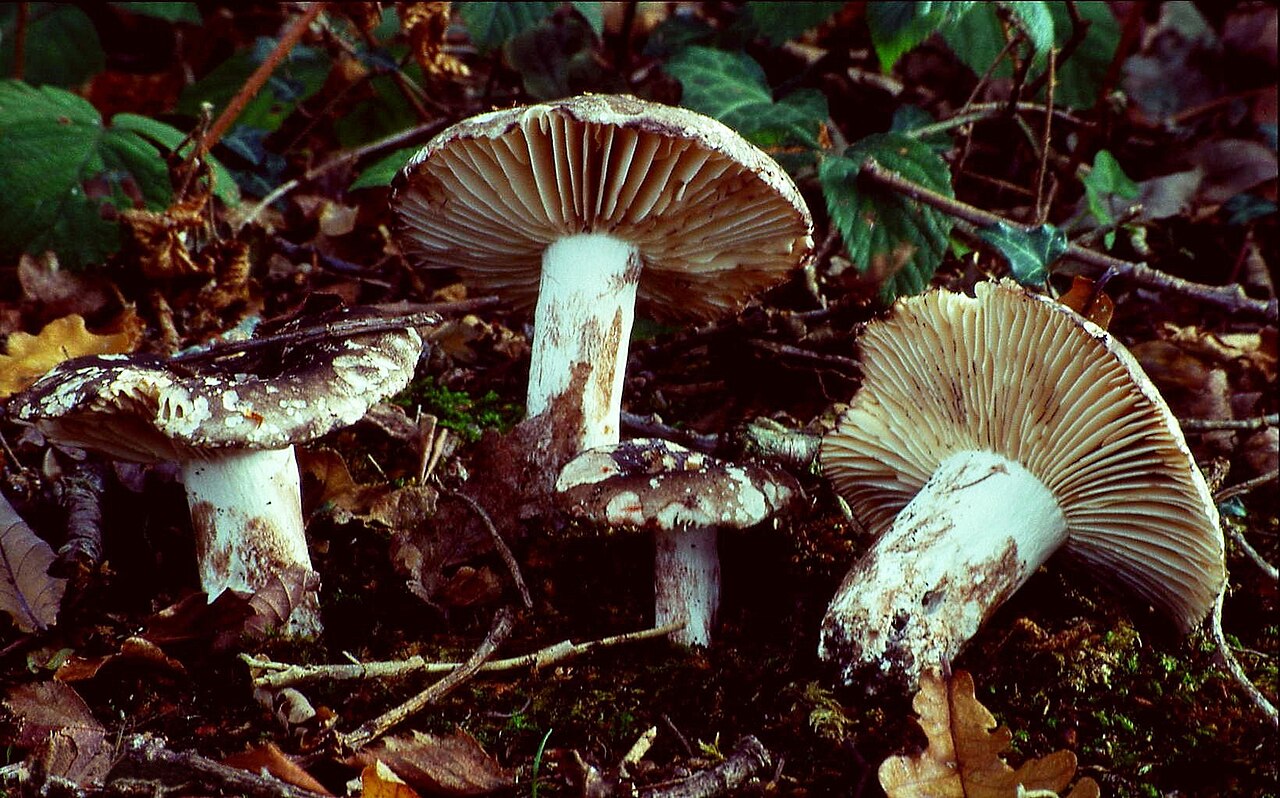
Photo: Frank Gardiner (Zonda Grattus) · CC BY 3.0 · Photo source · License

Description
A large brittlegill that first reddens and then slowly blackens after damage.
Identification features
Gills are very thick and widely spaced; old fruitbodies become almost entirely black.
Identification checklist
Check the entire fruitbody for identification. A large brittlegill that first reddens and then slowly blackens after damage. Gills are very thick and widely spaced; old fruitbodies become almost entirely black. Typical habitat: Deciduous and coniferous woodland, often with beech, oak and spruce.
Detailed features
- Cap
- 6–20 cm, initially dirty white, later grey-brown and eventually almost entirely black; mature cap broadly depressed.
- Hymenophore
- Gills are very thick, brittle and conspicuously widely spaced; when damaged they first redden, then turn grey and black.
- Stem
- 3–8 × 1–4 cm, white and firm, reddening and then blackening when damaged or with age.
- Flesh
- White, turning reddish when cut, then grey-brown and finally black.
- Smell
- May be slightly fruity.
- Spore print
- White.
Size
- Cap diameter
- 6–20 cm
- Stem height
- 3–8 cm
- Stem diameter
- 1–4 cm
Habitat
Deciduous and coniferous woodland, often with beech, oak and spruce.
Fruiting period
July, August, September, October, November
Ecology
- Trophic mode
- Mycorrhizal
- Host trees
- Beech (Fagus), Oak (Quercus), Spruce (Picea)
- Substrate
- Forest soil
- Notes
- An ectomycorrhizal species of broadleaved and coniferous woodland, occurring with various trees.
How to separate similar species
Compare especially with these similar species: Russula delica, Russula densifolia. Check the combination of cap shape and colour, spore-bearing surface, stem, flesh changes and habitat. A single feature or photograph is not enough; if the key characters do not match the description, do not treat the identification as confirmed.
Similar species
- Russula densifolia
Crowded brittlegill has much more crowded gills; it too can redden and then blacken.
- Russula albonigra
Black-and-white brittlegill usually has more crowded gills and often blackens more directly, without such a pronounced red intermediate stage.
Interesting facts
Did you know? The Latin epithet nigricans means “blackening” and describes the very characteristic progressive blackening of the fruitbody.