Species details
Coral tooth fungus
Hericium coralloides
Traditionally edible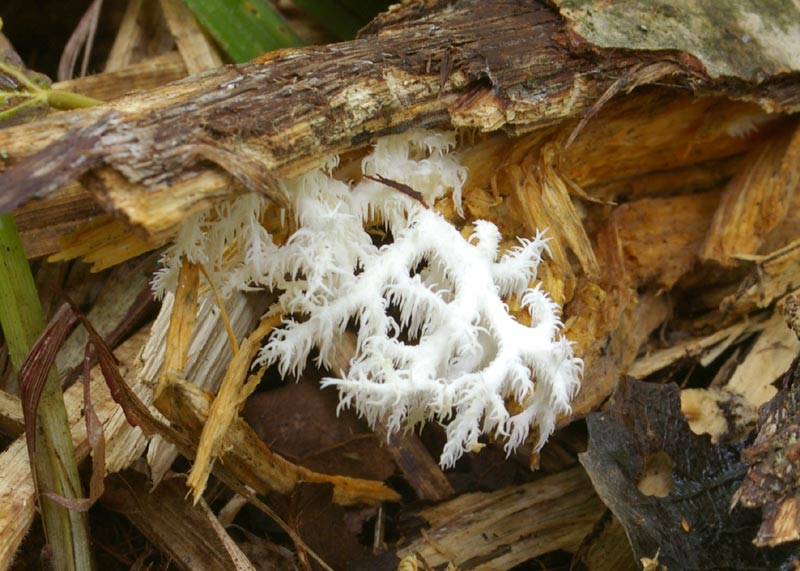
Photo: Игорь Лебединский · CC BY 3.0 · Photo source · License

Description
A white strongly branched wood fungus with many spines hanging from coral-like branches.
Identification features
Unlike lion's mane, the fruitbody is strongly branched; older specimens yellow.
Identification checklist
Check the entire fruitbody for identification. A white strongly branched wood fungus with many spines hanging from coral-like branches. Unlike lion's mane, the fruitbody is strongly branched; older specimens yellow. Typical habitat: On dead hardwood, especially beech; often rare and of conservation importance.
Detailed features
- Cap
- 6–30 cm wide, strongly coral-branched, initially snow-white to cream and later yellowish-ochre.
- Hymenophore
- The fertile surface covers thin, about 0.5–2 cm long spines hanging in small tufts from the branches.
- Stem
- A short thick attachment divides into numerous coral-like branches.
- Flesh
- White and brittle.
- Smell
- Pleasant and mild.
- Spore print
- White.
Habitat
On dead hardwood, especially beech; often rare and of conservation importance.
Fruiting period
August, September, October, November
Ecology
- Trophic mode
- Parasitic
- Host trees
- Fir (Abies)
- Substrate
- Living wood, Dead wood, Stumps
- Notes
- Grows on standing or fallen trunks and stumps of conifers, especially fir, from late summer into autumn.
How to separate similar species
Compare especially with these similar species: Hericium erinaceus. Check the combination of cap shape and colour, spore-bearing surface, stem, flesh changes and habitat. A single feature or photograph is not enough; if the key characters do not match the description, do not treat the identification as confirmed.
Similar species
- Lion's mane (Hericium erinaceus)
Lion’s mane is more compact and has very long parallel hanging spines rather than a strongly coral-like framework.
- Hericium clathroides
Hericium clathroides is macroscopically very similar but grows mainly on hardwood, especially beech.
Conservation
- Protected species
- Yes
- Red list
- V – vulnerable species
- Notes
- The species is legally protected in Slovenia under the regulation on protected wild fungi. On the Slovenian Red List: V – vulnerable species.
Interesting facts
Did you know? Besides the coral form, the host is important: the species is often associated with fir.