Species details
Charcoal burner
Russula cyanoxantha
Traditionally edible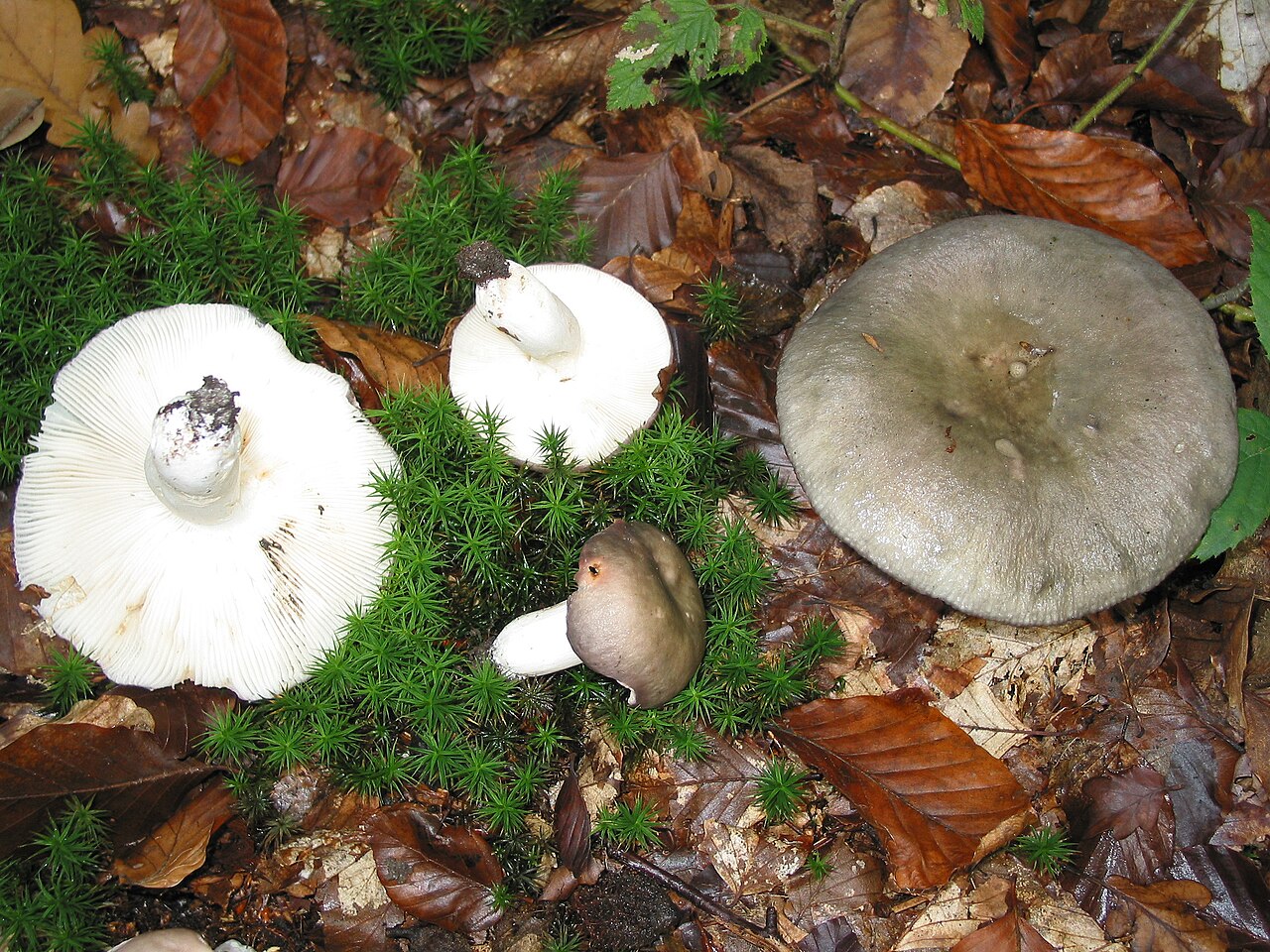
Photo: Jean-Pol GRANDMONT · CC BY 3.0 · Photo source · License

Description
A variably blue-violet, green, or grey brittlegill with white flexible gills.
Identification features
The gills are unusually flexible for a brittlegill and may feel greasy when rubbed. Cap colour alone is not enough for identification.
Identification checklist
Cap colour is extremely variable: violet, bluish, green, grey, brown, or mixed. Flesh and spore print are white, with no ring or volva. The most useful visible feature is the greasy, flexible gills, which bend under gentle rubbing rather than shattering.
Detailed features
- Cap
- 5–15 cm, highly variable in colour: violet, bluish, greenish or mixed; smooth and somewhat sticky when moist.
- Hymenophore
- Gills are white, often with a slight bluish sheen; characteristically flexible and tend to bend or smear rather than snap when rubbed.
- Stem
- 4–10 × 1–3 cm, white, solid, sometimes with a faint violet tinge.
- Flesh
- White, firm, sometimes slowly greying; relatively less brittle than many other brittlegills.
- Smell
- Mild, without a strong distinctive smell.
- Spore print
- White.
Size
- Cap diameter
- 5–15 cm
- Stem height
- 4–10 cm
- Stem diameter
- 1–3 cm
Habitat
In deciduous and mixed woodland, especially with beech and oak.
Fruiting period
June, July, August, September, October, November
Ecology
- Trophic mode
- Mycorrhizal
- Host trees
- Beech (Fagus), Oak (Quercus)
- Substrate
- Forest soil
- Notes
- A mycorrhizal species of deciduous and mixed woodland, often with beech and oak.
Distribution
- Notes
- A widespread and in many areas common European woodland species.
How to separate similar species
Green-cracking russula often has a cracked, mosaic-like cap surface and more brittle gills. Other green or violet brittlegills may look almost identical; cap colour alone is not reliable.
Similar species
- Green-cracking russula (Russula virescens)
Greencracked brittlegill usually has a greener, characteristically cracked or mosaic cap; its gills are not as flexibly waxy in feel.
Interesting facts
Did you know? Its flexible, almost greasy-feeling gills are among the most useful field characters of the species.