Species details
Amethyst chanterelle
Cantharellus amethysteus
Traditionally edible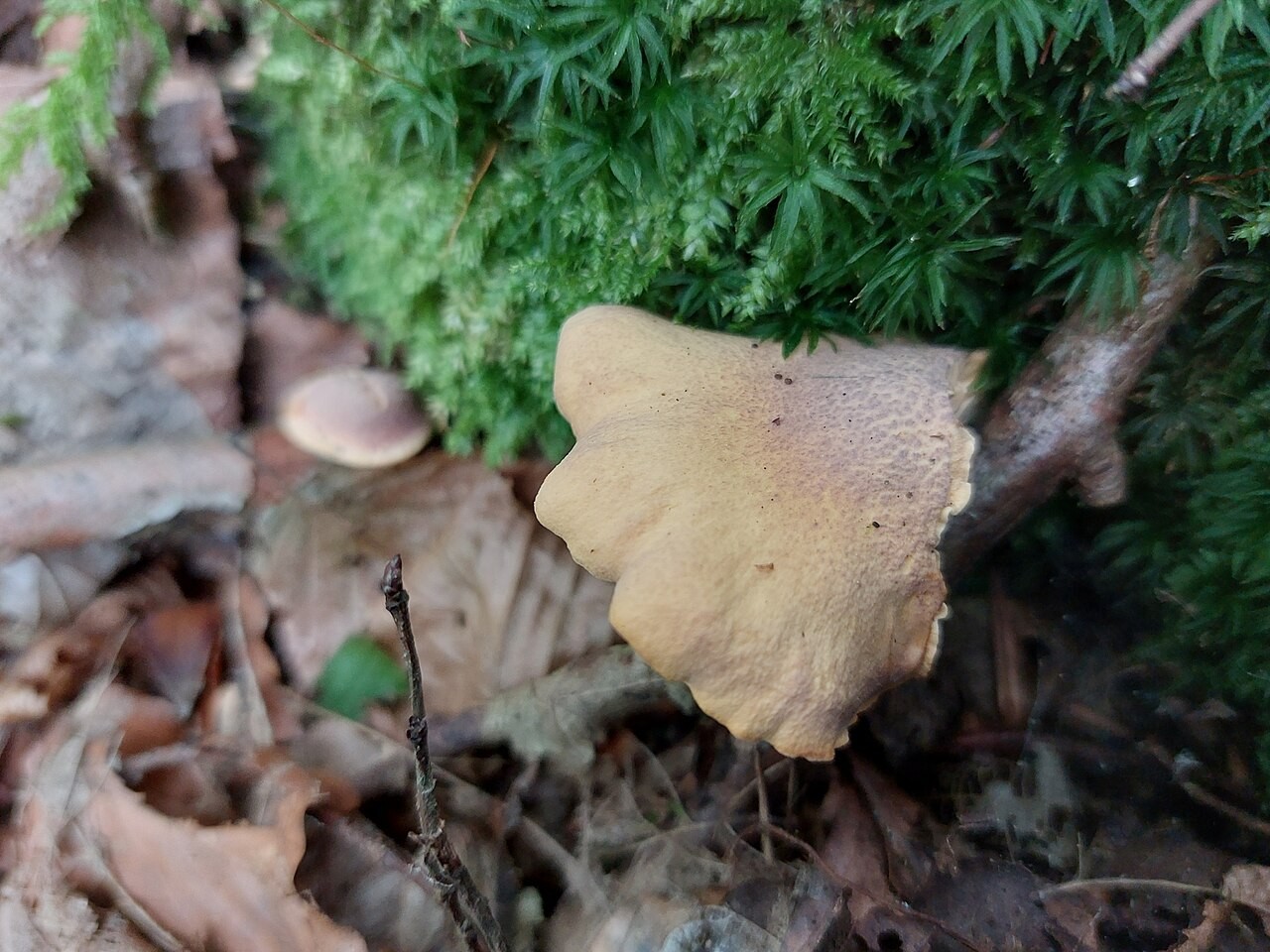
Photo: Tim Eberling · CC BY 4.0 · Photo source · License

Description
A yellow chanterelle with characteristic violet to amethyst scales and patches on the cap and branched ridges beneath.
Identification features
The cap is yellow to orange-yellow, often wavy and violet-scaled. Instead of true gills it has low, thick, branched ridges running down the stem.
Identification checklist
Check the amethyst-scaled cap, solid firm stem, and especially blunt branched ridges rather than thin true gills.
Detailed features
- Cap
- The cap is yellow to orange-yellow, often wavy and violet-scaled.
- Hymenophore
- Instead of true gills it has low, thick, branched ridges running down the stem.
- Stem
- The stem is firm, smooth, narrows toward the base, and merges into the cap without a sharp boundary.
- Flesh
- White, yellowish beneath the surface, fibrous.
- Smell
- Pleasant.
- Spore print
- Pale yellow.
Size
- Cap diameter
- 3–12 cm
- Stem height
- 3–7 cm
- Stem diameter
- 0,8–2 cm
Habitat
Mycorrhizal in coniferous and deciduous woodland, including with beech, in late summer and autumn.
Fruiting period
August, September, October
Ecology
- Trophic mode
- Mycorrhizal
- Host trees
- Spruce (Picea), Fir (Abies), Beech (Fagus)
- Substrate
- Forest soil
- Notes
- Mycorrhizal in coniferous and deciduous woodland, including with beech, in late summer and autumn.
How to separate similar species
The common chanterelle lacks strong amethyst scaling. False chanterelle and jack-o'-lantern have true gills; jack-o'-lantern is poisonous.
Similar species
Interesting facts
Did you know? It has no true gills beneath the cap, but forked ridges typical of chanterelles.