Species details
Jack-o'-lantern mushroom
Omphalotus olearius
Poisonous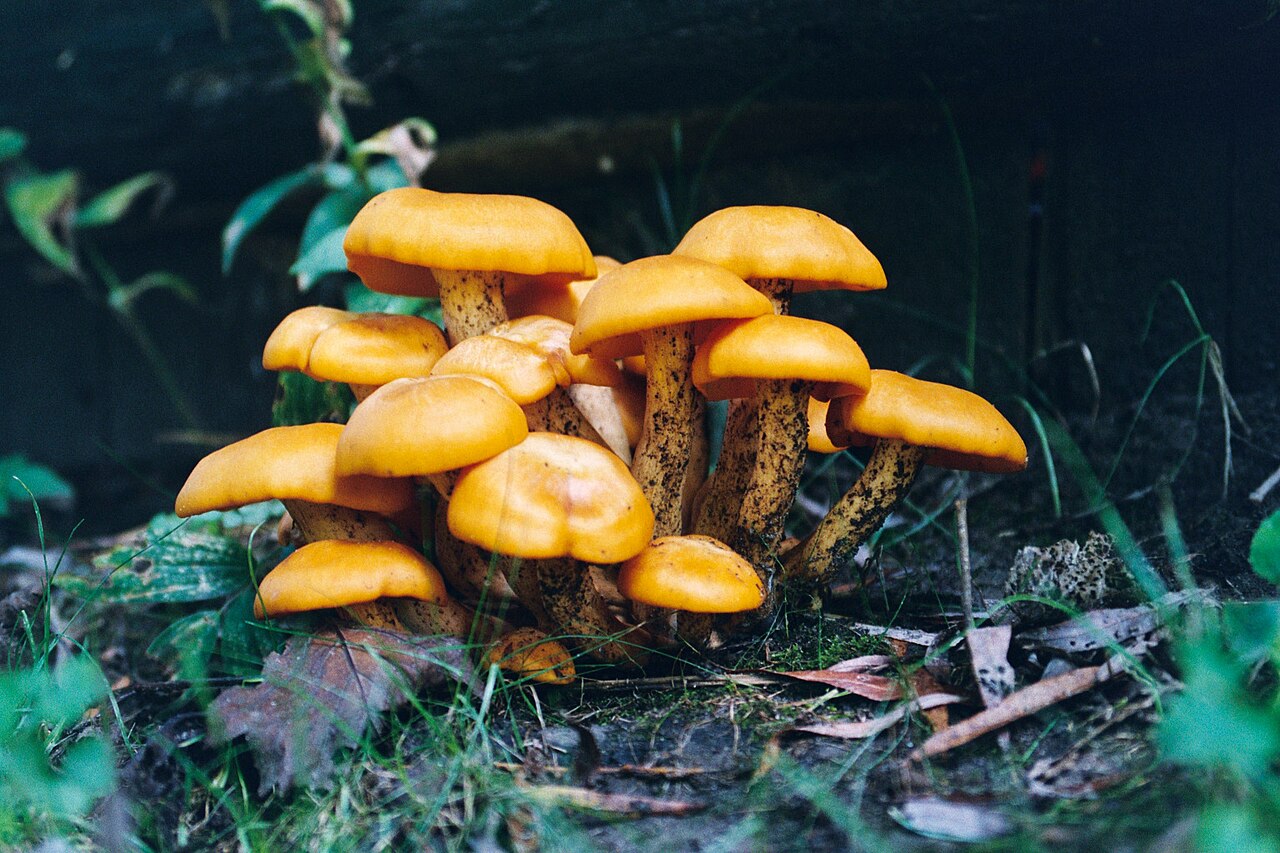
Photo: Tim Rushing · CC BY 2.5 · Photo source · License

Description
An orange mushroom growing in clusters on wood, with thin true gills running far down the stem.
Identification features
The gills may glow faintly. It differs from chanterelles by true thin gills and clustered growth on wood.
Identification checklist
Intensely orange, funnel-shaped caps grow in dense clusters from olive, oak, or buried roots. They have thin, sharp true gills running down the stem, which may glow faintly in darkness.
Detailed features
- Cap
- 6–12 cm, orange-red to brown, initially convex, later strongly depressed to funnel-shaped.
- Hymenophore
- True gills are golden-yellow to orange, crowded, narrow, often forked and deeply decurrent.
- Stem
- 5–10 cm, orange-yellow to brown, solid, fibrous and tough.
- Flesh
- Orange-yellow, fibrous and tough.
- Spore print
- White.
Size
- Cap diameter
- 6–12 cm
- Stem height
- 5–10 cm
- Stem diameter
- 0,8–1,5 cm
Habitat
On wood, roots, or buried hardwood, especially olive, oak, and sweet chestnut.
Fruiting period
July, August, September, October, November
Ecology
- Trophic mode
- Saprotrophic
- Host trees
- Olive (Olea), Oak (Quercus), Sweet chestnut (Castanea)
- Substrate
- Stumps, Roots, Wood
Distribution
- Notes
- A warmth-loving species more frequent in southern and central Europe, growing on hardwood and roots.
How to separate similar species
Chanterelle usually grows singly or scattered from soil and has blunt forked ridges with paler, firm flesh. False chanterelle is smaller and softer but also has true gills.
Similar species
Interesting facts
Did you know? The gills can show faint bioluminescence in darkness, but this should not be relied upon for identification.