Species details
Golden chanterelle
Cantharellus cibarius
Traditionally edible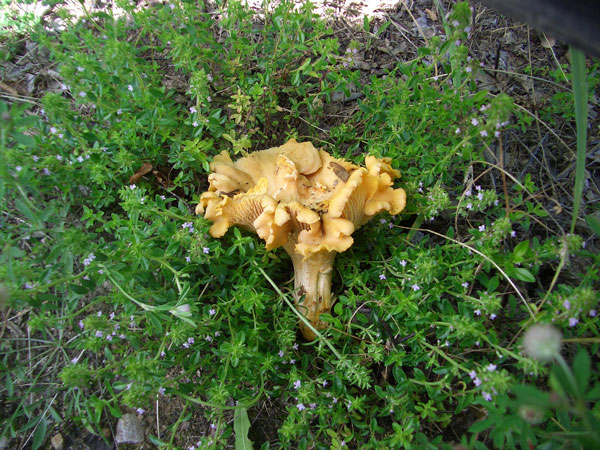
Photo: Струјајое · CC BY-SA 3.0 · Photo source · License

Description
A yellow to orange species with blunt folds running down the stem and often a fruity smell.
Identification features
The underside has branching blunt folds rather than thin true gills. The flesh is firm and paler.
Identification checklist
The cap is yellow to golden and irregularly funnel-shaped. The underside has blunt, forked ridges rather than true gills, running down the stem; the flesh is firm and paler inside.
Detailed features
- Cap
- Yellow to yellow-orange, initially convex, later depressed to funnel-shaped, with a wavy irregular margin.
- Hymenophore
- Instead of true gills it has thick, forked ridges that run down the stem.
- Stem
- Firm and solid, usually the same yellow or slightly paler than the cap.
- Flesh
- Firm and pale, often nearly white inside.
- Smell
- Often pleasantly fruity, reminiscent of apricots.
- Spore print
- Pale cream to yellowish.
Size
- Cap diameter
- 2–12 cm
- Stem height
- 3–7 cm
- Stem diameter
- 0,4–1,5 cm
Habitat
In deciduous and coniferous woodland, often in groups on nutrient-poor acidic soil.
Fruiting period
June, July, August, September, October, November
Ecology
- Trophic mode
- Mycorrhizal
- Host trees
- Oak (Quercus), Sweet chestnut (Castanea), Hazel (Corylus), Spruce (Picea), Pine (Pinus)
Distribution
- Notes
- Widespread in Europe; worldwide records should be interpreted with related chanterelle species in mind.
How to separate similar species
False chanterelle has thin, crowded true gills and softer orange flesh. Jack-o’-lantern grows in dense clusters from wood or buried roots, has sharp true gills, and is poisonous.
Similar species
Interesting facts
Did you know? Its 'gills' are not true thin gills but fleshy ridges, an important distinction from the poisonous jack-o'-lantern mushroom.