Species details
False chanterelle
Hygrophoropsis aurantiaca
Extra caution required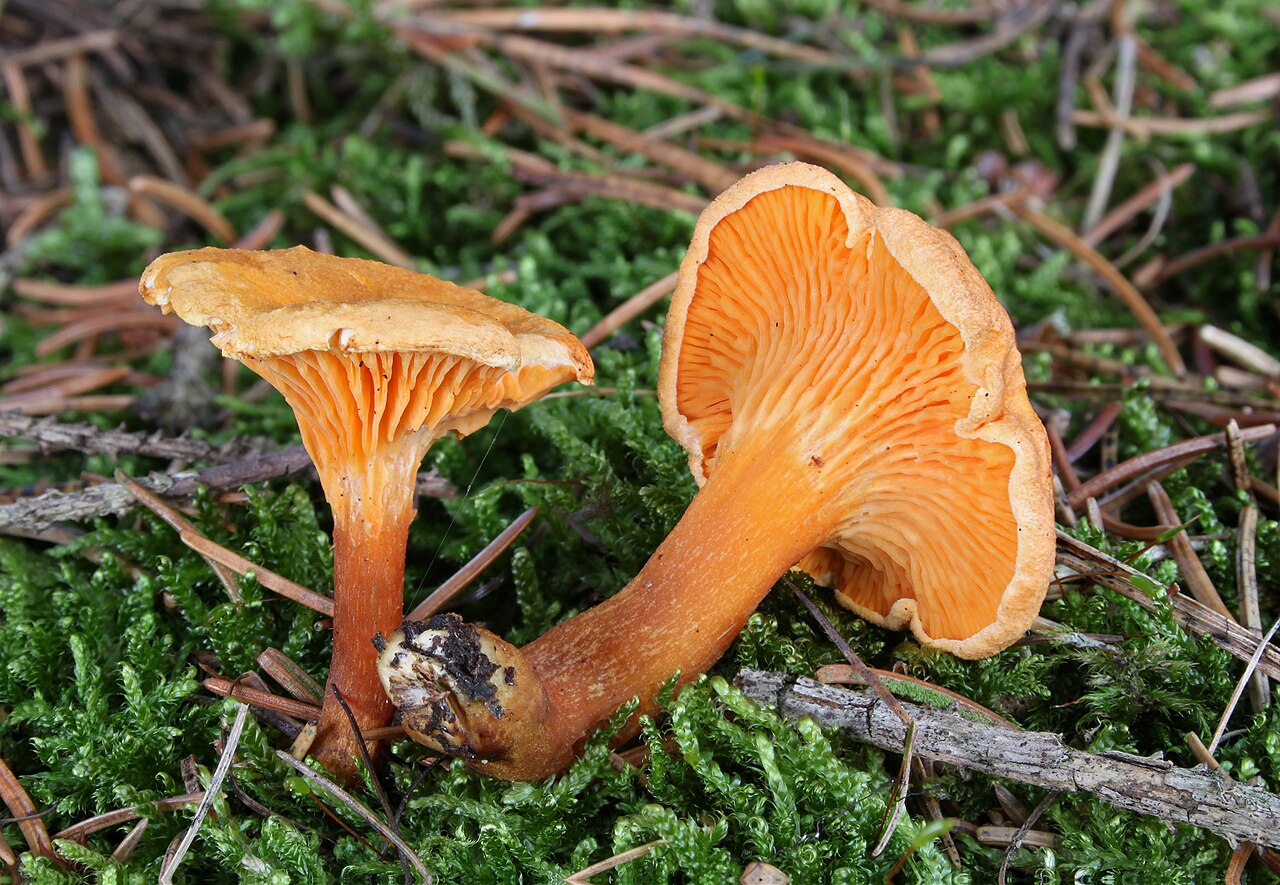
Photo: Holleday · CC BY 3.0 · Photo source · License

Description
An orange funnel-shaped mushroom with thin, crowded, strongly forked true gills.
Identification features
The cap is often velvety and darker in the centre. It differs from true chanterelles by thin true gills and softer flesh; dangerous confusion with Omphalotus is also possible.
Identification checklist
Check the entire fruitbody for identification. An orange funnel-shaped mushroom with thin, crowded, strongly forked true gills. The cap is often velvety and darker in the centre. It differs from true chanterelles by thin true gills and softer flesh; dangerous confusion with Omphalotus is also possible. Typical habitat: On woodland soil, litter, and decaying wood, mostly in coniferous woodland.
Detailed features
- Cap
- 4–8 cm, orange to yellow-orange, initially convex then funnel-shaped, with a margin remaining inrolled for a long time.
- Hymenophore
- The underside has very crowded, thin, repeatedly forked true gills that run down the stem.
- Stem
- 3–8 × 0.5–1 cm, orange-yellow, often somewhat darker toward the base.
- Flesh
- Yellow to orange, softer and thinner than in the true chanterelle.
- Smell
- Mild, lacking the characteristic fruity chanterelle smell.
- Spore print
- Yellowish to cream.
Size
- Cap diameter
- 4–8 cm
- Stem height
- 3–8 cm
- Stem diameter
- 0,5–1 cm
Habitat
On woodland soil, litter, and decaying wood, mostly in coniferous woodland.
Fruiting period
July, August, September, October, November
Ecology
- Trophic mode
- Saprotrophic
- Host trees
- Spruce (Picea)
- Substrate
- Forest soil, Dead wood
- Notes
- A saprotroph in forest litter and decaying wood, mostly in conifer woodland and often near spruce wood.
Distribution
- Notes
- A widely distributed European woodland species, especially in conifer and mixed woods.
How to separate similar species
Compare especially with these similar species: Cantharellus cibarius, Omphalotus olearius. Check the combination of cap shape and colour, spore-bearing surface, stem, flesh changes and habitat. A single feature or photograph is not enough; if the key characters do not match the description, do not treat the identification as confirmed.
Similar species
- Golden chanterelle (Cantharellus cibarius)
True chanterelle has no thin true gills; instead it has thicker blunt folds or ridges continuous with the cap flesh.
- Jack-o'-lantern mushroom (Omphalotus olearius) DANGEROUS
Jack-o’-lantern can be similarly orange, grows in dense clusters on wood or roots, and is poisonous.
Interesting facts
Did you know? Despite the name “false chanterelle”, it belongs to a different evolutionary group from true chanterelles.