Species details
Almond woodwax
Hygrophorus agathosmus
Traditionally edible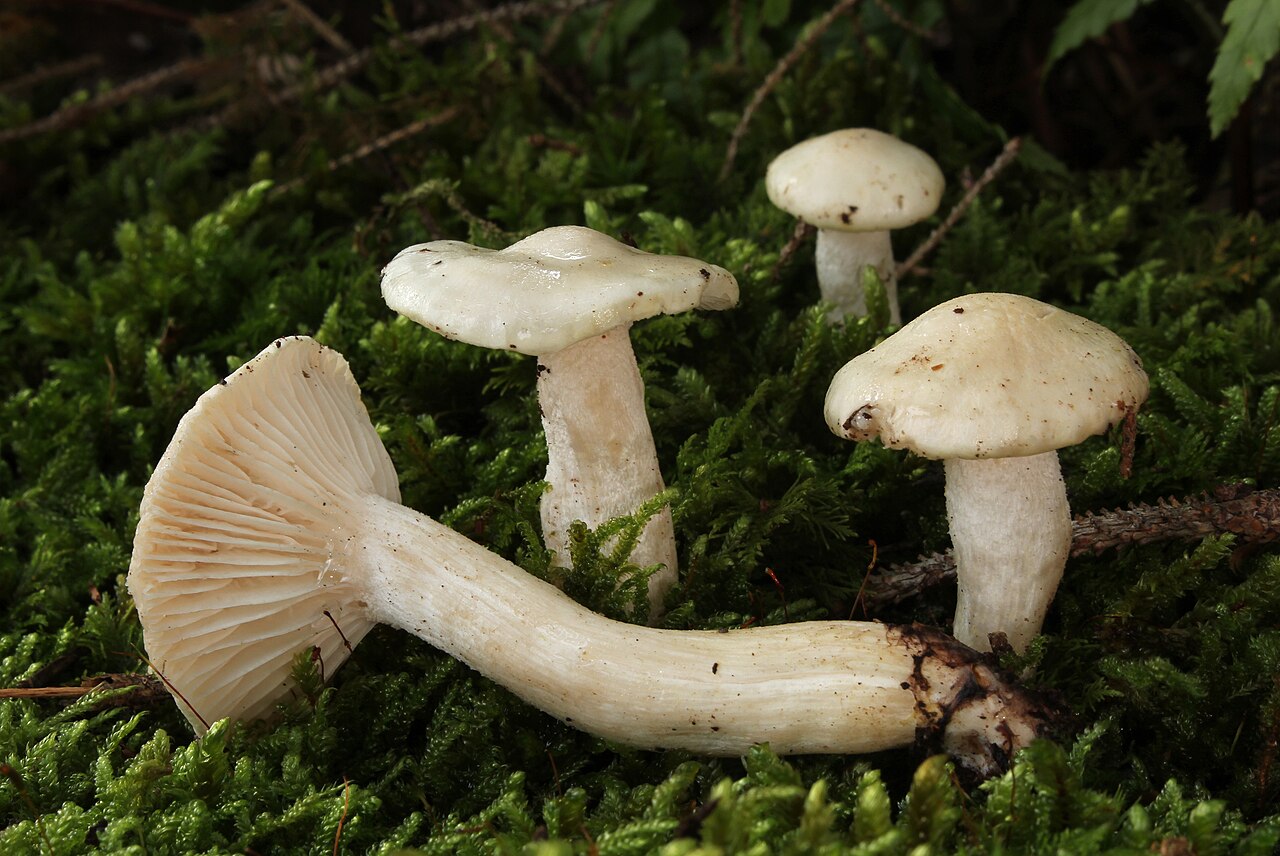
Photo: Holger Krisp · CC BY 3.0 · Photo source · License

Description
A grey to grey-olive woodwax with waxy pale gills and a characteristic bitter-almond smell.
Identification features
The cap is fleshy, smooth and slightly sticky when wet. Gills are thick, waxy, widely spaced and slightly decurrent. The stem is pale, dry to finely floccose.
Identification checklist
Check the grey fibrillose cap, thick waxy pale gills, pale stem and strong almond smell. Odour is an important supporting feature but is not sufficient on its own.
Detailed features
- Cap
- A grey to grey-olive waxcap relative with waxy pale gills and a characteristic bitter-almond smell.
- Hymenophore
- Gills are thick, waxy, widely spaced and slightly decurrent.
- Stem
- The stem is pale, dry to finely floccose.
- Flesh
- Whitish, soft and fleshy.
- Smell
- Distinctly aromatic, often described as almond- or marzipan-like.
- Spore print
- White.
Habitat
Mycorrhizal mainly with spruce and pine in coniferous and mixed woodland; mostly in autumn.
Fruiting period
August, September, October, November
Ecology
- Trophic mode
- Mycorrhizal
- Host trees
- Spruce (Picea), Pine (Pinus)
- Substrate
- Forest soil
- Notes
- Mycorrhizal species. Mycorrhizal mainly with spruce and pine in coniferous and mixed woodland; mostly in autumn.
How to separate similar species
Similar grey woodwaxes can be separated by size, degree of sliminess, odour and tree association; H. pustulatus is smaller and lacks the strong almond smell.
Similar species
Interesting facts
Did you know? Its strong aromatic smell is one of the most useful clues, but it should always be assessed together with other characters.