Species details
Olive waxcap
Hygrophorus olivaceoalbus
Conditional / expert preparation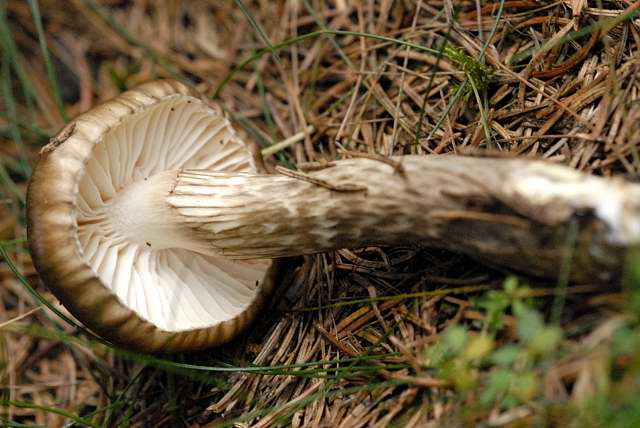
Photo: James K. Lindsey · CC BY-SA 3.0 · Photo source · License

Description
An olive-brown slimy Hygrophorus with a characteristically dark fibrillose-patterned stem.
Identification features
Gills are white and distant, cap centre darker; stem white at apex and dark-fibrillose below.
Identification checklist
Check the entire fruitbody for identification. An olive-brown slimy Hygrophorus with a characteristically dark fibrillose-patterned stem. Gills are white and distant, cap centre darker; stem white at apex and dark-fibrillose below. Typical habitat: Spruce and mixed woodland, often on acidic soils.
Detailed features
- Cap
- 2–4 cm, bell-conical to expanded, with a distinct umbo, olive-brown to almost black and strongly slimy.
- Hymenophore
- Gills white, short, thick, broad and very distant, slightly decurrent.
- Stem
- 5–10 × 0.5–1 cm, white near the apex, olive-brown below, slimy and ingrained-fibrillose patterned.
- Flesh
- White, thin and soft.
- Smell
- Pleasant and faint.
- Spore print
- White.
Size
- Cap diameter
- 2–4 cm
- Stem height
- 5–10 cm
- Stem diameter
- 0,5–1 cm
Habitat
Spruce and mixed woodland, often on acidic soils.
Fruiting period
August, September, October, November
Ecology
- Trophic mode
- Mycorrhizal
- Host trees
- Spruce (Picea)
- Substrate
- Forest soil
- Notes
- Characteristically with spruce, often at higher elevations, from late summer into autumn.
How to separate similar species
Compare especially with these similar species: Hygrophorus hypothejus. Check the combination of cap shape and colour, spore-bearing surface, stem, flesh changes and habitat. A single feature or photograph is not enough; if the key characters do not match the description, do not treat the identification as confirmed.
Similar species
- Herald of winter (Hygrophorus hypothejus)
Late waxcap is usually more yellowish and its lower stem is less distinctly dark-patterned.
- Hygrophorus dichrous
Hygrophorus dichrous is usually stouter and characteristically grows with hornbeam rather than spruce.
Interesting facts
Did you know? The dark slimy cap, white stem apex and olive-patterned lower stem create a distinctive contrast.