Species details
Shaggy parasol
Chlorophyllum rhacodes
Conditional / expert preparation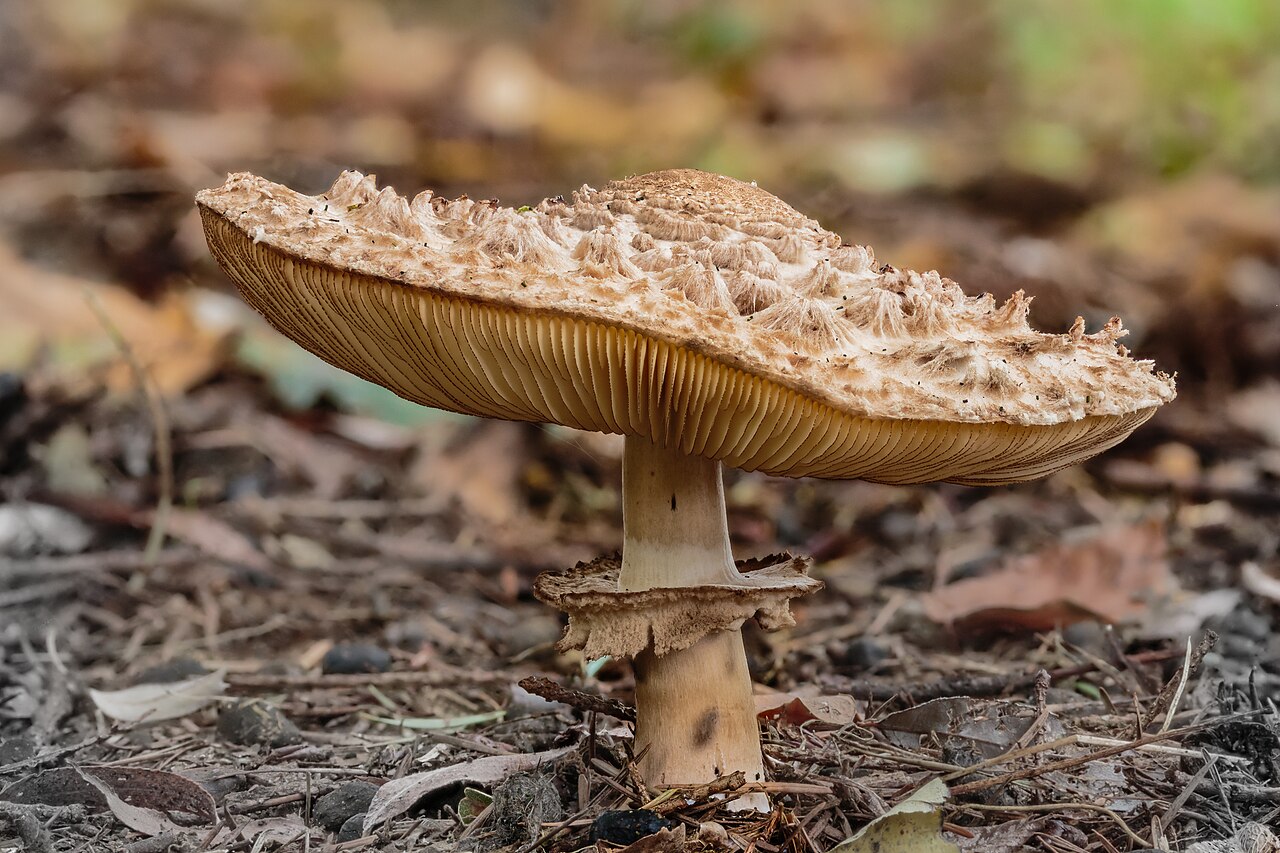
Photo: Dominicus Johannes Bergsma · CC BY-SA 4.0 · Photo source · License
_26-10-2020_(d.j.b.).jpg)
Description
A large parasol-like mushroom with a strongly scaly cap and white flesh that quickly stains orange-red and then brownish when cut.
Identification features
Gills are white, crowded and free. The stem is smooth and hollow with an enlarged base and a movable ring. The spore print is white.
Identification checklist
Check the coarse cap scales, smooth stem without a snakeskin pattern, movable ring, white spore print and rapid reddening of cut flesh. Always expose the entire stem base.
Detailed features
- Cap
- A large parasol-like mushroom with a strongly scaly cap and white flesh that quickly turns orange-red when cut and later browns.
- Hymenophore
- Gills are white, crowded and free. The spore print is white.
- Stem
- The stem is smooth and hollow with an enlarged base and a movable ring.
- Flesh
- White, rapidly reddening when damaged and later turning brown.
- Smell
- Pleasant smell.
- Spore print
- White.
Size
- Cap diameter
- 10–15 cm
- Stem height
- 10–15 cm
- Stem diameter
- 1–2 cm
Habitat
Saprotrophic on rich humus soils, woodland edges, clearings, parks and other disturbed ground; late summer and autumn.
Fruiting period
August, September, October, November
Ecology
- Trophic mode
- Saprotrophic
- Substrate
- Forest soil, Disturbed soil
- Notes
- Saprotrophic species. Saprotrophic on rich humus soils, woodland edges, clearings, parks and other disturbed ground; late summer and autumn.
How to separate similar species
True parasol has a distinct snakeskin stem pattern and usually reddens less. C. brunneum has a more strongly marginate bulb and can cause illness. Where C. molybdites occurs, spore-print colour is also important.
Similar species
- Parasol mushroom (Macrolepiota procera)
- Shaggy parasol (Chlorophyllum brunneum) DANGEROUS
C. brunneum usually has a shorter, thicker stem and a distinctly rimmed basal bulb; it can cause gastrointestinal poisoning.
- Chlorophyllum molybdites DANGEROUS
Mature fruitbodies have a greenish spore print and greenish gills; the species is poisonous.
Interesting facts
Did you know? Rapid reddening of damaged flesh is important, but similar and poisonous Chlorophyllum species can also change colour.