Species details
Parasol mushroom
Macrolepiota procera
Extra caution required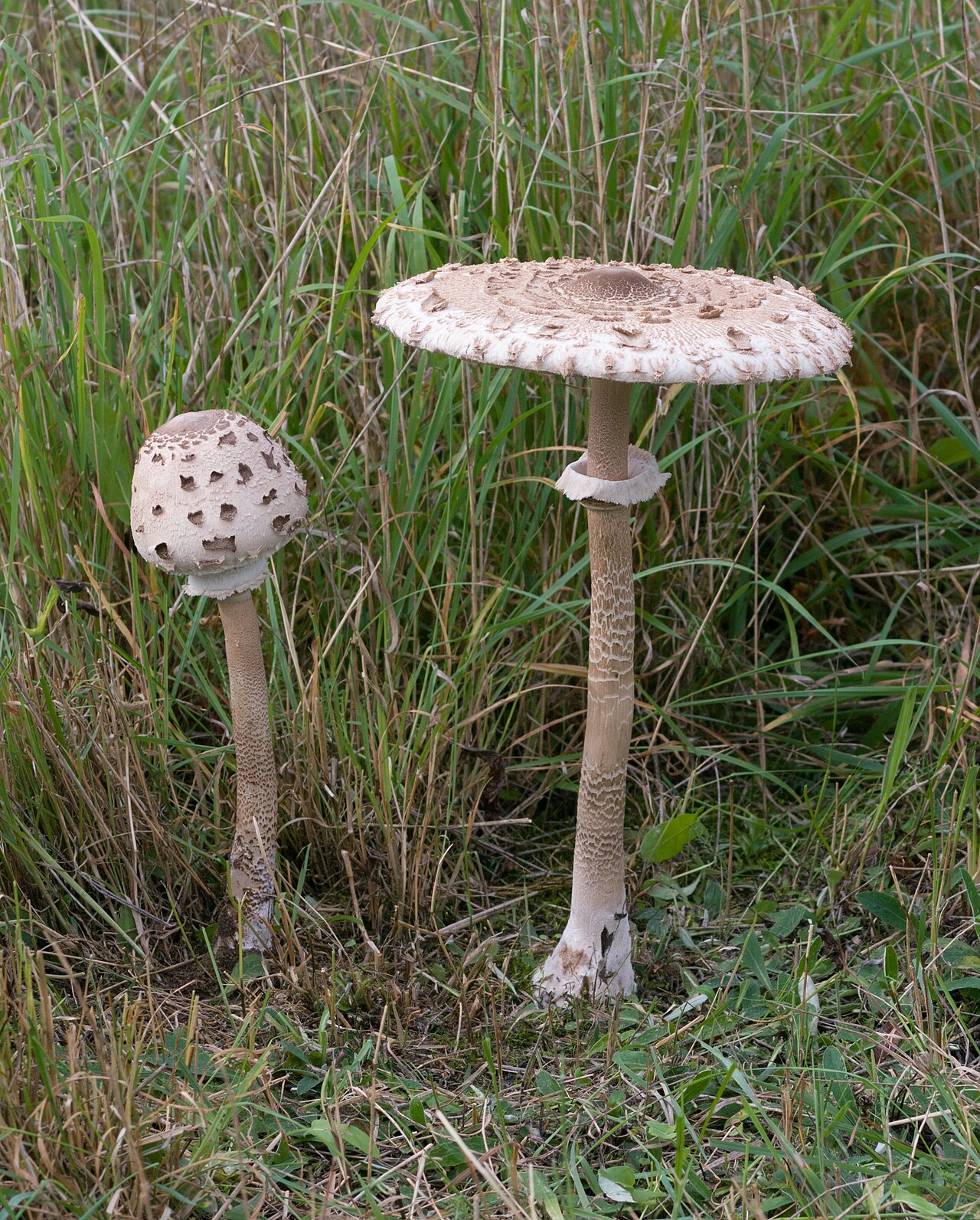
Photo: Chrumps · CC BY-SA 4.0 · Photo source · License

Description
A very large mushroom with a scaly cap, movable double ring, and snakeskin pattern on the long stem.
Identification features
The stem is tall, hollow, and bulbous at the base but lacks a volva. The ring is usually movable.
Identification checklist
Mature fruitbodies are large, with a scaly parasol cap, a long slender stem bearing a snakeskin pattern, and a thick movable ring. There is no sack-like volva at the stem base.
Detailed features
- Cap
- Large, initially egg-shaped then expanded, with a brown central umbo and brown scales on a paler background.
- Hymenophore
- Gills are white to cream, crowded and free from the stem.
- Stem
- Very tall and hollow, with a characteristic brown 'snakeskin' pattern, bulbous base and usually movable double ring.
- Flesh
- White; normally does not redden when damaged.
- Smell
- Pleasant, often slightly nutty.
- Spore print
- White.
Size
- Cap diameter
- 10–26 cm
- Stem height
- 20–40 cm
- Stem diameter
- 1–2 cm
Habitat
In grassland, woodland edges, clearings, and open woods.
Fruiting period
July, August, September, October, November
Ecology
- Trophic mode
- Saprotrophic
- Substrate
- Soil, Grassland
Distribution
- Notes
- Widespread in Europe on grassy woodland edges, clearings and open woodland.
How to separate similar species
Young closed specimens are difficult to identify safely. Shaggy parasols may be smaller, have a smoother stem, strong reddening, and a more bulbous base; Amanita species may have a volva.
Similar species
- Shaggy parasol (Chlorophyllum brunneum) DANGEROUS
- Shaggy parasol (Chlorophyllum rhacodes)
- Amanita species
Interesting facts
Did you know? The movable ring and snakeskin-patterned stem are especially useful identification features.