Species details
Shaggy parasol
Chlorophyllum brunneum
Poisonous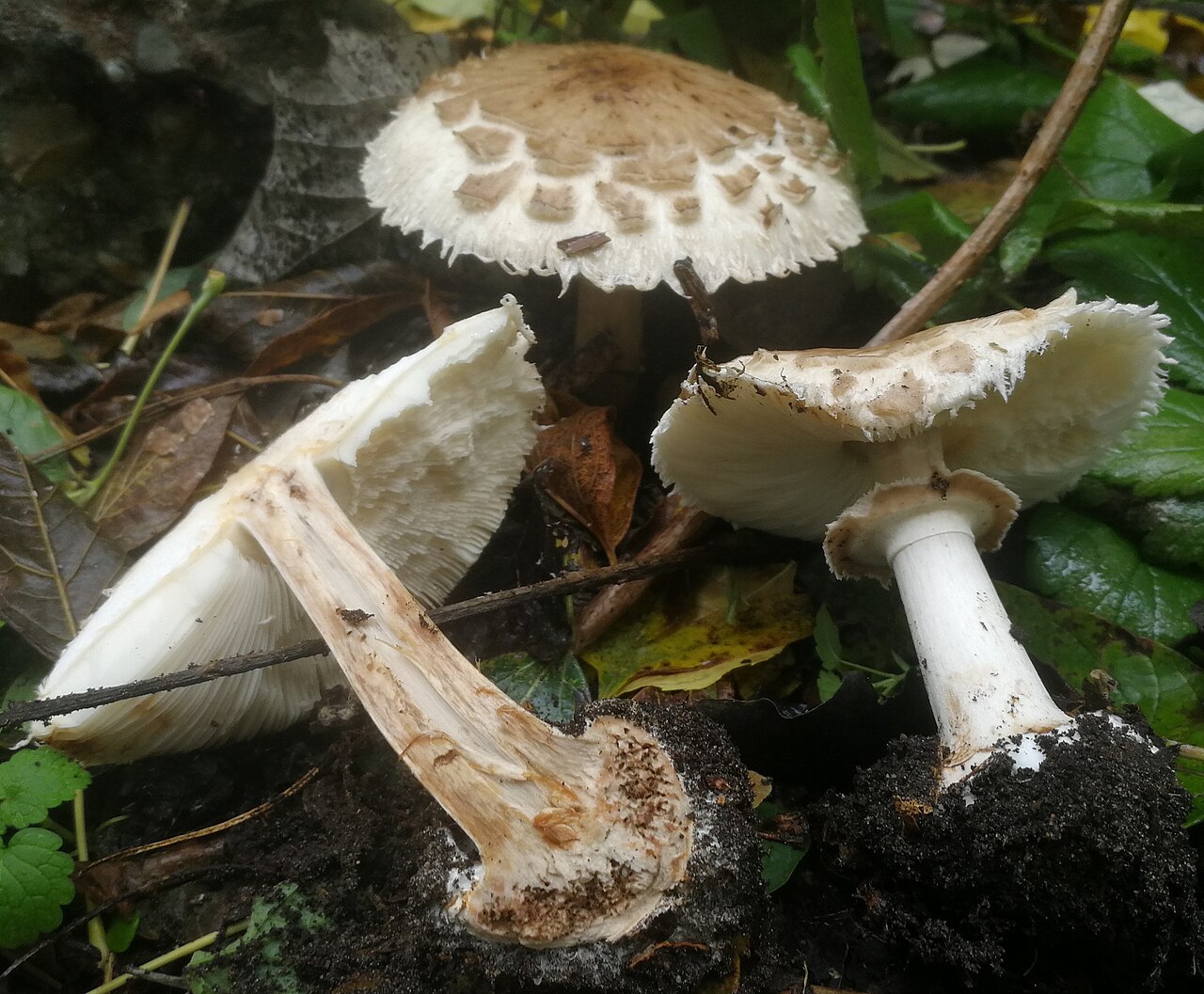
Photo: Tomasz Sobczak · CC BY-SA 4.0 · Photo source · License

Description
A large parasol with brown scales, a strong bulbous base, and flesh that stains orange-red.
Identification features
The ring is simple and movable, the base distinctly marginate-bulbous, and gills initially white.
Identification checklist
Check the entire fruitbody for identification. A large parasol with brown scales, a strong bulbous base, and flesh that stains orange-red. The ring is simple and movable, the base distinctly marginate-bulbous, and gills initially white. Typical habitat: Gardens, compost, greenhouses, parks, and nutrient-rich soil near settlements.
Detailed features
- Cap
- 5–15 cm, initially closed to cylindrical, later convex and expanded; centre smooth brown, remainder densely covered with paler brown fibrous scales.
- Hymenophore
- Gills white to cream, free, crowded and soft; may become brown-spotted with age.
- Stem
- 6–15 × 1.5–2.5 cm, relatively short and stout, with a large abruptly marginate bulb and a movable ring.
- Flesh
- Whitish, turning yellow-orange and then reddish-brown when damaged.
- Smell
- Pleasant to indistinct.
- Taste
- Do not taste.
- Spore print
- White.
Size
- Cap diameter
- 5–15 cm
- Stem height
- 6–15 cm
- Stem diameter
- 1,5–2,5 cm
Habitat
Gardens, compost, greenhouses, parks, and nutrient-rich soil near settlements.
Fruiting period
June, July, August, September, October
Ecology
- Trophic mode
- Saprotrophic
- Substrate
- Soil, Grassland
- Notes
- Common on rich garden and park soils, compost, and in greenhouses; often grows in groups.
How to separate similar species
Compare especially with these similar species: Chlorophyllum rhacodes, Macrolepiota procera, Chlorophyllum molybdites. Check the combination of cap shape and colour, spore-bearing surface, stem, flesh changes and habitat. A single feature or photograph is not enough; if the key characters do not match the description, do not treat the identification as confirmed.
Similar species
- Shaggy parasol (Chlorophyllum rhacodes)
The shaggy parasol is usually more woodland-associated and lacks such a sharply marginate basal bulb.
- Parasol mushroom (Macrolepiota procera)
The parasol has a snakeskin-patterned stem and its flesh does not redden in the same way.