Species details
Shaggy ink cap
Coprinus comatus
Conditional / expert preparation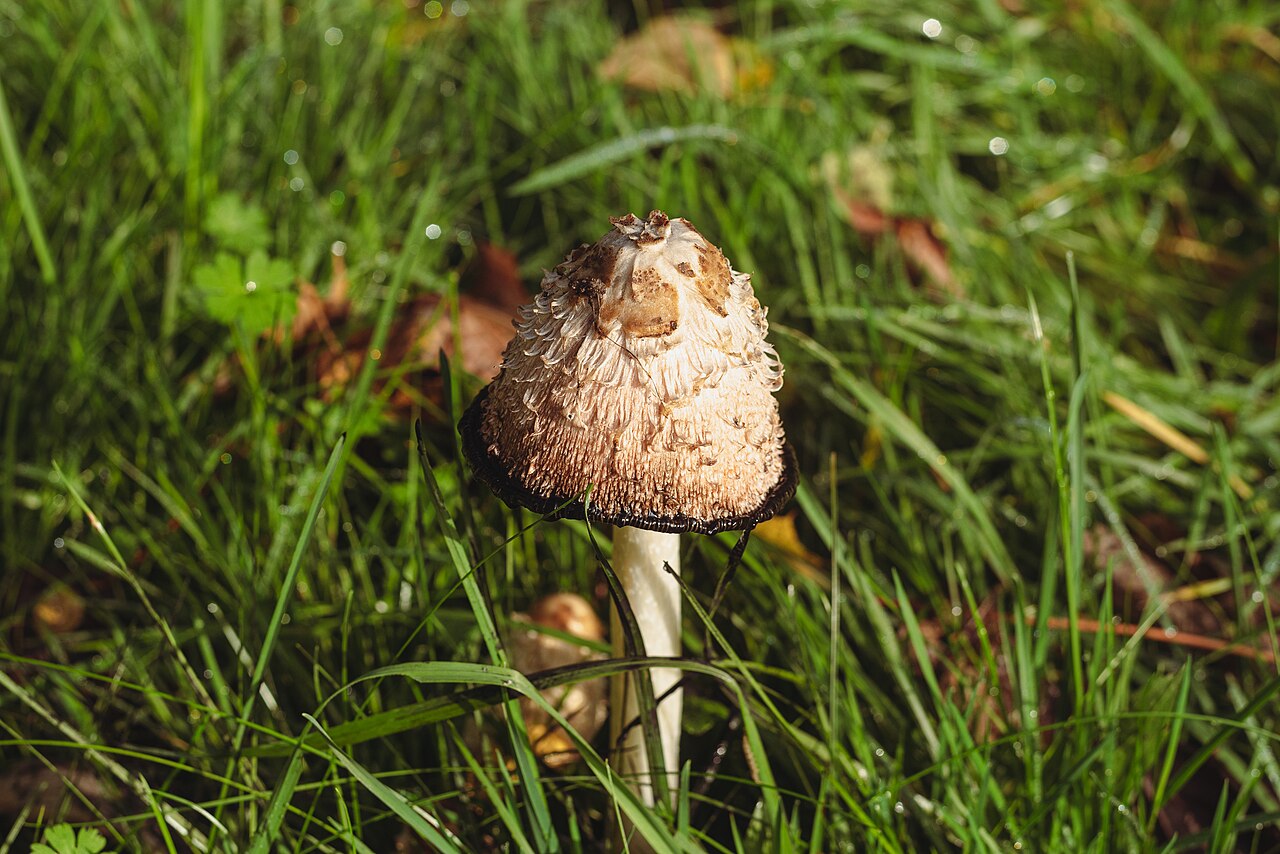
Photo: Flocci Nivis · CC BY 4.0 · Photo source · License

Description
A tall white inkcap with shaggy scales that dissolves from the cap margin into black liquid as it matures.
Identification features
The gills change from white to pink and then black. Reliable identification requires a young, fresh, complete specimen.
Identification checklist
The young cap is tall, cylindrical to bell-shaped and white, covered in large recurved shaggy scales; the top is often brownish. Gills change from white to pink and black before dissolving. The white hollow stem has a movable ring.
Detailed features
- Cap
- When young 5–8 cm high and 2–4 cm wide, ovoid to cylindrical, white with conspicuous shaggy scales; the margin blackens and liquefies as it matures.
- Hymenophore
- Gills are white at first, then pink, finally black; at maturity they deliquesce together with the cap.
- Stem
- 10–25 × 1–1.5 cm, white, hollow and rather fragile; a thin movable ring is often low on the stem and may fall away.
- Flesh
- White and tender; in mature fruitbodies the darkening parts rapidly turn into black liquid.
- Smell
- No strong characteristic smell.
- Spore print
- Black.
Size
- Cap diameter
- 2–4 cm
- Stem height
- 10–25 cm
- Stem diameter
- 1–1,5 cm
Habitat
On lawns, pathsides, parks, and other nutrient-rich disturbed ground.
Fruiting period
April, May, June, July, August, September, October, November
Ecology
- Trophic mode
- Saprotrophic
- Substrate
- Grassland, Disturbed soil
- Notes
- A saprotroph of nutrient-rich ground; common on lawns, in gardens, along paths and in parks.
Distribution
- Notes
- Widespread in Europe and also common in human-modified habitats.
How to separate similar species
Common inkcap is grey, nearly smooth, and grows in dense clusters; with alcohol it can cause the coprine reaction. Magpie inkcap has a black cap with large white patches. Use only young, complete specimens for identification.
Similar species
- Common inkcap (Coprinopsis atramentaria) DANGEROUS
Common inkcap lacks the conspicuously shaggy white cap and usually grows in denser clusters associated with buried wood.
Interesting facts
Did you know? Mature fruitbodies digest themselves into a black liquid, a process called deliquescence.