Species details
Ivory waxcap
Hygrophorus eburneus
Conditional / expert preparation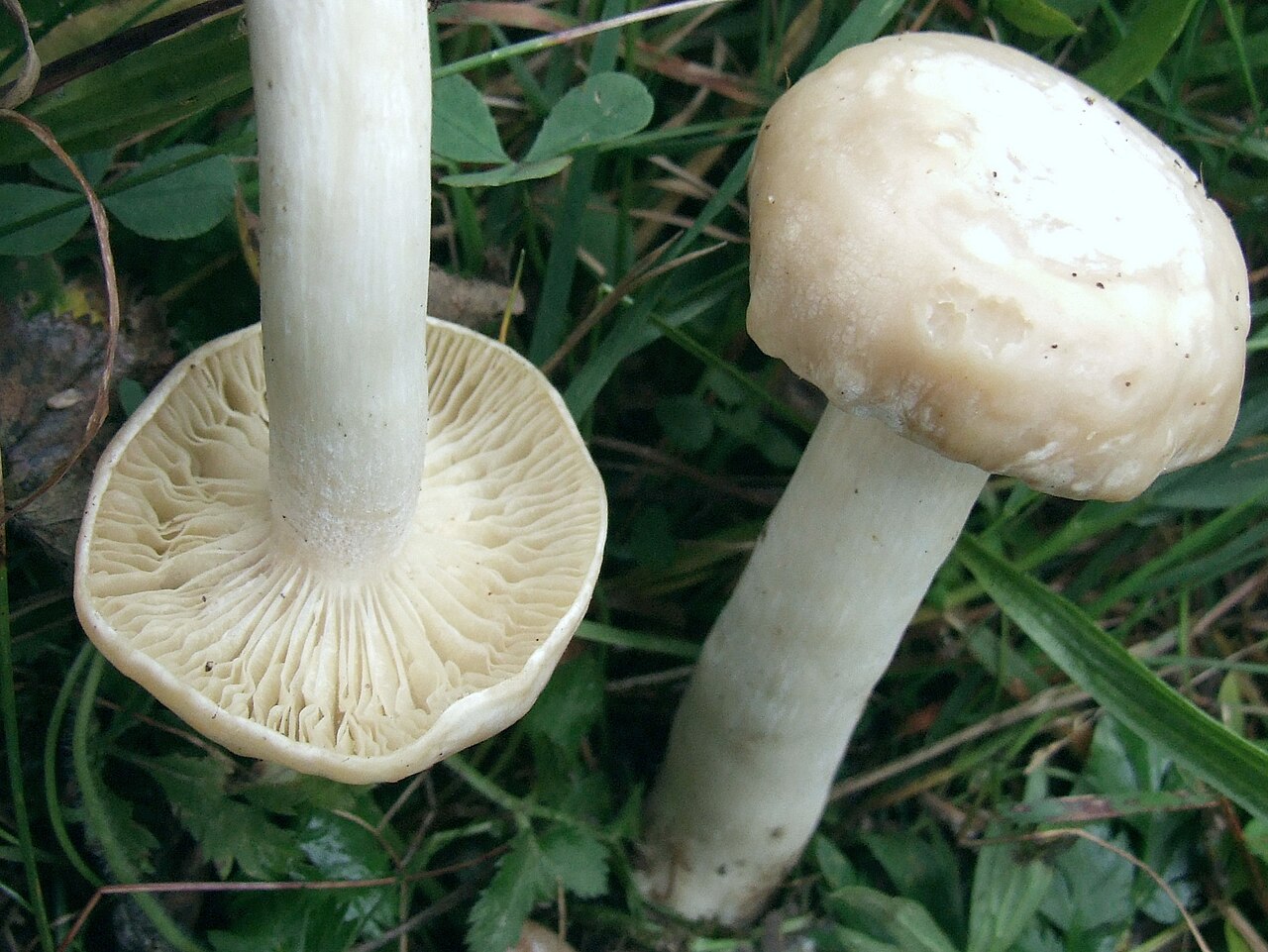
Photo: Jerzy Opioła · CC BY-SA 4.0 · Photo source · License

Description
An entirely white to ivory, very slimy Hygrophorus with waxy gills.
Identification features
Cap and stem are very slimy when wet; gills are distant and slightly decurrent.
Identification checklist
Check the entire fruitbody for identification. An entirely white to ivory, very slimy Hygrophorus with waxy gills. Cap and stem are very slimy when wet; gills are distant and slightly decurrent. Typical habitat: Mainly beech and other deciduous woodland.
Detailed features
- Cap
- 3–6 cm, initially bell-convex, later expanded with a broad umbo, white to ivory and strongly slimy.
- Hymenophore
- Gills white, thick and distant, adnate or slightly decurrent.
- Stem
- 4–8 × 0.3–0.8 cm, white, cylindrical, slimy and finely granular near the apex.
- Flesh
- White, soft to firm.
- Smell
- Slightly unpleasant and sometimes distinctive in fresh specimens.
- Spore print
- White.
Size
- Cap diameter
- 3–6 cm
- Stem height
- 4–8 cm
- Stem diameter
- 0,3–0,8 cm
Habitat
Mainly beech and other deciduous woodland.
Fruiting period
August, September, October, November
Ecology
- Trophic mode
- Mycorrhizal
- Host trees
- Beech (Fagus)
- Substrate
- Forest soil
- Notes
- A mycorrhizal waxcap of broadleaved woodland, often associated with beech.
How to separate similar species
Compare especially with these similar species: Hygrophorus cossus, Hygrophorus discoxanthus. Check the combination of cap shape and colour, spore-bearing surface, stem, flesh changes and habitat. A single feature or photograph is not enough; if the key characters do not match the description, do not treat the identification as confirmed.
Similar species
- Hygrophorus cossus
Hygrophorus cossus is also white and slimy but has a different, often stronger unpleasant smell and differs ecologically.
- Discolouring woodwax (Hygrophorus discoxanthus)
Hygrophorus discoxanthus often yellows to browns with age or damage.
Interesting facts
Did you know? In this species the stem base can react flesh-red to orange with strong KOH solution.