Species details
Blusher
Amanita rubescens
Conditional / expert preparation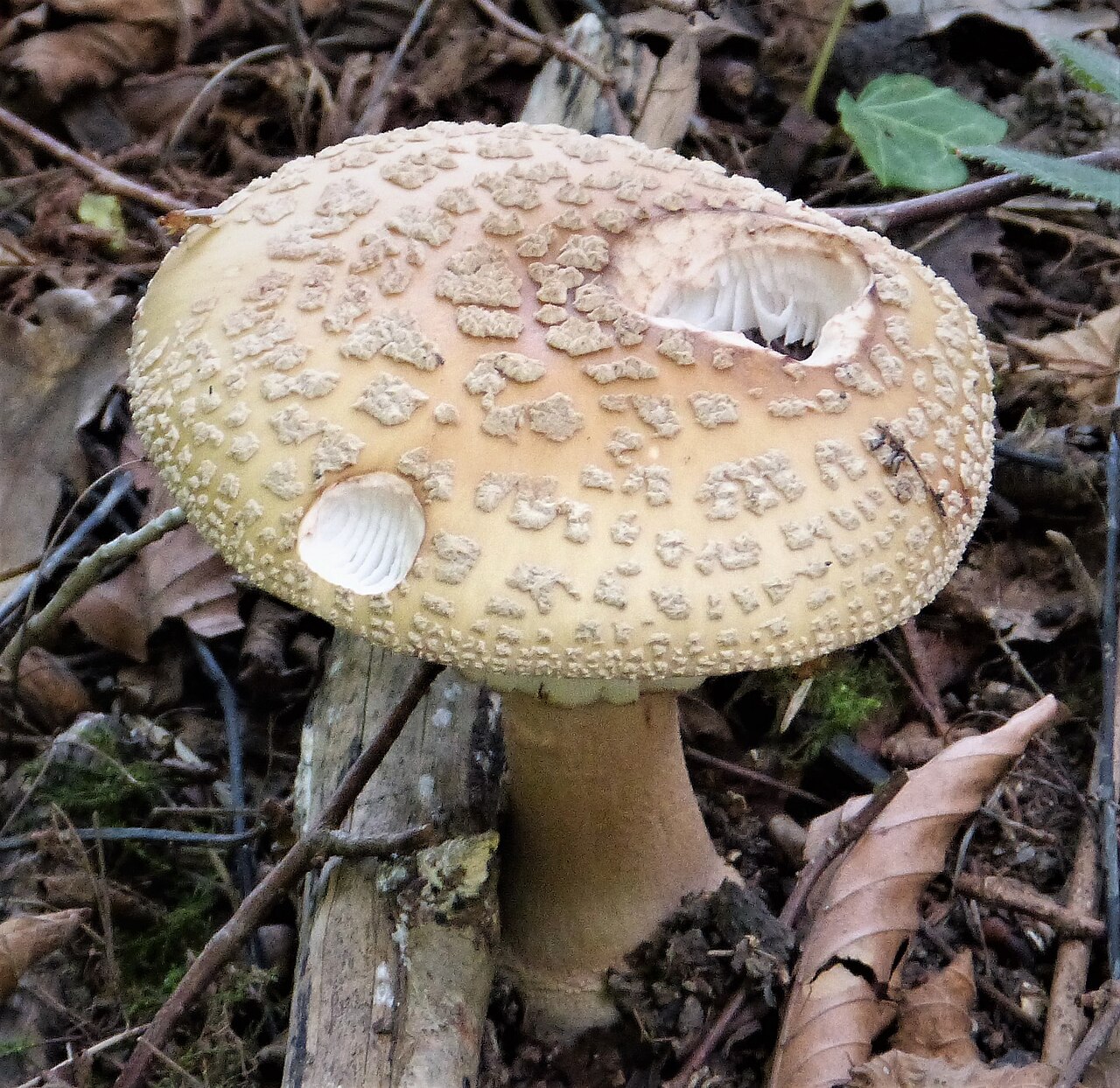
Photo: gailhampshire · CC BY 2.0 · Photo source · License
.jpg)
Description
A grey-brown amanita whose flesh and damaged areas slowly blush reddish.
Identification features
The cap has grey warts and the stem a ring, but the base lacks a sac-like volva. It is harmful raw or undercooked, and confusion with the panther cap is dangerous.
Identification checklist
The cap is brownish to grey-brown with dirty grey patches. Flesh, gills, and especially the stem base slowly blush pink to wine-red when damaged. The upper ring surface is finely striate, and the base lacks a sharply rimmed sac-like volva.
Detailed features
- Cap
- 5–15 cm, brownish to pinkish-brown, with characteristic greyish veil patches; damaged areas gradually redden.
- Hymenophore
- Gills are white, crowded and often redden when damaged.
- Stem
- 5–15 cm, whitish to brownish, with a hanging striate ring; base swollen but without a free sac-like volva.
- Flesh
- White, characteristically reddening when cut or damaged, especially near the base.
- Spore print
- White.
Size
- Cap diameter
- 5–15 cm
- Stem height
- 5–15 cm
- Stem diameter
- 1–2 cm
Habitat
In deciduous and coniferous woodland, often with beech, oak, and spruce.
Fruiting period
June, July, August, September, October, November
Ecology
- Trophic mode
- Mycorrhizal
- Host trees
- Beech (Fagus), Oak (Quercus), Spruce (Picea), Pine (Pinus)
Distribution
- Notes
- A very common species in European deciduous, coniferous and mixed woodland.
How to separate similar species
Panther cap normally does not redden, has white warts, a smooth upper ring surface, and sharply rimmed bands on the bulbous base. Grey spotted amanita also lacks reliable reddening.
Similar species
Interesting facts
Did you know? Reddening of the flesh is one of the most important features separating it from the dangerous panther cap, which normally does not redden.