Species details
Panther cap
Amanita pantherina
Poisonous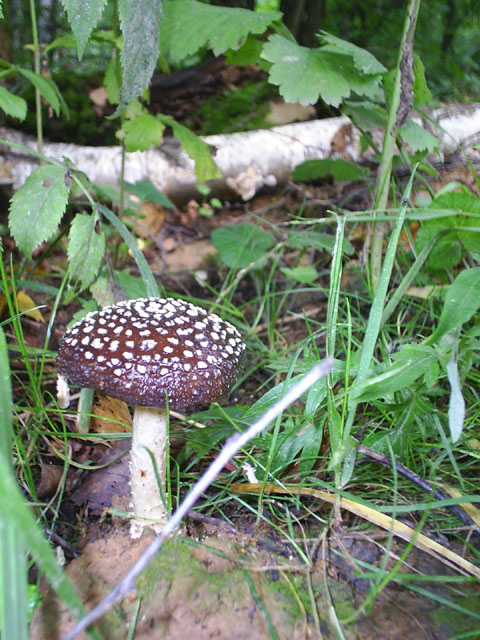
Photo: Tod Schwarzkaiser · CC BY-SA 3.0 · Photo source · License

Description
A strongly poisonous amanita with a brown cap, white warts, a striate margin, and a characteristic stem base.
Identification features
The ring is usually smooth, with rim-like or ring-like veil remnants at the base. Cap colour is variable.
Identification checklist
The cap is brown to olive-brown with white patches and often a clearly striate margin. Gills and stem are white; the ring is usually smooth, and the bulbous base has a distinct rim or several volval bands.
Detailed features
- Cap
- Brown to grey-brown, usually with small white veil patches; the margin is characteristically striate when expanded.
- Hymenophore
- Gills are white, crowded and free from the stem.
- Stem
- White with a smooth ring; the bulbous base carries characteristic rim-like or ring-like veil remnants.
- Flesh
- White and normally does not redden when damaged.
- Spore print
- White.
Size
- Cap diameter
- 6–12 cm
- Stem height
- 6–16 cm
- Stem diameter
- 0,6–1,5 cm
Habitat
In deciduous and coniferous woodland, often on sandy or acidic soil.
Fruiting period
June, July, August, September, October
Ecology
- Trophic mode
- Mycorrhizal
- Host trees
- Oak (Quercus), Beech (Fagus)
Distribution
- Notes
- Widespread in Europe in deciduous and mixed woodland.
How to separate similar species
Blusher reddens when damaged and usually has a striate ring; panther cap does not redden. Grey-spotted amanita has greyish veil patches and a striate ring. Individual features may be missing or washed off.
Similar species
Interesting facts
Did you know? When separating it from blusher, the lack of reddening and the different stem base are especially important.