Species details
Yellowfoot
Craterellus tubaeformis
Traditionally edible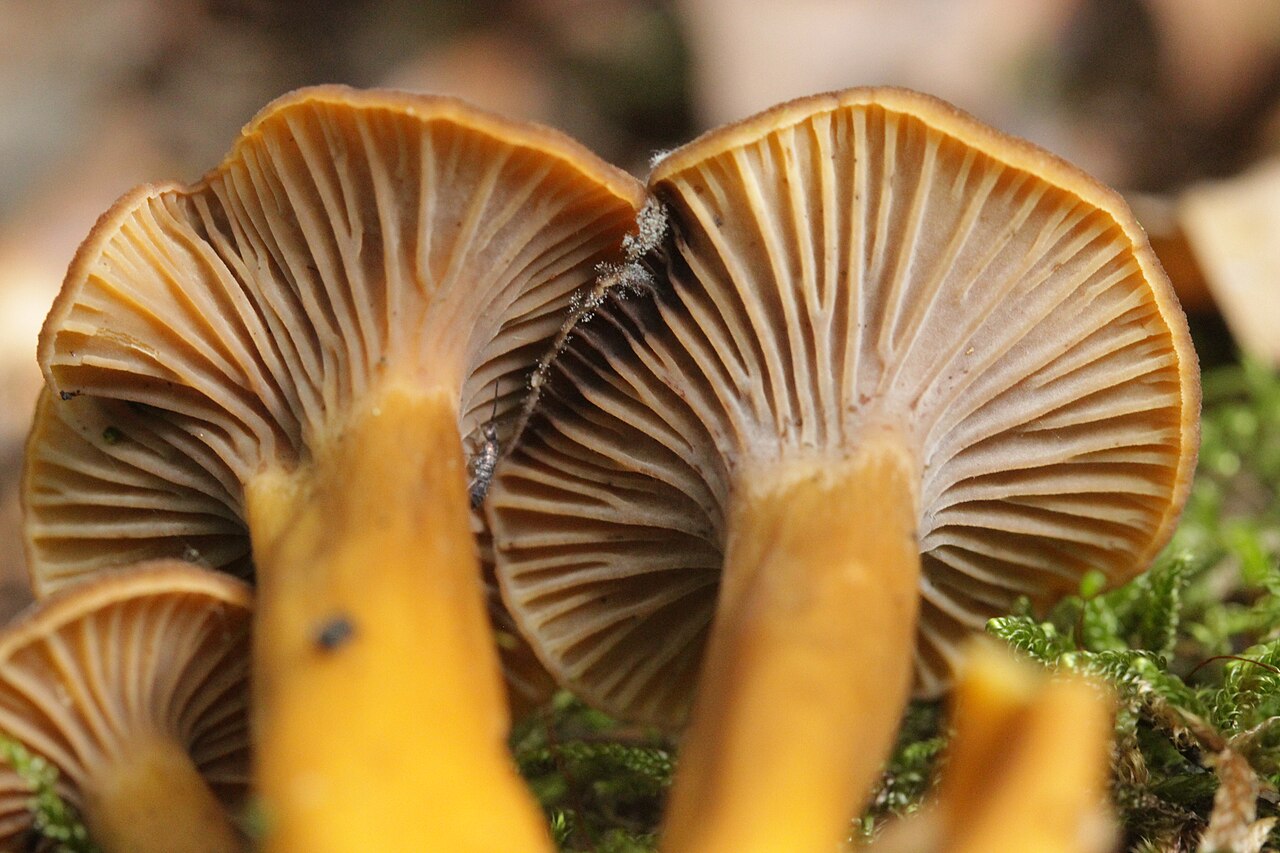
Photo: Holger Krisp · CC BY 3.0 · Photo source · License

Description
A slender funnel-shaped mushroom with a brown cap, grey ridges, and a hollow yellowish stem.
Identification features
The cap is perforated centrally, the ridges are forked, and the stem is distinctly hollow.
Identification checklist
Check the entire fruitbody for identification. A slender funnel-shaped mushroom with a brown cap, grey ridges, and a hollow yellowish stem. The cap is perforated centrally, the ridges are forked, and the stem is distinctly hollow. Typical habitat: Moist conifer and mixed woodland, often among moss in large groups.
Detailed features
- Cap
- 2–5 cm, funnel-shaped, grey-yellow to ochre-brown; the centre opens into the hollow stem with age.
- Hymenophore
- Grey-ochre, thick, widely spaced, forked ridges running somewhat down the stem.
- Stem
- 3–7 × 0.3–0.6 cm, yellow, smooth and hollow, often somewhat compressed.
- Flesh
- White to yellowish, thin and flexible.
- Smell
- Not distinctive.
- Spore print
- Whitish.
Size
- Cap diameter
- 2–5 cm
- Stem height
- 3–7 cm
- Stem diameter
- 0,3–0,6 cm
Habitat
Moist conifer and mixed woodland, often among moss in large groups.
Fruiting period
August, September, October, November, December
Ecology
- Trophic mode
- Mycorrhizal
- Host trees
- Spruce (Picea), Pine (Pinus), Beech (Fagus)
- Substrate
- Forest soil
- Soil
- Moist
- Notes
- Often in damp mossy coniferous and mixed woodland, usually in groups.
How to separate similar species
Compare especially with these similar species: Craterellus lutescens, Cantharellus cibarius, Hygrophoropsis aurantiaca. Check the combination of cap shape and colour, spore-bearing surface, stem, flesh changes and habitat. A single feature or photograph is not enough; if the key characters do not match the description, do not treat the identification as confirmed.
Similar species
- Yellowfoot (Craterellus lutescens)
Usually has a more yellow-orange stem and a smoother or less distinctly ridged underside.
- Golden chanterelle (Cantharellus cibarius)
Has a solid rather than hollow stem and a fleshier yellow cap.
- False chanterelle (Hygrophoropsis aurantiaca)
Has true thin crowded orange gills rather than thick grey ridges.