Species details
Yellowfoot
Craterellus lutescens
Traditionally edible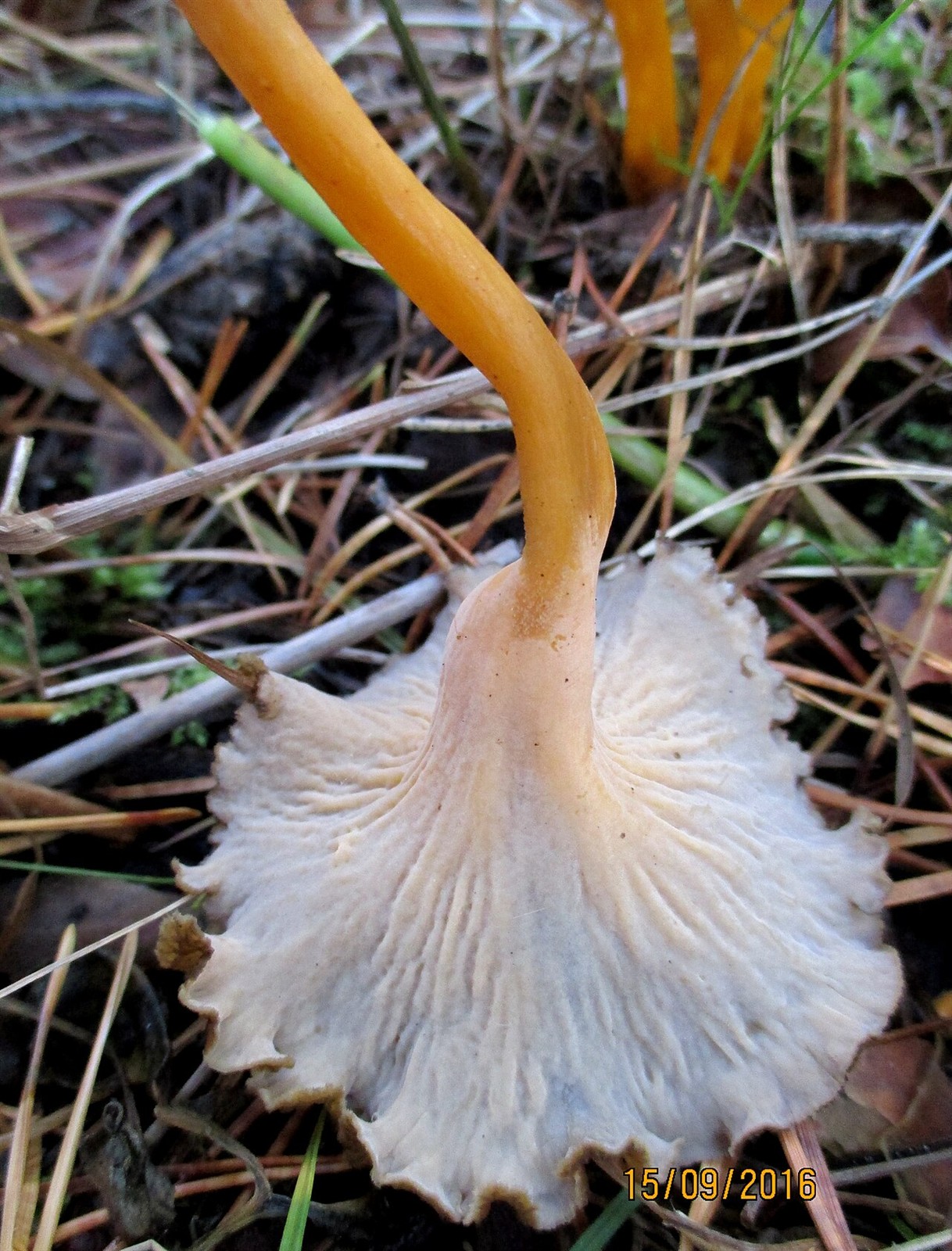
Photo: Igor (Igor_Yevdokimov) · CC BY-SA 3.0 · Photo source · License
_692587.jpg)
Description
A slender hollow trumpet-shaped fungus with a brownish wavy cap, yellow-orange stem, and an almost smooth to weakly wrinkled fertile surface.
Identification features
The cap is funnelled, thin, and wavy-curled. The underside is orange-yellow and mostly smooth or only weakly wrinkled. The stem is hollow, slender, and strongly yellow to orange.
Identification checklist
Check the completely hollow fruitbody, yellow-orange stem, and very weak ridges or almost smooth fertile surface. The smell can be distinctly pleasant and fruity.
Detailed features
- Cap
- The cap is funnelled, thin, and wavy-curled.
- Hymenophore
- The underside is orange-yellow and mostly smooth or only weakly wrinkled.
- Stem
- The stem is hollow, slender, and strongly yellow to orange.
- Flesh
- Yellowish, thin, fibrous and rather tough.
- Smell
- Pleasantly fruity to slightly alcoholic.
- Spore print
- White.
Size
- Cap diameter
- 2–6 cm
- Stem height
- 5–8 cm
- Stem diameter
- 0,5–1,5 cm
Habitat
Fruits in groups in autumn in moist coniferous and mixed woodland, often in uplands on nutrient-poor soils; mycorrhizal mainly with conifers.
Fruiting period
September, October, November
Ecology
- Trophic mode
- Mycorrhizal
- Host trees
- Spruce (Picea), Pine (Pinus), Fir (Abies)
- Substrate
- Forest soil, Moss
- Soil
- Moist
- Notes
- Fruits in groups in autumn in moist coniferous and mixed woodland, often in uplands on nutrient-poor soils; mycorrhizal mainly with conifers.
How to separate similar species
Trumpet chanterelle has more pronounced ridges and usually a differently coloured underside. Common chanterelle is fleshier and not hollow throughout.
Similar species
Interesting facts
Did you know? The hymenium is nearly smooth to slightly wrinkled, helping separate it from more strongly ridged relatives.