Species details
Violet webcap
Cortinarius violaceus
Extra caution required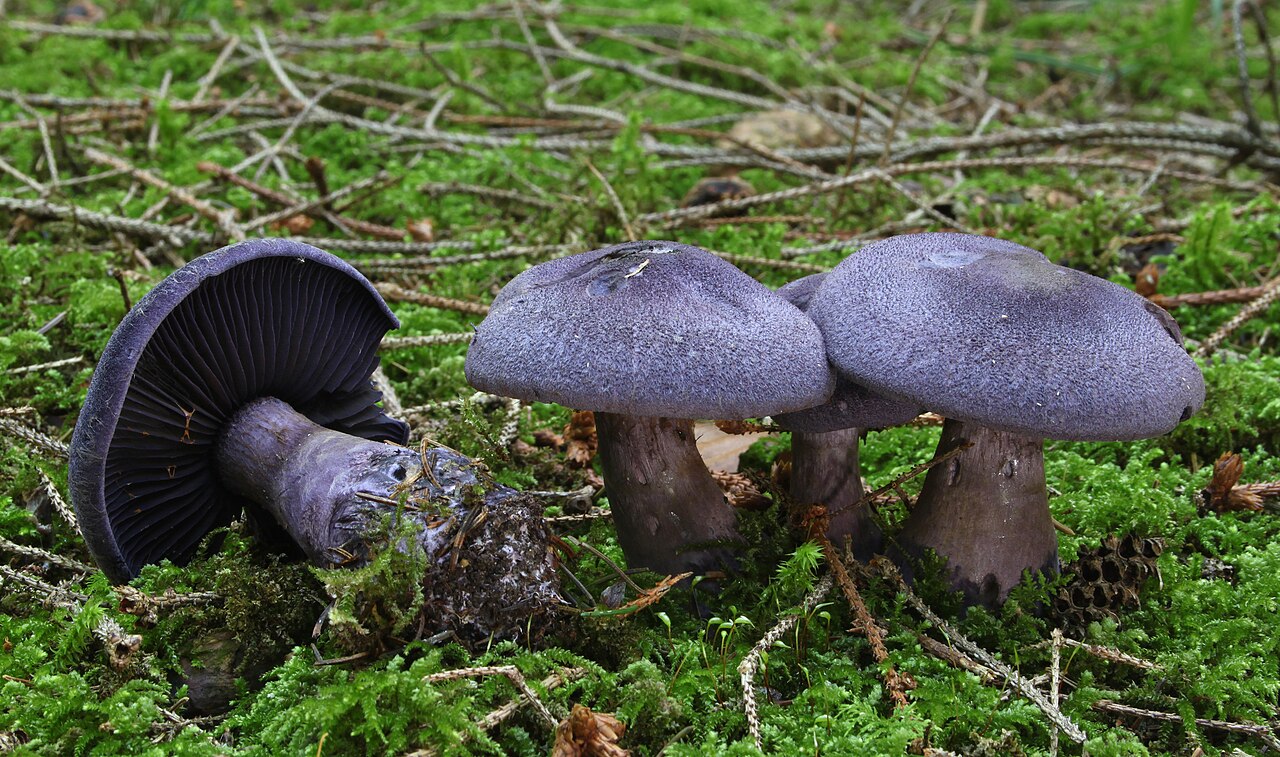
Photo: Holger Krisp · CC BY 3.0 · Photo source · License

Description
A large, almost entirely dark-violet webcap with a dry velvety-scaly cap, violet stem and initially violet gills.
Identification features
The cap is dry, dark violet and finely fibrillose-scaly. Young gills are violet, later reddish brown. The stem is dark violet, longitudinally fibrous and club-shaped at the base; the cortina is violet.
Identification checklist
Check that cap, stem and young gills are distinctly dark violet and that the cap surface is dry and velvety-fibrous. As it matures, the gills turn brown from the rust-brown spores.
Detailed features
- Cap
- A large, almost entirely dark-violet webcap with a dry velvety-scaly cap, violet stem and initially violet gills.
- Hymenophore
- Young gills are violet, later reddish brown.
- Stem
- The stem is dark violet, longitudinally fibrous and club-shaped at the base; the cortina is violet.
- Flesh
- Dark violet, firm and fibrous.
- Smell
- The smell is weak and not a reliable identification character.
- Spore print
- Rust-brown.
Habitat
Mainly in shaded deciduous woodland with beech, oak, hornbeam and birch; in autumn.
Fruiting period
September, October, November
Ecology
- Trophic mode
- Mycorrhizal
- Host trees
- Beech (Fagus), Oak (Quercus), Hornbeam (Carpinus), Birch (Betula)
- Substrate
- Forest soil
- Notes
- Mycorrhizal species. Mainly in shaded deciduous woodland with beech, oak, hornbeam and birch; in autumn.
How to separate similar species
Gassy webcap is usually paler, mainly associated with conifers and has an unpleasant smell. Wood blewit lacks a cortina and rust-brown spore print. Habitat is an important additional character.
Similar species
Interesting facts
Did you know? Cap, gills, stem and flesh are violet, giving this webcap a particularly distinctive overall appearance.