Species details
Gassy webcap
Cortinarius traganus
Poisonous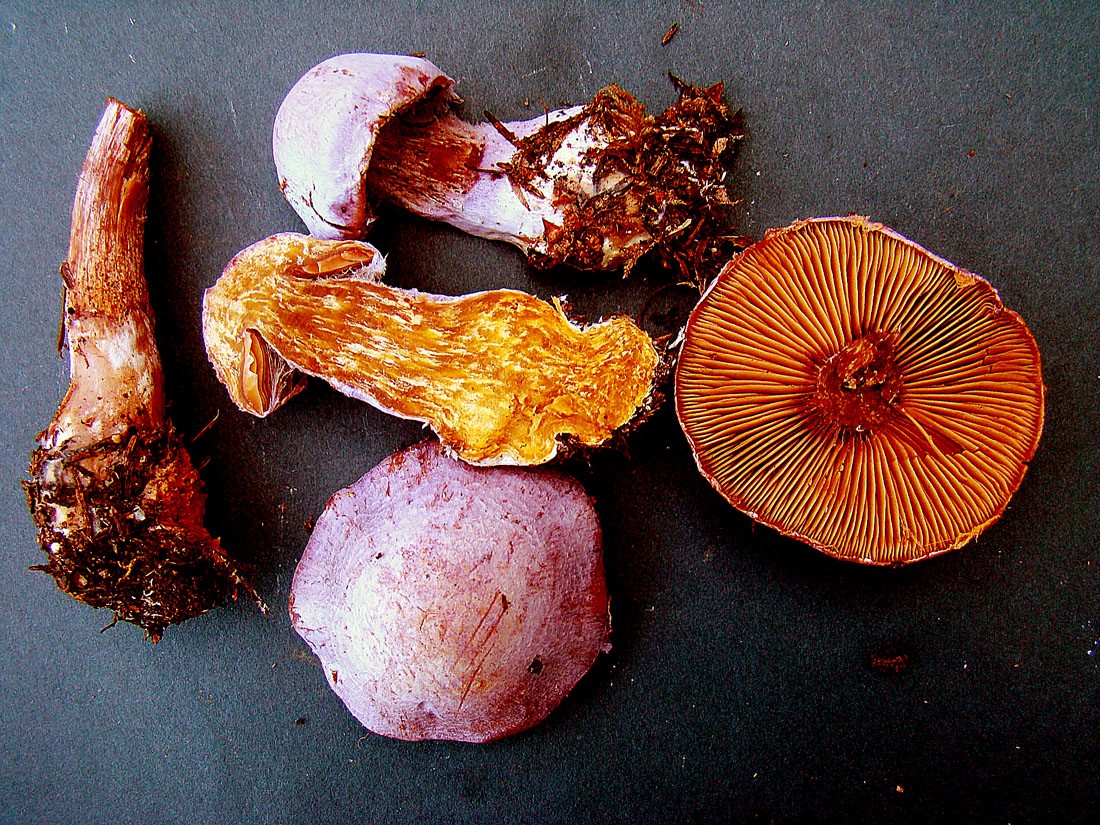
Photo: Walt Sturgeon (Mycowalt) · CC BY-SA 3.0 · Photo source · License

Description
A lilac-purple webcap with brownish flesh and a characteristically unpleasant, often acetylene-like odour.
Identification features
The young cap is lilac, later fading and browning. Gills turn from yellow-brown to rusty brown. The stem is stout and club-shaped with cortina remnants; flesh is yellow-brown.
Identification checklist
Check lilac colours, rust-brown spore print, club-shaped stem, flesh colour, and strong unpleasant smell. Do not taste.
Detailed features
- Cap
- The young cap is lilac, later fading and browning.
- Hymenophore
- Gills turn from yellow-brown to rusty brown.
- Stem
- The stem is stout and club-shaped with cortina remnants; flesh is yellow-brown.
- Flesh
- Yellow-brown, sometimes faintly violet in the cap.
- Smell
- Strong unpleasant carbide- or acetylene-like smell.
- Spore print
- Cinnamon- to rusty-brown.
Size
- Cap diameter
- 5–13 cm
- Stem height
- 6–10 cm
- Stem diameter
- 1–3 cm
Habitat
Occurs mainly in coniferous and mixed woodland in late summer and autumn.
Fruiting period
August, September, October
Ecology
- Trophic mode
- Mycorrhizal
- Host trees
- Spruce (Picea), Pine (Pinus)
- Substrate
- Forest soil
- Notes
- Occurs mainly in coniferous and mixed woodland in late summer and autumn.
How to separate similar species
Young Cortinarius can look very similar, and the genus includes deadly species. A cap-only photo is not sufficient.
Similar species
Interesting facts
Did you know? The characteristic carbide/acetylene smell is more diagnostic than violet colour alone.