Species details
Pearly webcap
Cortinarius alboviolaceus
Extra caution required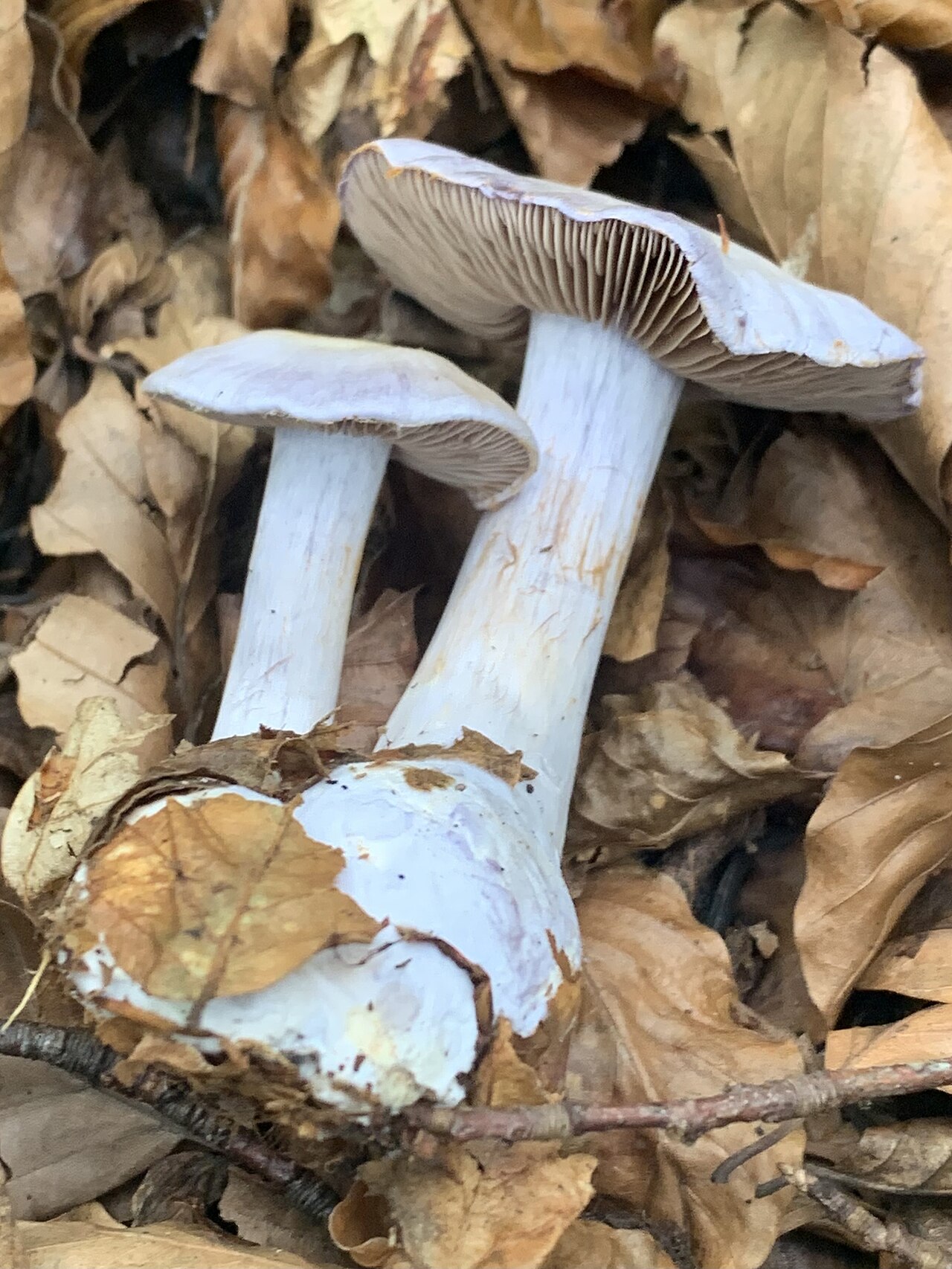
Photo: Jose Angel Urquia Goitia · CC BY-SA 4.0 · Photo source · License

Description
A silky whitish to pale violet webcap with a broad blunt umbo and fibrous veil remnants on the stem.
Identification features
The gills start violet and become clay to rusty brown as the spores mature. The cap is dry and silky; the stem is pale to violet and often slightly club-shaped.
Identification checklist
Check for a dry silky pale-lilac to whitish-violet cap with a broad umbo, young violet gills that turn rusty brown, and a cobweb-like cortina. Rust-brown spores and the gill colour change are important Cortinarius characters.
Detailed features
- Cap
- A silky whitish to pale violet webcap with a broad blunt umbo and fibrous veil remnants on the stem.
- Hymenophore
- The gills are initially violet and become clay-coloured to rusty-brown as the spores mature. The cap is dry and silky, and the stem is pale to violet and often slightly club-shaped.
- Flesh
- Initially violet, later becoming whiter.
- Smell
- No distinctive smell.
- Spore print
- Rusty yellow.
Size
- Cap diameter
- 3–6 cm
- Stem height
- 5–12 cm
- Stem diameter
- 0,8–1,8 cm
Habitat
A mycorrhizal species in deciduous and mixed woodland, especially with beech and other hardwoods; summer to late autumn.
Fruiting period
July, August, September, October, November
Ecology
- Trophic mode
- Mycorrhizal
- Host trees
- Oak (Quercus), Beech (Fagus), Birch (Betula)
- Substrate
- Forest soil
- Notes
- Mycorrhizal species. A mycorrhizal species in deciduous and mixed woodland, especially with beech and other hardwoods; summer to late autumn.
How to separate similar species
Pale violet webcaps can be very similar. Wood blewit lacks a cortina and does not have a rusty-brown spore print. A photograph that does not show the stem, gills and young veil remnants is insufficient for reliable identification.
Similar species
- Cortinarius argentatus
- Cortinarius anomalus
- Wood blewit (Lepista nuda)
Interesting facts
Did you know? In webcaps, the gills become increasingly rusty-brown as the spores mature.