Species details
Gypsy mushroom
Cortinarius caperatus
Extra caution required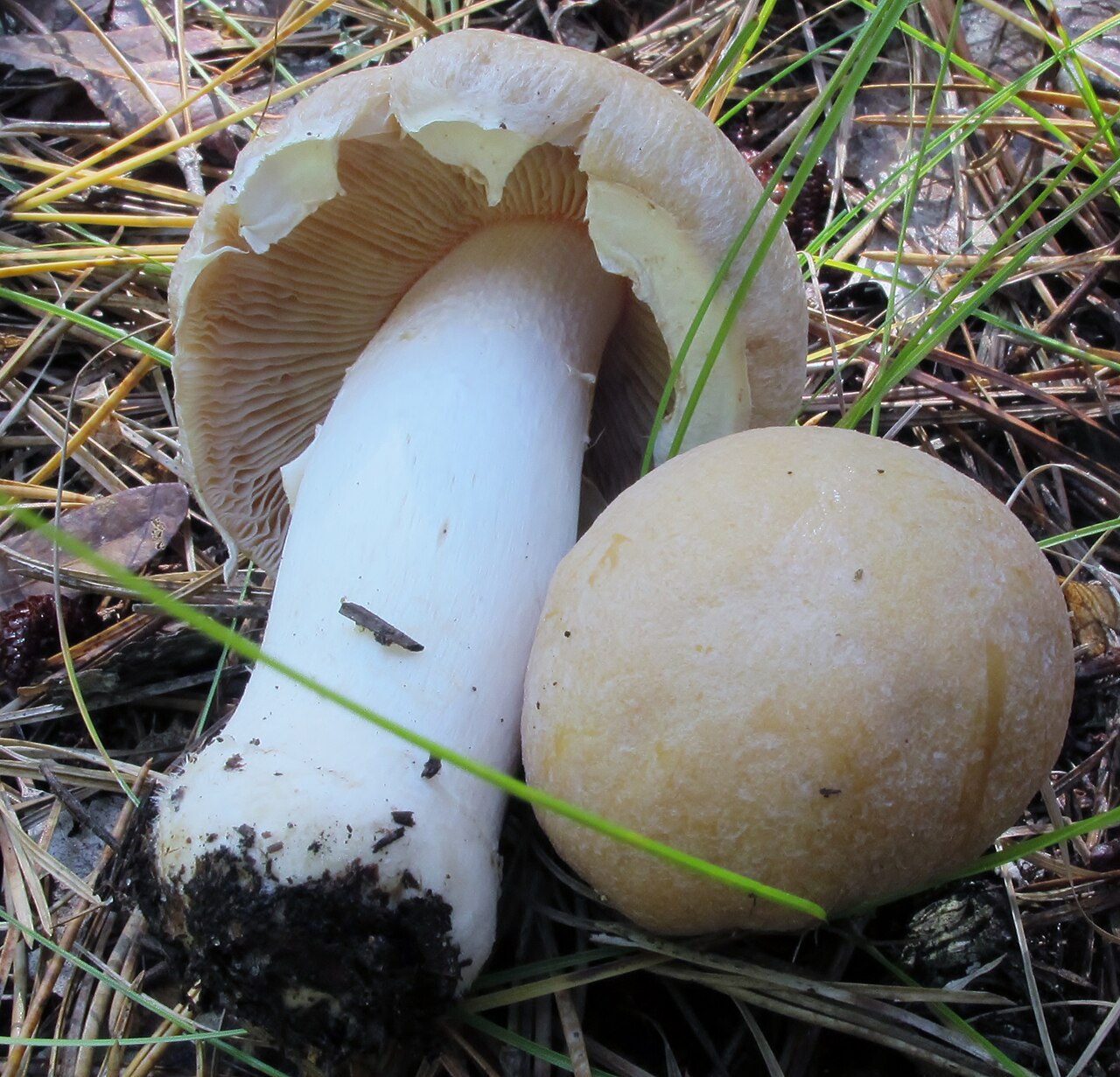
Photo: Walt Sturgeon (Mycowalt) · CC BY-SA 3.0 · Photo source · License
_Fr_473943.jpg)
Description
A fleshy ochre to wheat-coloured mushroom with a whitish bloom on young caps and a distinctive persistent membranous ring.
Identification features
Gills start pale and later become ochre to rusty brown. The pale fibrous stem bears a clear ring; the cap is often wrinkled and powdery-bloomed, especially centrally.
Identification checklist
The key combination is a wheat-ochre cap with whitish bloom, a pale sturdy stem and a distinct membranous ring. Check that the gills darken to rusty tones with age and that the spore print is rust brown.
Detailed features
- Cap
- A fleshy ochre to wheat-coloured mushroom with whitish-bloomed young caps and a conspicuous persistent membranous ring.
- Hymenophore
- The gills are initially pale, later ochre to rusty-brown. The pale fibrous stem bears a distinct ring; the cap is often wrinkled and especially bloomed in the centre.
- Flesh
- Whitish to pale brownish and fleshy.
- Smell
- No distinctive smell.
- Spore print
- Ochre-brown.
Size
- Cap diameter
- 6–12 cm
- Stem height
- 6–15 cm
- Stem diameter
- 1–2 cm
Habitat
In coniferous and mixed woodland, often on acidic soils; from late summer through autumn.
Fruiting period
August, September, October, November
Ecology
- Trophic mode
- Mycorrhizal
- Host trees
- Spruce (Picea), Pine (Pinus)
- Substrate
- Forest soil
- Soil
- Acidic
- Notes
- Mycorrhizal species. In coniferous and mixed woodland, often on acidic soils; from late summer through autumn.
How to separate similar species
Poisonous Hebeloma species lack the same combination of a powdery-bloomed cap and persistent membranous ring and may smell strongly of radish. Other webcaps usually lack such a distinct ring. Old specimens are more difficult.
Similar species
- Hebeloma sinapizans
- Cortinarius allutus
- Cortinarius species
Interesting facts
Did you know? The persistent membranous ring is conspicuous and unusually strong for a Cortinarius.