Species details
Velvet chanterelle
Cantharellus friesii
Traditionally edible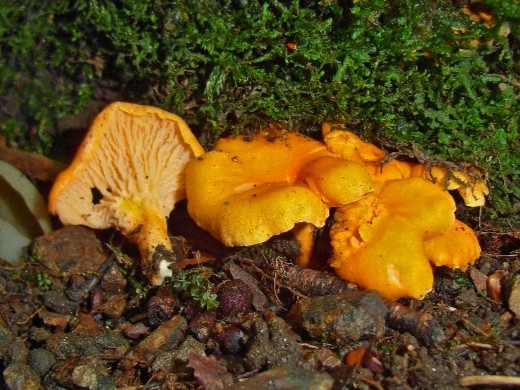
Photo: Inger-Lise Fonneland · CC BY 4.0 · Photo source · License

Description
A small vivid orange chanterelle with a wavy margin and low, blunt, branching ridges running down the stem.
Identification features
The cap is usually only a few centimetres wide, orange to reddish-orange and finely velvety. The hymenium has blunt branching ridges rather than true thin gills.
Identification checklist
Check the small size, vivid orange colour and especially the blunt branching ridges that are integral with the flesh and run down the stem. True thin gills indicate another group.
Detailed features
- Cap
- A small vivid orange chanterelle with a wavy margin and low blunt branched ridges running down the stem.
- Hymenophore
- The hymenium has blunt branching ridges rather than true thin gills.
- Flesh
- Thin, white to yellowish, firmer in the stem.
- Smell
- No distinctive smell.
- Spore print
- Pale yellowish.
Size
- Cap diameter
- ≤ 3 cm
- Stem height
- ≤ 4 cm
- Stem diameter
- ≤ 0,8 cm
Habitat
Mycorrhizal in deciduous and mixed woodland, especially with beech; from late spring to autumn. It is regionally uncommon or rare.
Fruiting period
May, June, July, August, September, October
Ecology
- Trophic mode
- Mycorrhizal
- Host trees
- Beech (Fagus)
- Substrate
- Forest soil
- Notes
- Mycorrhizal species. Mycorrhizal in deciduous and mixed woodland, especially with beech; from late spring to autumn. It is regionally uncommon or rare.
How to separate similar species
Common chanterelle is larger and usually yellower. False chanterelle has true, thinner and more crowded gills and softer flesh. With orange fungi also confirm that growth is from soil rather than wood.
Similar species
Interesting facts
Did you know? It is much smaller than the common chanterelle and is notable for its vivid orange to red-orange colours.