Species details
Turkey tail
Trametes versicolor
Inedible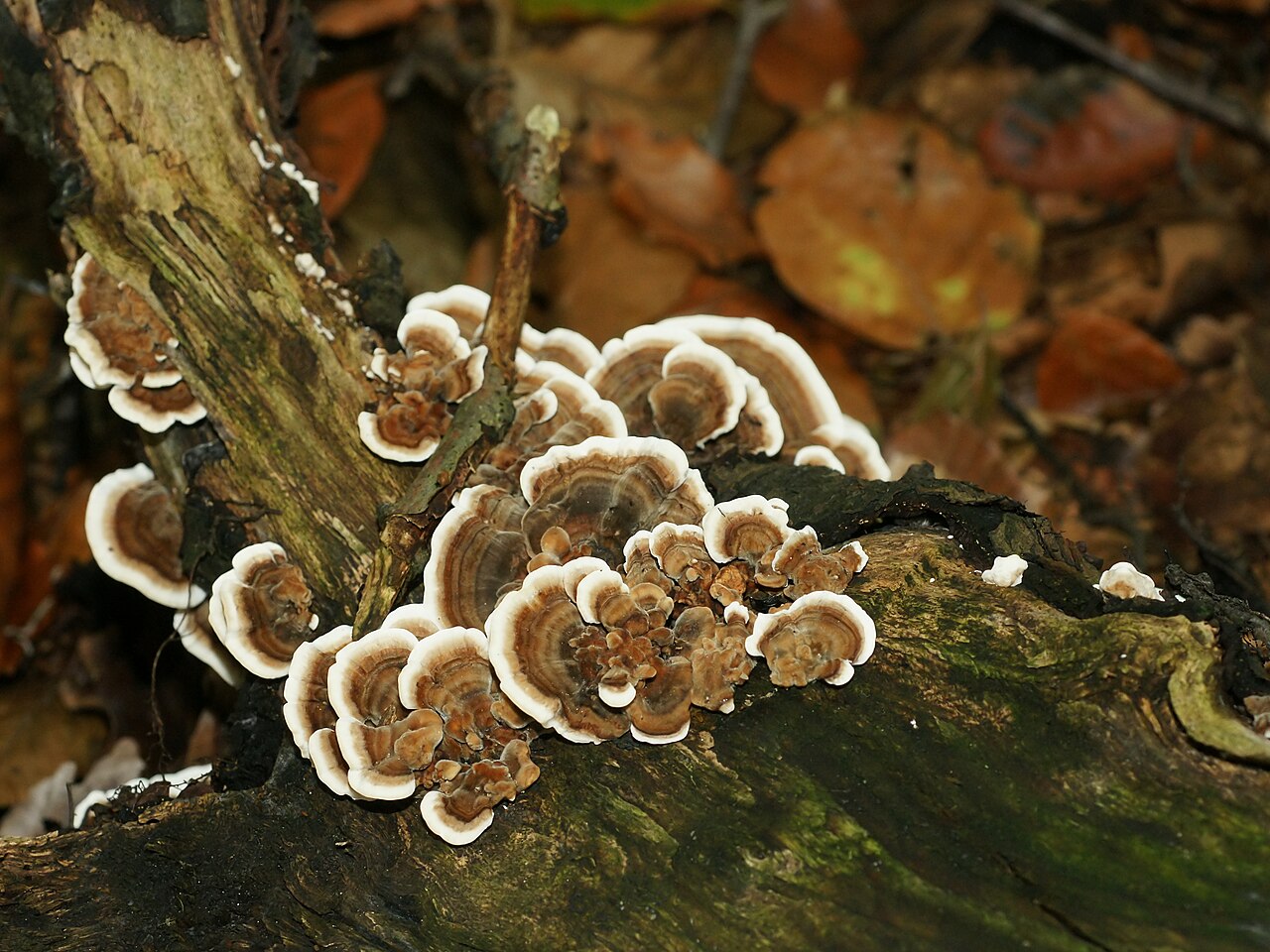
Photo: Hans Hillewaert · CC BY-SA 4.0 · Photo source · License

Description
A thin bracket fungus with striking multicoloured concentric zones.
Identification features
The underside has tiny white to cream pores; leathery brackets grow in overlapping tiers.
Identification checklist
Check the entire fruitbody for identification. A thin bracket fungus with striking multicoloured concentric zones. The underside has tiny white to cream pores; leathery brackets grow in overlapping tiers. Typical habitat: On dead wood of many hardwoods, less often conifers.
Detailed features
- Cap
- 2–8 cm wide, thin fan-shaped brackets, often overlapping in tiers; upper surface has strong concentric grey, brown, bluish and yellowish bands.
- Hymenophore
- Underside is poroid with very small round white to cream pores.
- Stem
- No stem; the bracket is laterally attached to wood.
- Flesh
- Pale, corky, tough and thin.
- Smell
- No characteristic smell.
- Spore print
- White to colourless.
Size
- Cap diameter
- 2–8 cm
Habitat
On dead wood of many hardwoods, less often conifers.
Fruiting period
January, February, March, April, May, June, July, August, September, October, November, December
Ecology
- Trophic mode
- Saprotrophic
- Host trees
- Beech (Fagus), Oak (Quercus), Birch (Betula), Hornbeam (Carpinus)
- Substrate
- Dead hardwood, Stumps
- Notes
- A very common saprotroph on dead hardwood; the durable brackets can remain visible year-round.
How to separate similar species
Compare especially with these similar species: Stereum species, Trametes ochracea. Check the combination of cap shape and colour, spore-bearing surface, stem, flesh changes and habitat. A single feature or photograph is not enough; if the key characters do not match the description, do not treat the identification as confirmed.
Similar species
- Ochre bracket (Trametes ochracea)
Trametes ochracea is usually thicker and its bands are less contrasting and more ochre-brown.
- Hairy curtain crust (Stereum hirsutum)
Hairy curtain crust has no true pore layer; its underside is smooth to slightly wrinkled.
Interesting facts
Did you know? The coloured concentric bands explain the Latin epithet versicolor, meaning “many-coloured”.