Species details
Split fibrecap
Pseudosperma rimosum
Poisonous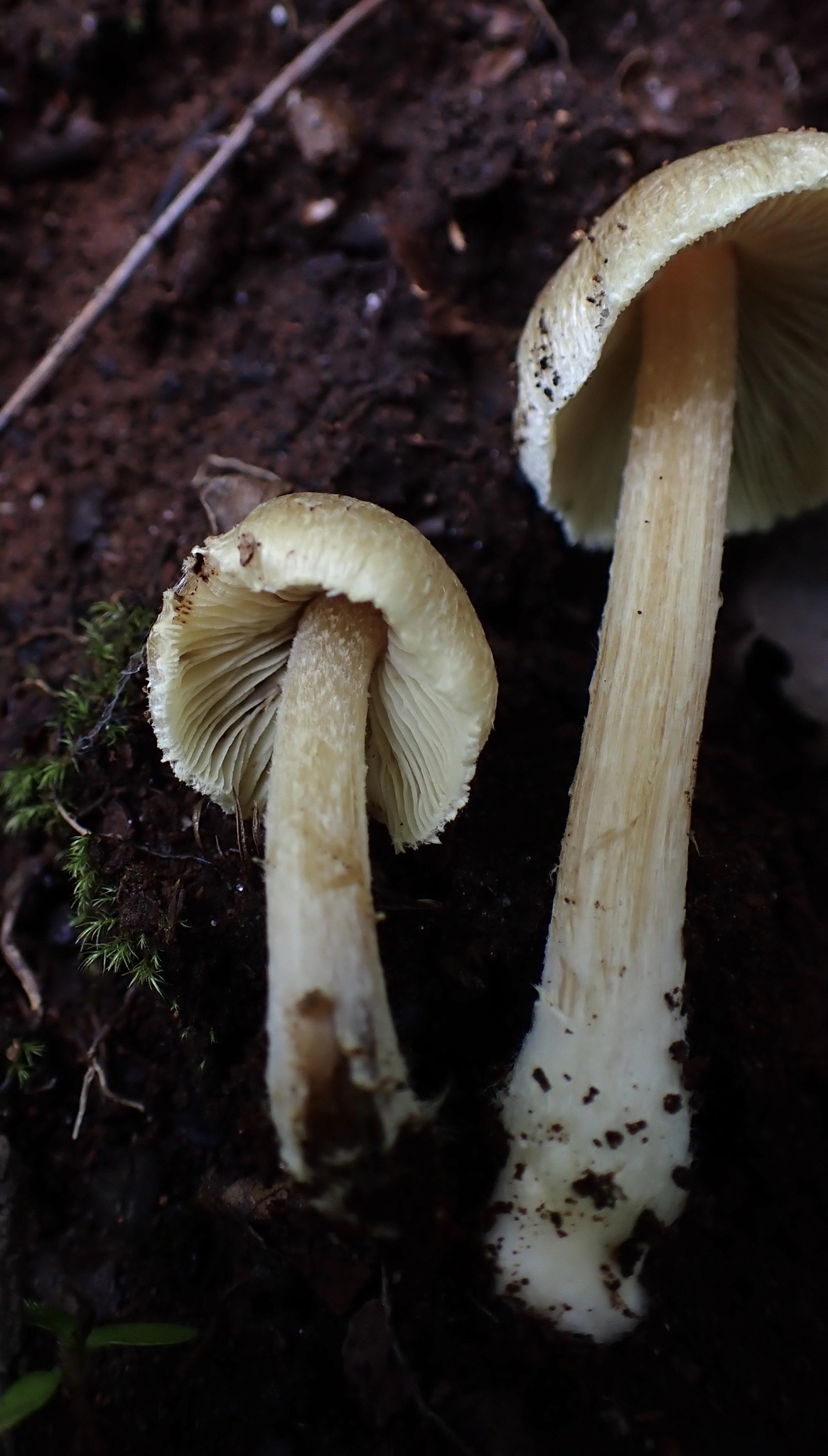
Photo: Sigrid Jakob · CC BY 4.0 · Photo source · License

Description
A conical to bell-shaped ochre fibrecap with a radially fibrous, often deeply split cap.
Identification features
Gills are greyish when young and later brown; the whitish fibrous stem is ringless and the species contains muscarine.
Identification checklist
Check the entire fruitbody for identification. A conical to bell-shaped ochre fibrecap with a radially fibrous, often deeply split cap. Gills are greyish when young and later brown; the whitish fibrous stem is ringless and the species contains muscarine. Typical habitat: Parks, gardens, grassland, woodland edges, and paths, often on disturbed soil.
Detailed features
- Cap
- 3–6 cm, initially strongly conical, later expanded with a prominent umbo; ochre to brown radially fibrous surface characteristically splits and cracks at the margin.
- Hymenophore
- Gills initially pale, sometimes greenish-tinged, later brown; the edges remain paler.
- Stem
- 4–8 × 0.5–1 cm, pale ochre, cylindrical and somewhat broader toward the base, with a fibrous surface.
- Flesh
- White and fibrous.
- Smell
- Strong and unpleasant, characteristically spermatic.
- Taste
- Do not taste.
- Spore print
- Brown.
Size
- Cap diameter
- 3–6 cm
- Stem height
- 4–8 cm
- Stem diameter
- 0,5–1 cm
Habitat
Parks, gardens, grassland, woodland edges, and paths, often on disturbed soil.
Fruiting period
May, June, July, August, September, October
Ecology
- Trophic mode
- Mycorrhizal
- Substrate
- Soil, Forest soil
- Notes
- An ectomycorrhizal species associated with various deciduous and coniferous trees; also frequent on disturbed soils along paths, roads and in parks.
How to separate similar species
Compare especially with these similar species: Inosperma erubescens, Inocybe geophylla, Agrocybe praecox. Check the combination of cap shape and colour, spore-bearing surface, stem, flesh changes and habitat. A single feature or photograph is not enough; if the key characters do not match the description, do not treat the identification as confirmed.
Similar species
- Deadly fibrecap (Inosperma erubescens) DANGEROUS
Also dangerous, but reddens more strongly with age or injury; both contain muscarine and are not edible.
- Spring fieldcap (Agrocybe praecox)
The spring fieldcap has a different cap, often a ring, and lacks the characteristic radial splitting of fibrecaps.