Species details
Solitary amanita
Amanita echinocephala
Poisonous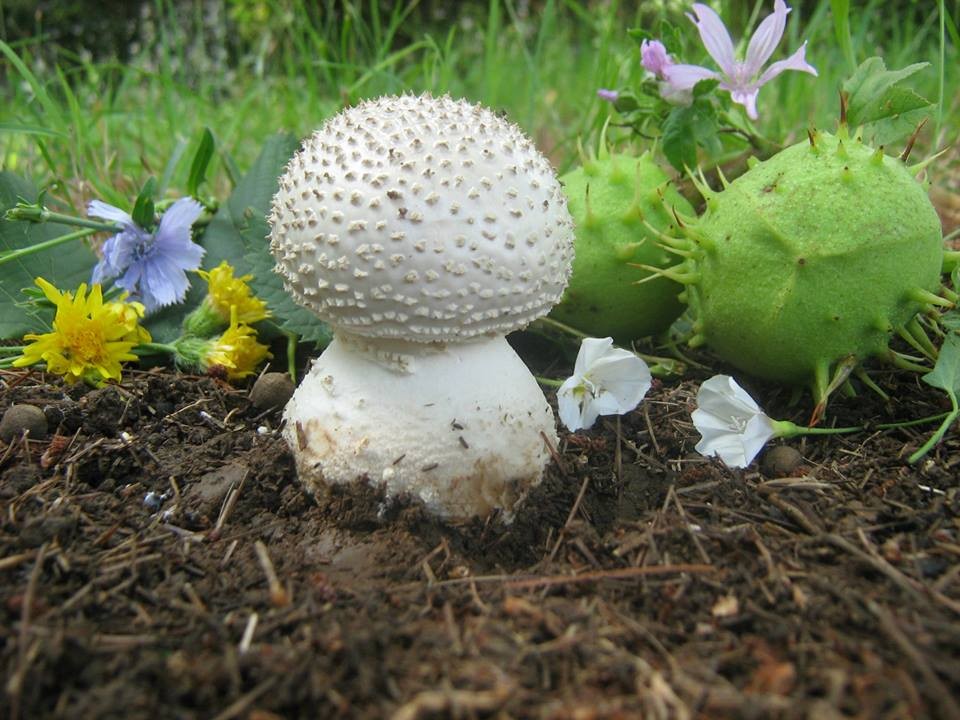
Photo: GLJIVARSKO DRUSTVO NIS from Serbia · CC BY 2.0 · Photo source · License
_Qu%C3%A9l._(15169447246).jpg)
Description
A large pale Amanita with conspicuous pointed pyramidal warts on the cap, a strong ring, and an enlarged stem base.
Identification features
The cap is white to grey-ochre and covered in pointed warts. Gills are white to cream. The stout stem has a ring and bulbous base, sometimes with ring-like veil remnants.
Identification checklist
Identification requires the whole fruitbody including the stem base. Check the pointed pyramidal warts, free white gills, ring, and shape of the bulbous base.
Detailed features
- Cap
- The cap is white to grey-ochre and covered in pointed warts.
- Hymenophore
- Gills are white to cream.
- Stem
- The stout stem has a ring and bulbous base, sometimes with ring-like veil remnants.
- Flesh
- Whitish and relatively firm, especially in the stem.
- Smell
- Unpleasant, sometimes medicinal or hospital-like.
- Spore print
- White.
Size
- Cap diameter
- ≤ 20 cm
- Stem height
- 6–10 cm
- Stem diameter
- 1–3 cm
Habitat
A mycorrhizal species of warmer woodland on calcareous soils; uncommon to rare, fruiting from late summer into autumn.
Fruiting period
August, September, October
Ecology
- Trophic mode
- Mycorrhizal
- Substrate
- Forest soil
- Soil
- Calcareous
- Notes
- A mycorrhizal species of warmer woodland on calcareous soils; uncommon to rare, fruiting from late summer into autumn.
How to separate similar species
Other pale Amanita can look very similar, especially when young. A. strobiliformis has different, larger veil patches and a different base; incomplete specimens are unsafe to identify.
Similar species
- Warted Amanita (Amanita strobiliformis)
- Gilded amanita (Amanita franchetii) DANGEROUS
- Amanita vittadinii
Interesting facts
Did you know? The sharp pyramidal warts on the cap may be partly washed off by heavy rain.