Species details
Gilded amanita
Amanita franchetii
Poisonous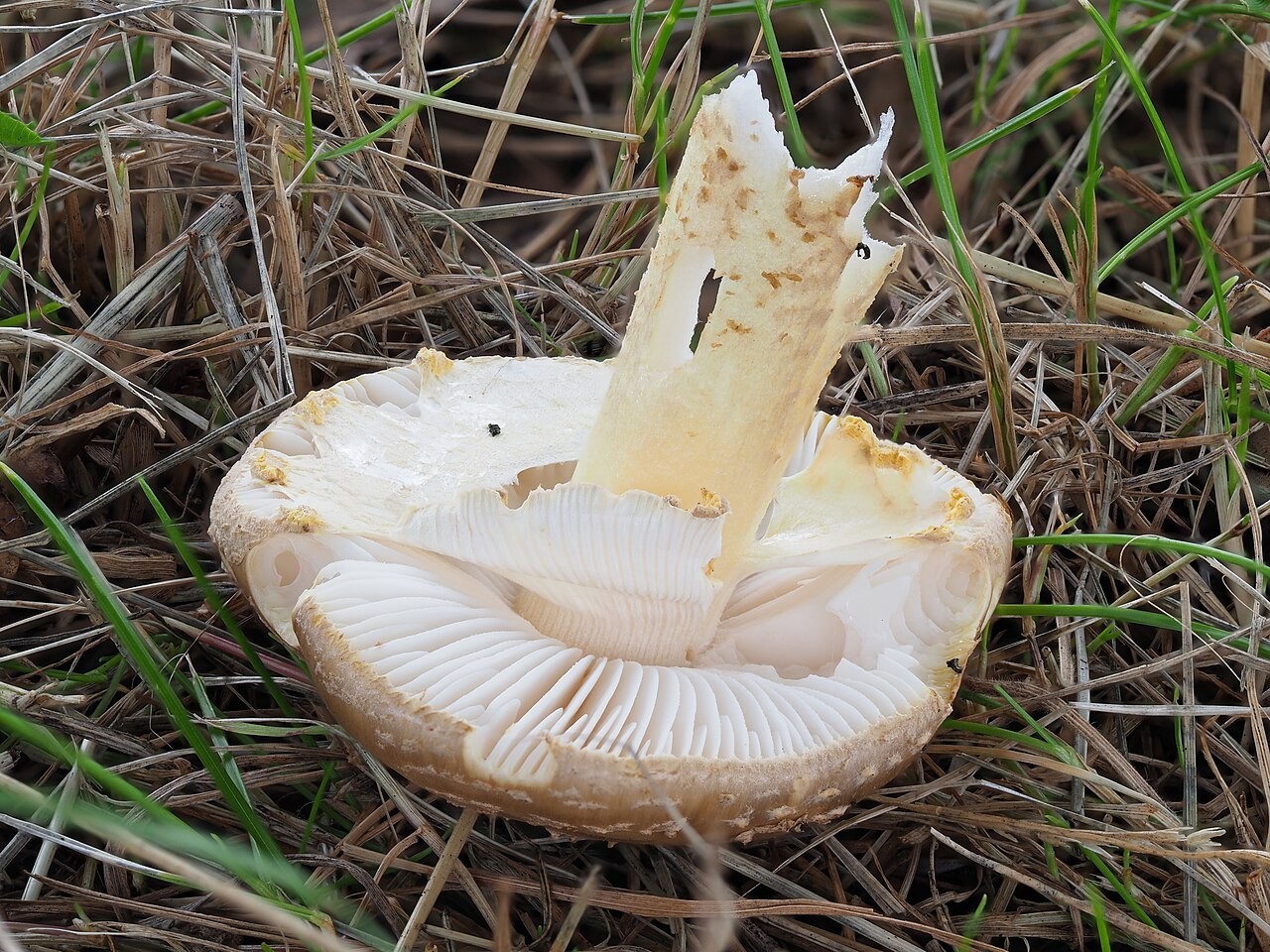
Photo: Lukas Large from Stourbridge, United Kingdom · CC BY-SA 2.0 · Photo source · License
.jpg)
Description
A grey-brown to yellowish-brown Amanita with yellowish warty veil remnants on the cap and yellowish remnants around the stem base.
Identification features
The cap is grey-, yellow- to olive-brown and densely covered with grey to yellowish warts. Gills are white to cream and free. The stem has a hanging ring and a bulbous base with yellowish veil remnants.
Identification checklist
Check the colour and distribution of veil remnants, free white gills, hanging ring, and especially yellowish flaky zones around the bulbous base.
Detailed features
- Cap
- The cap is grey-, yellow- to olive-brown and densely covered with grey to yellowish warts.
- Hymenophore
- Gills are white to cream and free.
- Stem
- The stem has a hanging ring and a bulbous base with yellowish veil remnants.
- Flesh
- White to pale, without a strong colour change.
- Smell
- Mild to indistinct.
- Spore print
- White.
Habitat
Mycorrhizal in deciduous and mixed woodland, often with beech and on calcareous soils, from summer into autumn.
Fruiting period
June, July, August, September, October
Ecology
- Trophic mode
- Mycorrhizal
- Host trees
- Beech (Fagus)
- Substrate
- Forest soil
- Soil
- Calcareous
- Notes
- Mycorrhizal in deciduous and mixed woodland, often with beech and on calcareous soils, from summer into autumn.
How to separate similar species
The blusher can look similar but normally reddens when damaged. Rain can wash away yellowish veil remnants, so a single colour feature is not sufficient.
Similar species
Interesting facts
Did you know? Yellowish veil remnants on the cap and at the stem base are an important clue.