Species details
Red-banded webcap
Cortinarius armillatus
Inedible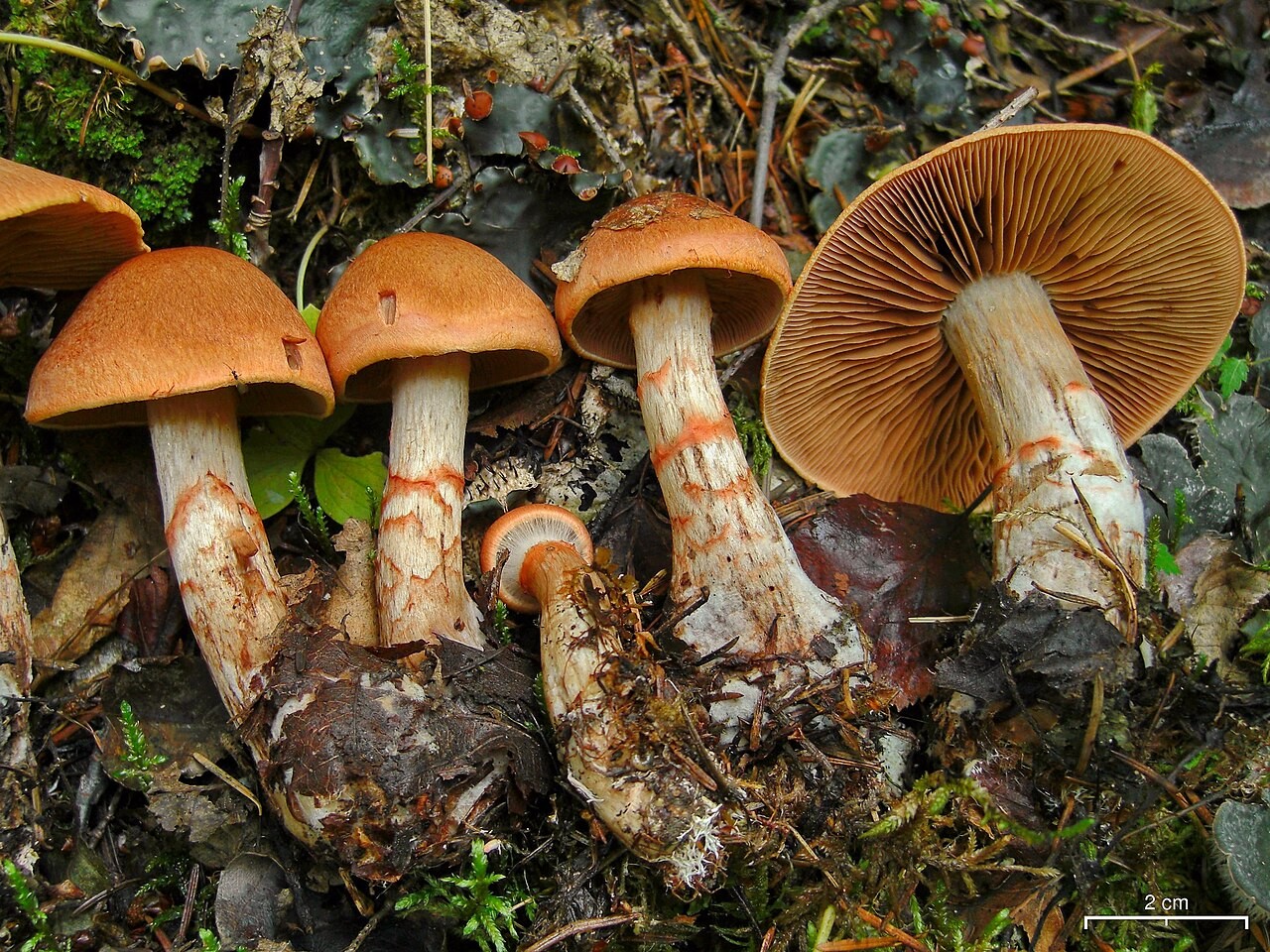
Photo: Jason Hollinger (jason) · CC BY-SA 3.0 · Photo source · License
_Fr_56586.jpg)
Description
A larger reddish-brown webcap with a dry cap and characteristic cinnabar-red veil bands on the stem.
Identification features
The cap is rusty to reddish-brown, dry, and radially fibrous. Gills become rusty brown. The long stem is often enlarged at the base and bears several reddish veil bands.
Identification checklist
Check the dry reddish-brown cap, rust-brown spore print, and especially several distinct red bands on the stem. Cortinarius requires examination of the whole fruitbody.
Detailed features
- Cap
- The cap is rusty to reddish-brown, dry, and radially fibrous.
- Hymenophore
- Gills become rusty brown.
- Stem
- The long stem is often enlarged at the base and bears several reddish veil bands.
- Smell
- No distinctive smell.
- Spore print
- Rust-brown.
Size
- Cap diameter
- 5–10 cm
- Stem height
- 6–14 cm
- Stem diameter
- 1–3 cm
Habitat
Usually grows in damp woodland with birch, mainly in autumn.
Fruiting period
September, October
Ecology
- Trophic mode
- Mycorrhizal
- Host trees
- Birch (Betula)
- Substrate
- Forest soil
- Soil
- Moist
- Notes
- Usually grows in damp woodland with birch, mainly in autumn.
How to separate similar species
Other brown webcaps can be very similar, and the genus includes deadly species. The red bands are important but not sufficient on their own.
Similar species
Interesting facts
Did you know? Check the dry reddish-brown cap, rust-brown spore print, and especially several distinct red bands on the stem. Cortinarius requires examination of the whole fruitbody.