Species details
Deadly webcap
Cortinarius rubellus
Deadly poisonous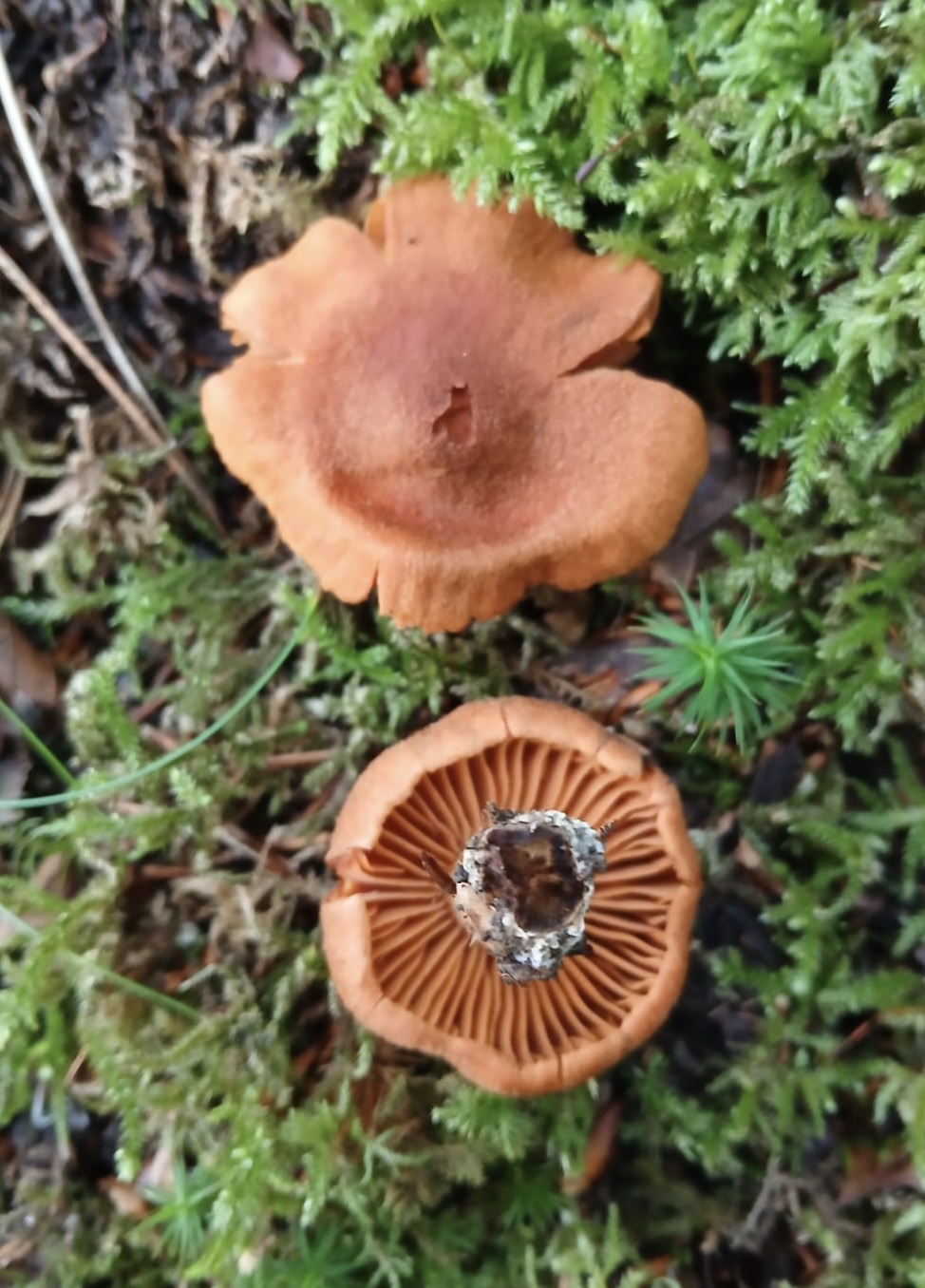
Photo: Jose Angel Urquia Goitia · CC BY-SA 4.0 · Photo source · License

Description
An orange-brown deadly webcap with a pointed umbo, rusty gills, and remnants of a cobweb-like veil.
Identification features
The stem is orange-yellow with brown fibres. Poisoning may cause severe kidney damage only after a long delay.
Identification checklist
The cap is orange- to reddish-brown, often conical or pointed and finely fibrous. Gills start ochre-orange and become rusty brown; young fruitbodies have a cobweb-like cortina, and the stem is yellowish-orange.
Detailed features
- Cap
- 4–8 cm, orange to reddish-brown, dry, initially pointed, later convex with a prominent umbo.
- Hymenophore
- Gills are initially cinnamon-orange, becoming rusty-brown as spores mature.
- Stem
- 6–12 cm, orange-brown, often with yellowish bands and remnants of the cortina.
- Flesh
- Yellowish to orange-brown.
- Spore print
- Rusty reddish-brown.
Size
- Cap diameter
- 4–8 cm
- Stem height
- 6–12 cm
- Stem diameter
- 1–2 cm
Habitat
Mostly in damp coniferous woodland, often with spruce.
Fruiting period
July, August, September, October
Ecology
- Trophic mode
- Mycorrhizal
- Host trees
- Spruce (Picea), Pine (Pinus)
- Soil
- Acidic, Moist
Distribution
- Notes
- A European woodland species especially associated with damp acidic sites under conifers.
How to separate similar species
Many webcaps are very similar and cannot be identified reliably without microscopy. Fool’s webcap is also deadly. Avoid the entire genus Cortinarius for food.
Similar species
- Fool’s webcap (Cortinarius orellanus) DANGEROUS
- Cortinarius species
Interesting facts
Did you know? Orellanine poisoning is particularly insidious because severe kidney injury may appear only after a long delay.